
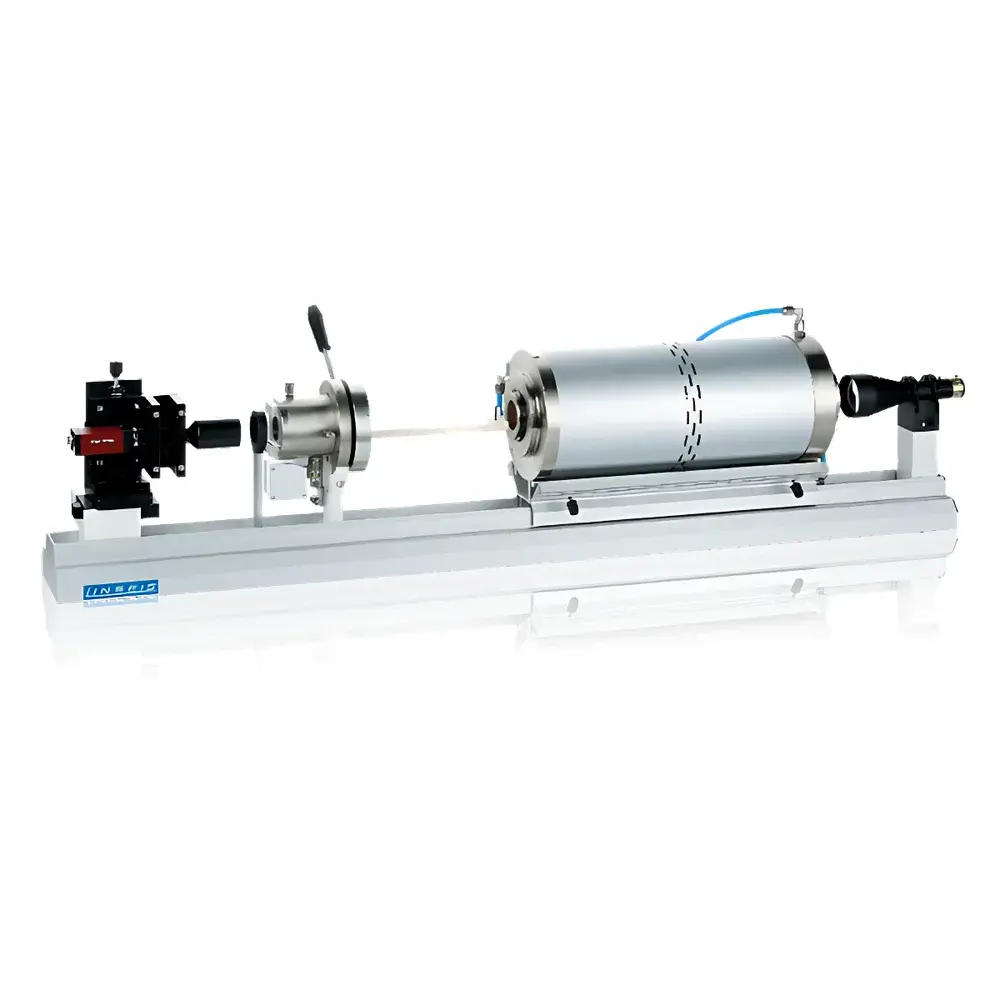
LINSEIS DIL L74 OD Optical Dilatometer
| Brand | LINSEIS |
|---|---|
| Origin | Germany |
| Model | DIL L74 OD |
| Temperature Range | -100 to 2000 °C |
| Heating Rate | 0.01–100 °C/min (dependent on furnace configuration) |
| Field of View | 3.3 × 2.8 mm² |
| Measurement Resolution | 1 µm |
| Atmosphere Options | Oxidizing (optional: reducing, inert, vacuum) |
| Vacuum Level | 10⁻⁵ mbar |
| Compliance Standards | ASTM D1857, ISO 540, DIN 51730, CEN/TS 15370-1, BS 1016-15, NF M03-048, CEN/TR 15404, IS 12891 |
Overview
The LINSEIS DIL L74 OD Optical Dilatometer is a high-precision, non-contact thermal expansion measurement system engineered for rigorous materials characterization across glass-ceramics, metallurgy, energy storage, and advanced functional materials research. Unlike conventional push-rod dilatometers that rely on mechanical contact and impose axial load on the specimen, the DIL L74 OD employs digital image correlation (DIC)-enhanced optical metrology based on high-resolution CCD imaging and real-time edge-detection algorithms. This principle eliminates mechanical interference, enabling accurate dimensional change tracking during phase transitions—including solid-to-liquid, glass transition (Tg), sintering, and decomposition—where sample softening, surface flow, or viscosity collapse would otherwise compromise contact-based measurements. The instrument operates over an exceptional temperature range from -100 °C to 2000 °C, supported by interchangeable furnace modules (RT–500 °C, 500–1000 °C, 1000–1500 °C, and 1500–2000 °C), each optimized for thermal stability, homogeneity, and ramp fidelity.
Key Features
- Non-contact optical measurement principle using a 5-megapixel monochrome CCD sensor with sub-pixel edge resolution
- Automated real-time focus tracking and dynamic contrast optimization for consistent image quality across full temperature range
- Field of view precisely calibrated to 3.3 × 2.8 mm², centered on the upper sample edge for direct linear expansion quantification
- Measurement resolution of 1 µm, traceable to NIST-traceable length standards via in-situ reference calibration
- Integrated reference material comparison mode: simultaneous imaging of sample and certified reference (e.g., fused quartz, α-alumina) to compensate for thermal lensing, air convection drift, and stage-induced optical path variation
- Multi-atmosphere compatibility: standard oxidizing environment; optional gas manifolds support controlled reducing (H₂/N₂), inert (Ar, He), or high-vacuum (≤10⁻⁵ mbar) operation
- Heating rate programmability from 0.01 to 100 °C/min, with closed-loop PID control and ±0.5 °C accuracy at steady state
Sample Compatibility & Compliance
The DIL L74 OD accommodates diverse geometries and physical states: cylindrical rods (Ø 2–12 mm), thin films (≥10 µm thickness), powders (in crucibles), and viscous liquids undergoing solidification. Its non-contact architecture enables reliable measurement of low-modulus polymers (e.g., epoxy resins), metallic glasses, battery electrode slurries, and refractory ceramics prone to creep or surface deformation under load. All measurement protocols align with internationally recognized standards including ASTM D1857 (coefficient of linear expansion of plastics), ISO 540 (coal and coke), DIN 51730 (ceramic raw materials), and CEN/TS 15370-1 (biomass ash behavior). Data acquisition supports GLP-compliant audit trails, with timestamped metadata (temperature, atmosphere, focus position, illumination intensity) embedded in every image frame.
Software & Data Management
Control and analysis are executed via LINSEIS ThermoSoft v5.x, a modular platform compliant with FDA 21 CFR Part 11 requirements (electronic signatures, role-based access, immutable data logs). The software provides synchronized video capture (up to 30 fps), automated edge detection with user-adjustable thresholding, and pixel-to-micron calibration using on-screen reference grids. Thermal expansion coefficient (CTE) is calculated via numerical differentiation of displacement vs. temperature curves, with optional segmentation for multi-phase regimes (e.g., α- and β-CTE determination across Tg). Export formats include CSV, ASCII, and HDF5 for integration with MATLAB, Python (NumPy/Pandas), or third-party statistical packages. Raw image stacks are stored losslessly in TIFF format with EXIF metadata.
Applications
- Quantification of CTE mismatch in multilayer ceramic capacitors (MLCCs) and SOFC electrolyte/anode interfaces
- In-situ monitoring of sintering kinetics in additive-manufactured metal and ceramic preforms
- Thermal stability assessment of nuclear fuel cladding alloys under simulated LOCA conditions
- Phase transition mapping in shape-memory alloys (SMA) and high-entropy alloys during heating/cooling cycles
- Viscoelastic transition analysis of thermosetting composites during cure and post-cure
- Expansion behavior of molten salts and liquid metals in concentrated solar power (CSP) containment systems
FAQ
How does the DIL L74 OD eliminate thermal drift artifacts inherent in optical systems?
It uses dual-reference imaging: one channel tracks the sample edge, while a second simultaneously images a thermally stable reference material placed within the same field of view. Real-time differential pixel shift computation removes atmospheric refraction and lens expansion effects.
Can the system measure volumetric expansion?
Yes—when combined with sample geometry modeling and orthogonal imaging (via optional dual-camera module), volumetric strain is derived from in-plane expansion plus height-change estimation using focus-distance correlation.
Is vacuum-compatible sample loading possible without breaking vacuum?
Yes—the chamber features a motorized load-lock mechanism enabling rapid sample exchange while maintaining base pressure below 10⁻⁵ mbar between runs.
What calibration procedures are required before routine use?
Daily verification uses a certified fused silica reference rod; annual full calibration includes temperature uniformity mapping, focus linearity validation, and pixel-scale metrology traceable to PTB (Physikalisch-Technische Bundesanstalt).
Does the software support automated pass/fail evaluation against specification limits?
Yes—customizable acceptance criteria can be defined per test method (e.g., max CTE deviation ±0.2 × 10⁻⁶/K); results trigger visual alerts and exportable compliance reports.



