
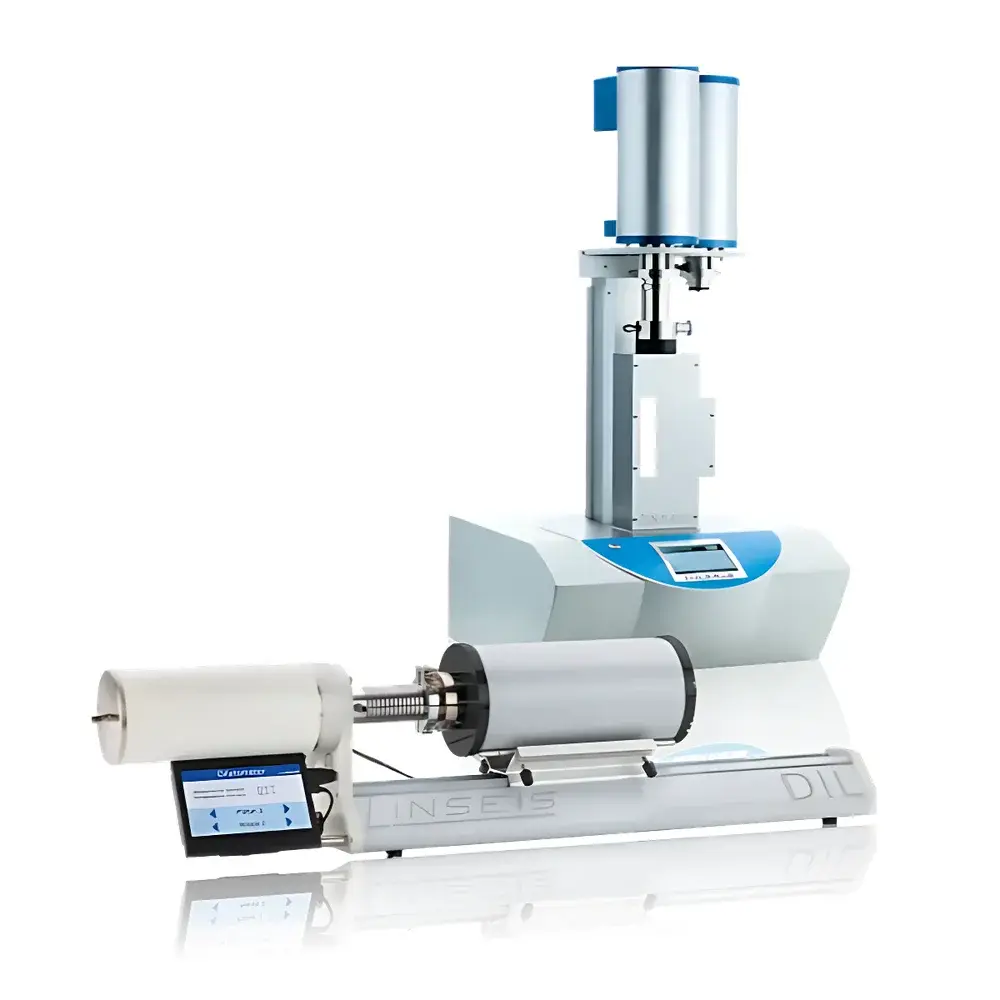
LINSEIS DIL L75 Horizontal and Vertical High-Temperature Thermal Dilatometers
| Brand | LINSEIS |
|---|---|
| Origin | Germany |
| Model | DIL L75 Horizontal / Vertical |
| Temperature Range | −263 °C to 2800 °C |
| Displacement Range | ±2500 µm and ±25000 µm |
| Resolution | 0.03 nm (LVDT) and 0.1 nm (optical encoder) |
| Atmosphere Control | Manual gas dosing or mass flow controllers for 1, 3, or multiple gases |
Overview
The LINSEIS DIL L75 Horizontal and Vertical Thermal Dilatometers are precision instruments engineered for high-accuracy measurement of dimensional changes in solid, liquid, powder, and paste-like materials under controlled thermal and atmospheric conditions. Based on the principle of contact dilatometry—where a non-load-bearing probe measures axial length variation as a function of temperature—the DIL L75 systems deliver traceable, reproducible data essential for materials science R&D, quality control, and process optimization. Both configurations operate across an exceptional temperature span from cryogenic −263 °C (using LN₂ or internal cryocooler) up to 2800 °C, enabling characterization of refractory ceramics, ultra-low-expansion (ULE) glasses, advanced composites, sintered metals, and functional polymers. The horizontal variant features a hermetically sealed push-rod design suitable for high-vacuum (≤10⁻⁶ mbar), oxidizing, or reducing atmospheres. The vertical configuration incorporates a frictionless suspension mechanism that eliminates mechanical hysteresis—critical for detecting sub-nanometer expansions during sintering onset or phase transitions in low-CTE materials.
Key Features
- Two configurable platforms: Horizontal (vacuum-tight push-rod) and Vertical (zero-friction suspension) — each optimized for distinct material classes and experimental constraints
- Dual-resolution displacement detection: High-stability LVDT sensor (0.03 nm resolution, ±2500 µm range) and optical encoder (0.1 nm resolution, ±25000 µm range) for multi-scale expansion analysis
- Programmable contact force control (10 mN–5 N) with real-time feedback, ensuring consistent probe-sample interaction across thermal cycles
- Automated sample length detection and dynamic force adjustment to compensate for thermal drift and probe wear
- Multi-furnace capability: Up to 2 furnaces for horizontal and 3 for vertical configurations, supporting sequential or parallel measurements
- Integrated softening point detection, density calculation, and optional simultaneous L-DTA (up to 2000 °C) with calibrated thermocouple referencing
- Rate-Controlled Sintering (RCS) software module compliant with Palmour III theory, enabling closed-loop densification control based on real-time expansion rate
- Modular gas handling: Manual rotameters or digital mass flow controllers (MFCs) for precise regulation of single- or multi-gas atmospheres (e.g., Ar, N₂, H₂, CO, O₂, forming gas)
Sample Compatibility & Compliance
The DIL L75 accommodates diverse sample geometries—including rods, discs, powders (in crucibles), pastes, and thin films—without requiring metallization or special mounting beyond standard alumina or graphite fixtures. Its vacuum-compatible construction (horizontal) and inert-gas purged chamber (vertical) meet ASTM E228, ISO 11359-1/2, and DIN 51045 standards for linear thermal expansion testing. All furnace assemblies are certified for GLP/GMP environments and support full audit trails per FDA 21 CFR Part 11 when paired with LINSEIS ThermoSoft™ v5.0. Optional OGS (oxygen getter system) and automatic evacuation modules ensure oxygen-free processing for reactive metals and nitride ceramics. Cryogenic accessories (LN₂ dewar or closed-cycle cooler) enable compliance with low-temperature protocols defined in ASTM C372 and IEC 60751.
Software & Data Management
ThermoSoft™ v5.0 provides integrated instrument control, real-time visualization, and post-processing workflows aligned with ISO/IEC 17025 documentation requirements. The software supports multi-parameter acquisition (ΔL, dL/dT, CTE, density, softening point, DTA signal), derivative curve generation, and automated peak identification (e.g., α-β quartz transition at 574 °C). Raw data is stored in vendor-neutral HDF5 format with embedded metadata (timestamp, operator ID, calibration certificate hash, gas composition logs). Export options include CSV, Excel, and XML for LIMS integration. Advanced scripting (Python API) enables custom automation of RCS protocols, batch analysis of sintering kinetics, and correlation with XRD or SEM datasets. All user actions—including method edits, calibration updates, and report generation—are time-stamped and digitally signed for regulatory review.
Applications
- Quantitative CTE determination and softening point mapping of glass-ceramics, optical glasses, and sealing glasses per ISO 7888
- In-situ monitoring of densification kinetics in ZrO₂, Al₂O₃, SiC, and WC-Co compacts using RCS mode
- Phase transition analysis in shape-memory alloys (NiTi), ferroelectrics (BaTiO₃), and martensitic steels via dL/dT inflection detection
- Thermal stability assessment of polymer composites, battery electrode slurries, and ceramic green bodies under simulated firing schedules
- Simultaneous dilatometric-thermal analysis (L-DTA) for correlating dimensional changes with endo/exothermic events in crystalline SiO₂, LiCoO₂, or pharmaceutical excipients
- Low-temperature coefficient validation of ULE materials (e.g., fused silica, Zerodur®) down to 0.6 K
FAQ
What distinguishes the horizontal and vertical configurations?
The horizontal DIL L75 employs a vacuum-sealed push-rod mechanism ideal for high-purity inert or reducing atmospheres and long-term stability testing. The vertical system uses a counterbalanced, frictionless suspension optimized for ultra-low-expansion materials and sintering studies where mechanical load must be decoupled from thermal drift.
Can the DIL L75 perform measurements under high vacuum?
Yes—the horizontal model achieves base pressures ≤10⁻⁶ mbar with optional turbomolecular pumping and bake-out capability. The vertical model operates under inert purge or low-pressure gas environments but is not rated for ultra-high vacuum.
Is the system compatible with glovebox integration?
Both models support electrical/mechanical separation: sensor heads and sample chambers can be installed inside an argon-filled glovebox while electronics remain external via feedthrough-rated cabling.
What calibration standards are supported?
Certified reference materials including NIST SRM 735 (α-alumina), SRM 736 (fused quartz), and PTB-certified Invar rods are natively supported in ThermoSoft™ with automated CTE fitting routines.
How is data integrity ensured for regulated environments?
ThermoSoft™ v5.0 implements role-based access control, electronic signatures, change logging, and encrypted audit trails compliant with FDA 21 CFR Part 11 and EU Annex 11 requirements.



