
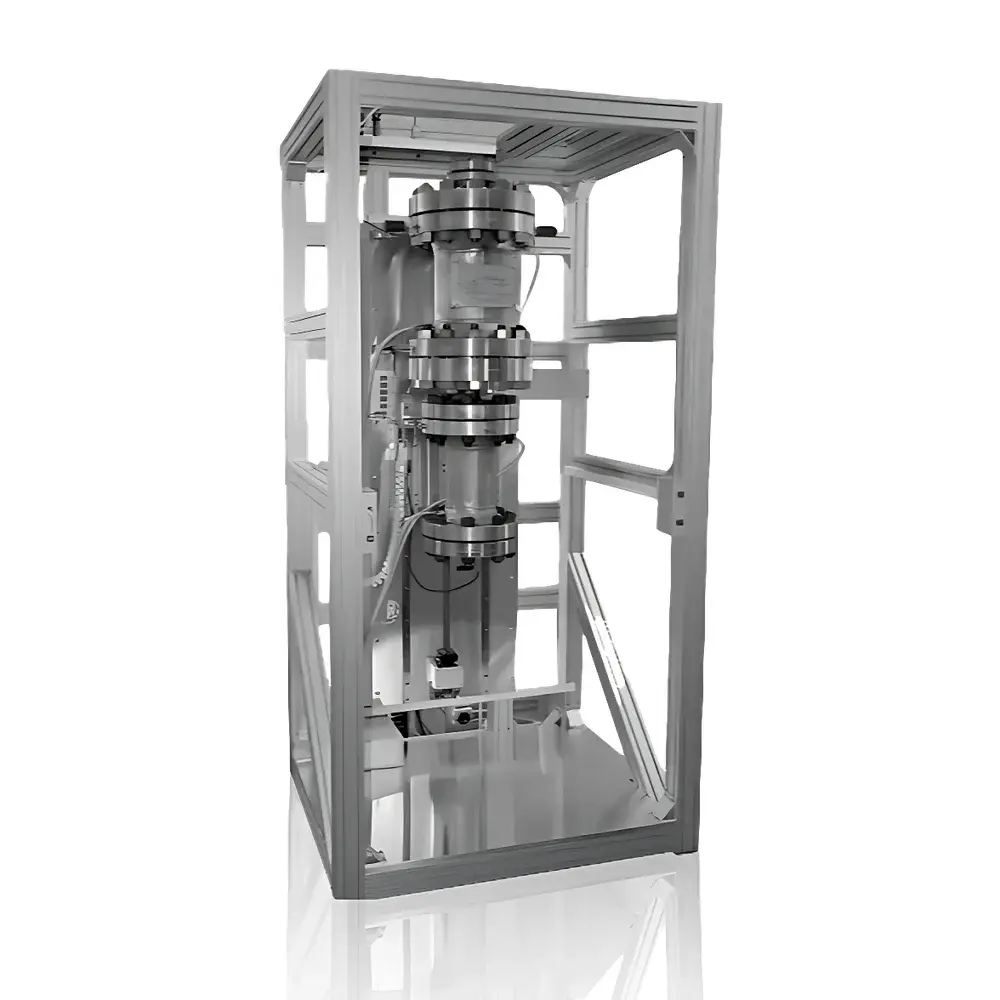
LINSEIS DIL L75 HP High-Pressure Dilatometer
| Brand | LINSEIS |
|---|---|
| Origin | Germany |
| Model | DIL L75 HP |
| Temperature Range | RT to 1100 °C / RT to 1400 °C / RT to 1800 °C |
| Maximum Pressure | 100 bar / 150 bar (configurable) |
| Vacuum Level | 1×10⁻⁴ mbar |
| Sample Length | up to 50 mm |
| Sample Diameter | φ7 / φ12 / φ20 mm |
| Measurement Range | 500 µm / 5000 µm |
| Resolution | 0.125 nm |
| Atmosphere Compatibility | Inert, Oxidizing, Reducing, Vacuum |
| Optional Accessories | Steam Generator, Mass Flow Controlled Gas Mixing System (MFC), QMS/FTIR Coupling Interface |
Overview
The LINSEIS DIL L75 HP High-Pressure Dilatometer is a precision thermal expansion measurement system engineered for quantitative analysis of dimensional changes in solid materials under controlled high-temperature and high-pressure conditions. Based on the proven push-rod dilatometry principle—where axial displacement of a sample is measured via a high-resolution capacitive or optical transducer—the instrument delivers traceable, reproducible linear expansion data across a broad thermodynamic envelope. Unlike conventional ambient-pressure dilatometers, the DIL L75 HP integrates a hermetically sealed high-pressure furnace chamber capable of sustaining pressures up to 150 bar while operating from room temperature to 1800 °C. This unique capability enables direct investigation of pressure-dependent phase transitions, sintering kinetics, densification behavior, and thermo-mechanical stability—parameters critical to advanced ceramic processing, nuclear fuel development, geophysical material modeling, and high-temperature alloy qualification.
Key Features
- Simultaneous high-temperature (RT–1800 °C) and high-pressure (up to 150 bar) operation within a single, integrated measurement environment
- Sub-nanometer resolution (0.125 nm) enabled by differential capacitance transduction and low-drift electronics, ensuring detection of minute dimensional shifts during subtle phase events
- Dual-furnace configuration options: DIL L75 HP/1 (max 1100 °C, 150 bar) and DIL L75 HP/2 (max 1800 °C, 100 bar), with vacuum integrity maintained at ≤1×10⁻⁴ mbar
- Modular sample holder system supporting fused silica (≤1100 °C) and high-purity alumina (≤1750 °C) crucibles and spacers, accommodating cylindrical samples up to 50 mm in length and 20 mm in diameter
- Programmable axial load control (up to 1000 mN) to minimize creep-induced artifacts during prolonged high-temperature holds
- Native coupling interface for real-time evolved gas analysis (EGA) via quadrupole mass spectrometry (QMS) or Fourier-transform infrared (FTIR) spectroscopy, synchronized with thermal expansion data acquisition
Sample Compatibility & Compliance
The DIL L75 HP accommodates a wide range of inorganic and metallic materials—including oxides (e.g., ZrO₂, Al₂O₃), carbides, nitrides, refractory metals (Mo, W, Nb), and intermetallics—under atmospheres spanning inert (Ar, He), oxidizing (air, O₂), reducing (H₂, CO/H₂ mixtures), and high-vacuum conditions. Optional steam generation and MFC-based multi-gas blending allow precise control of partial pressures for simulating realistic service environments (e.g., steam oxidation of turbine alloys, CO₂-rich sintering of functional ceramics). The system complies with ISO 11359-1 (plastics—dilatometry), ASTM E228 (linear thermal expansion of solids), and supports GLP/GMP documentation workflows through audit-trail-enabled software. All pressure vessels conform to PED 2014/68/EU and ASME BPVC Section VIII Div. 1 standards.
Software & Data Management
Control and analysis are executed via LINSEIS’s proprietary ThermoSoft® platform, which provides full instrument orchestration—including pressure ramping, temperature programming, load modulation, and synchronized EGA triggering. The software implements rate-controlled sintering (RCS) algorithms based on Palmour III theory, enabling closed-loop feedback control of heating rates to maintain constant densification velocity. Raw displacement, temperature, pressure, and gas evolution signals are time-aligned and stored in HDF5 format for long-term archival. Integrated spectral libraries and chemometric tools support automated peak assignment in QMS/FTIR datasets. Export modules generate ASTM-compliant reports and facilitate data exchange with MATLAB®, Python (via API), and LIMS systems. All user actions, parameter changes, and calibration events are logged with timestamps and operator IDs in accordance with FDA 21 CFR Part 11 requirements.
Applications
- Quantification of pressure-modified CTE and phase transition temperatures (e.g., α→γ iron transformation, Curie point determination at elevated p–T conditions)
- In-situ monitoring of sintering kinetics in technical ceramics, including shrinkage onset, intermediate densification, and final pore closure stages
- Thermal stability assessment of battery electrode materials (e.g., NMC, LFP) under simulated cell-relevant gas environments
- Geophysical simulation of mantle mineral behavior (e.g., olivine, perovskite) under lithostatic pressure analogs
- Validation of thermomechanical models used in nuclear fuel performance codes (e.g., BISON, TRANSURANUS)
- Decomposition onset and volatile release profiling during thermal processing of precursors (e.g., metal-organic frameworks, polymer-derived ceramics)
FAQ
What is the maximum allowable pressure for the DIL L75 HP at 1800 °C?
The DIL L75 HP/2 configuration supports up to 100 bar at 1800 °C; for 150 bar operation, the upper temperature limit is 1400 °C.
Can the system perform isothermal pressure holds while measuring dimensional change?
Yes—pressure can be stabilized and held constant during isothermal segments, with real-time displacement monitoring enabled throughout.
Is calibration traceable to national standards?
All displacement and temperature calibrations are performed using NIST-traceable reference materials (e.g., SRM 735a for CTE, Pt–Rh thermocouples calibrated against fixed points).
How is gas purity maintained during reducing atmosphere experiments?
Integrated dual-stage purification (oxygen/moisture scrubbers + cold traps) and leak-tight stainless-steel gas lines ensure <1 ppm O₂/H₂O contamination in H₂ or CO flows.
Does the system support automated method transfer between instruments?
Yes—ThermoSoft® uses XML-based method templates that preserve all hardware-specific parameters, enabling seamless replication across identical DIL L75 HP units in multi-site laboratories.



