
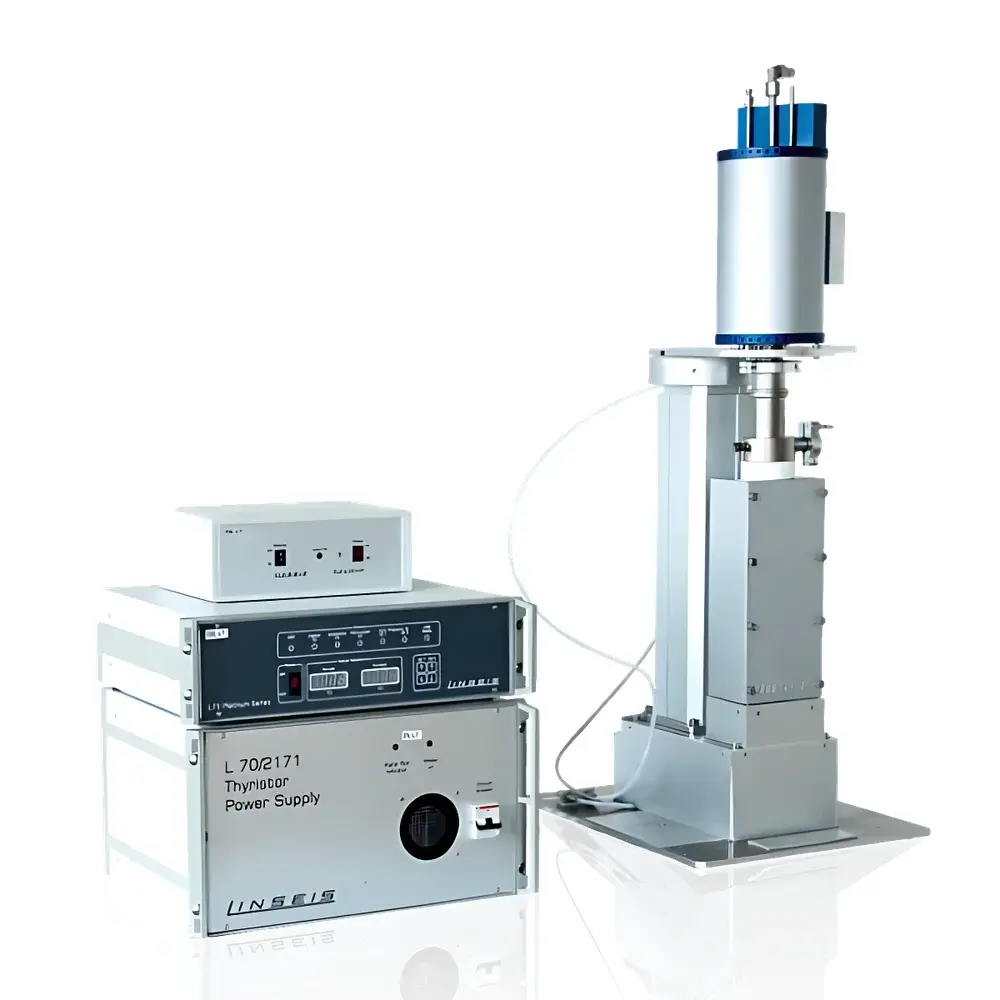
LINSEIS DIL L75 Nuclear Vertical Thermal Dilatometer
| Brand | LINSEIS |
|---|---|
| Origin | Germany |
| Model | DIL L75 Nuclear |
| Temperature Range | −263 to 2800 °C |
| Measurement Range | ±2500 µm |
| Delta L Resolution | 0.03 nm |
| Atmosphere Control | Manual gas dosing or mass flow controller (1, 3, or multi-gas capability) |
| Contact Force Range | 10 mN – 5 N |
| Vacuum Compatibility | Yes |
| Dual/Triple Furnace Configuration | Up to 3 furnaces |
| Glovebox-Compatible Mechanical–Electrical Separation | Optional |
| Low-Temperature Accessory | LN₂ cryostat & internal cooler |
| Softening Point Detection | Yes |
| Density Determination Module | Yes |
| Optical Encoder L-DTA Option | Up to 2000 °C (0.1 nm resolution) |
| Rate-Controlled Sintering (RCS) | Yes |
| Auto Sample Length Detection | Yes |
| Thermostatic Probe | Yes |
| Vacuum Sealing | Yes |
| Automatic Evacuation System | Optional |
| Electric Furnace Option | Optional |
| OGS Deoxygenation System | Optional |
Overview
The LINSEIS DIL L75 Nuclear is a vertically configured, high-precision thermal dilatometer engineered specifically for the dimensional metrology of nuclear and radioactively sensitive materials under rigorously controlled thermal and atmospheric conditions. It operates on the principle of contact-based linear thermal expansion measurement—employing a high-stability inductive displacement sensor (LVDT-type architecture) to detect minute length changes (ΔL) as a function of temperature, without applying excessive mechanical load. Unlike conventional dilatometers, the DIL L75 Nuclear integrates structural and functional adaptations essential for radiological safety: full mechanical–electrical separation, glovebox-compatible modular assembly, radiation-hardened mechanical interfaces, and zero-electronics-in-furnace-zone design. Its operational temperature range spans from cryogenic (−263 °C, near absolute zero) to ultra-high temperatures (2800 °C), enabling characterization across critical phase transitions—including solid–solid transformations, melting onset, sintering kinetics, and thermal decomposition—of advanced nuclear fuels (e.g., UO₂, MOX, TRISO particles), cladding alloys (e.g., Zr-based, FeCrAl), and structural ceramics (e.g., SiC, graphite composites).
Key Features
- “Zero-friction” probe mechanism optimized for ultra-low-expansion (ULE) materials and sintering studies, minimizing parasitic mechanical interference during softening or creep regimes.
- High-resolution inductive displacement sensing with ΔL resolution down to 0.03 nm—validated per ISO 11359-2 and ASTM E228 calibration protocols.
- Modular furnace architecture supporting up to three independently programmable vertical furnaces, each configurable for vacuum, inert, oxidizing, or reducing atmospheres via integrated mass flow controllers (1–3 gas channels standard; expandable).
- Programmable contact force control (10 mN – 5 N) with real-time feedback, ensuring consistent mechanical coupling across heterogeneous sample geometries and thermal contraction regimes.
- Optional optical encoder–based L-DTA configuration (up to 2000 °C, 0.1 nm resolution) for non-contact, load-free expansion monitoring—critical for volatile, fragile, or X-ray–emitting specimens.
- Integrated softening point detection, density determination module, and rate-controlled sintering (RCS) algorithm suite compliant with ISO 4042 and ASTM C1229 for ceramic processing validation.
- Cryogenic compatibility via LN₂ dewar or closed-cycle internal cooler, enabling low-temperature CTE mapping relevant to helium-cooled reactor systems.
Sample Compatibility & Compliance
The DIL L75 Nuclear accommodates cylindrical, disc, or prismatic samples (diameter ≤ 12 mm, height ≤ 25 mm) including irradiated fuel pellets, neutron-irradiated cladding segments, and molten-salt–corroded structural coupons. All wetted and proximity components are constructed from high-purity alumina, TZP zirconia, or molybdenum disilicide—materials selected for low neutron activation cross-sections and chemical inertness in aggressive environments (e.g., fluoride salt vapors). The system conforms to IAEA SSG-27 requirements for radiological instrumentation handling, supports ALARA-compliant operation via remote actuation interfaces, and meets EU Machinery Directive 2006/42/EC and Pressure Equipment Directive 2014/68/EU where applicable. For GMP/GLP-regulated nuclear R&D labs, optional 21 CFR Part 11–compliant audit trail logging and electronic signature modules are available.
Software & Data Management
Control and analysis are executed via LINSEIS ThermoSoft® v5.x—a validated, multi-user platform supporting ISO/IEC 17025 traceability workflows. The software implements automated baseline correction, CTE calculation per ASTM E228 Annex A1, derivative-based transition identification (e.g., α–β quartz inversion), and RCS parameter extraction (dw/dt vs. T). Raw data export complies with ASTM E1447 (ASCII) and HDF5 formats for integration into nuclear fuel performance codes (e.g., BISON, TRANSURANUS). Database management includes sample metadata tagging (irradiation history, burnup, cooling time), cross-referenced with thermogravimetric (TGA) and differential thermal analysis (DTA) datasets when coupled with optional L-DTA modules.
Applications
- Thermal expansion coefficient (CTE) profiling of nuclear fuel matrices across fast-neutron spectrum operating envelopes (e.g., SFR fuel pins).
- Sintering shrinkage kinetics and pore closure dynamics in TRISO particle fabrication.
- Thermal stability assessment of molten salt reactor (MSR) containment alloys under fluorination stress.
- Cryogenic dimensional stability testing of VHTR graphite reflector blocks at 4 K–300 K.
- Phase transformation mapping in irradiated zirconium alloys (e.g., α→β transus shift under dose accumulation).
- Softening behavior quantification of borosilicate waste glass forms during vitrification process optimization.
FAQ
Can the DIL L75 Nuclear be operated inside a nitrogen-purged glovebox?
Yes—optional mechanical–electrical separation enables full instrument deployment within ISO Class 4–5 gloveboxes; only pneumatic and optical feedthroughs require penetration.
Is vacuum integrity maintained during rapid heating to 2800 °C?
Yes—the dual-stage vacuum sealing system (metal gasket + ceramic O-ring) sustains ≤1×10⁻⁵ mbar throughout the full temperature ramp, verified per ISO 204.
How is calibration traceability ensured for nuclear-grade measurements?
Each system ships with NIST-traceable quartz and tungsten standards; in-house calibration certificates include uncertainty budgets per GUM (JCGM 100:2008).
Does the software support automated compliance reporting for regulatory submissions?
Yes—preconfigured templates generate ASTM/ISO-aligned reports with embedded raw data, metadata, and electronic signatures meeting IAEA TS-G-1.1 documentation requirements.
Can the system measure anisotropic expansion in polycrystalline nuclear ceramics?
Yes—dual-probe configuration (standard option) enables independent axial and radial strain resolution; combined with crystallographic texture data, it supports tensorial CTE derivation.



