
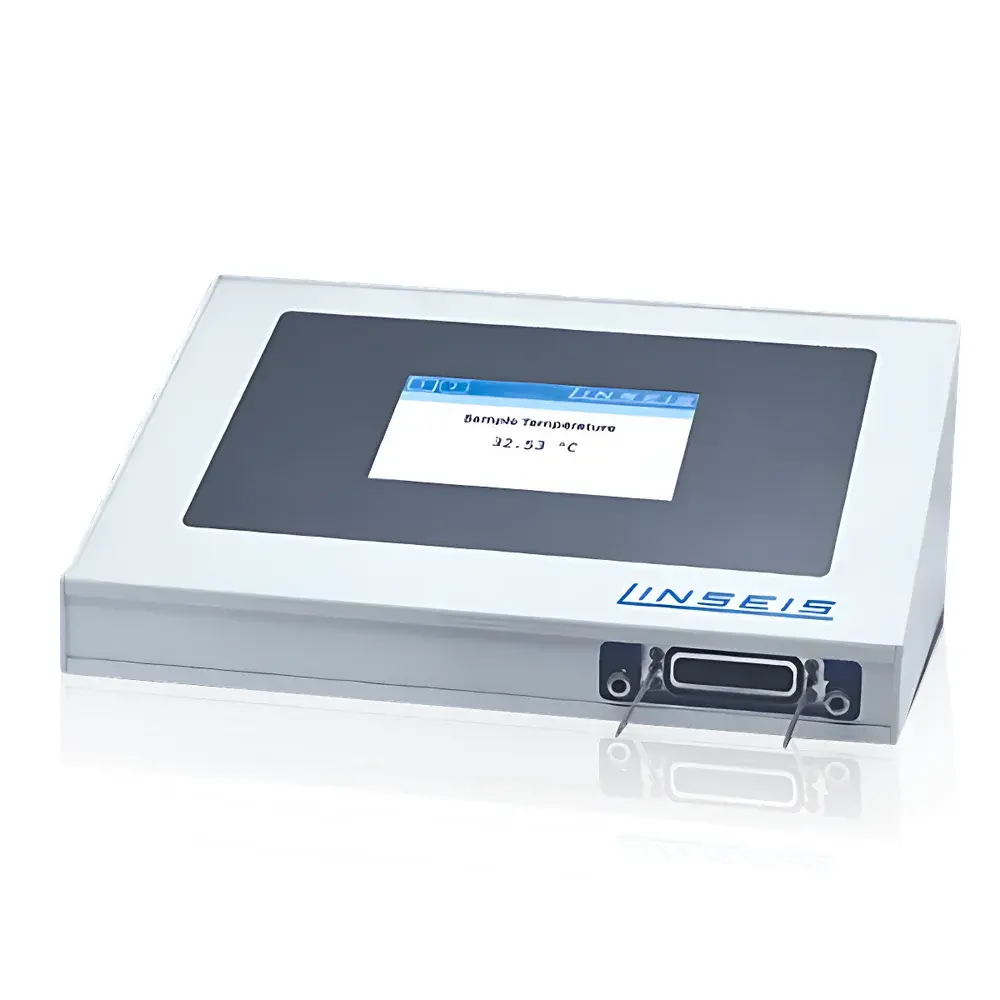
LINSEIS LSR-1 (LSR L32) Seebeck Coefficient and Electrical Resistivity Analyzer
| Brand | LINSEIS |
|---|---|
| Origin | Germany |
| Model | LSR-1 (LSR L32) |
| Temperature Range (Base Unit) | RT to 200 °C |
| Extended Low-Temp Range (with LN₂ Accessory) | –160 °C to 200 °C |
| Extended High-Temp Resistivity Range (with HT Probe) | up to 600 °C |
| Seebeck Coefficient Range | 0–2.5 mV/K |
| Seebeck Voltage Range | ±8 mV |
| Electrical Resistance Range | 10 nΩ |
| Voltage Sensitivity | 0.5 nV/K |
| Temperature Accuracy | ±1.5 °C or 0.0040· |
| Heating Rate | 0.01–100 K/min |
| Atmosphere Options | Inert, Reducing, Oxidizing, Vacuum |
| Recommended Purge Gas | Low-pressure He |
| Sample Dimensions (Seebeck) | 8–25 mm (L) × 2–25 mm (W) × ≤2 mm (T) |
| Sample Dimensions (Resistivity) | 18–25 mm (L) × 18–25 mm (W) × ≤2 mm (T) |
| Measurement Principles | Van der Pauw method (resistivity), Static DC method & Slope-based Seebeck measurement |
Overview
The LINSEIS LSR-1 (LSR L32) Seebeck Coefficient and Electrical Resistivity Analyzer is a precision benchtop instrument engineered for simultaneous, high-fidelity characterization of thermoelectric transport properties in bulk and thin-film materials. It operates on three complementary physical principles: the Van der Pauw method for four-point resistivity determination, static direct-current (DC) excitation for absolute Seebeck voltage acquisition, and slope-based differential Seebeck analysis under controlled thermal gradients. The system establishes a stable, linear temperature gradient across a sample mounted on a thermally symmetric PCB-based sample holder—featuring integrated primary and auxiliary heating zones—to ensure uniform thermal boundary conditions and minimize parasitic heat losses. Designed for rigorous thermoelectric research, the LSR-1 supports measurements from cryogenic temperatures (–160 °C with liquid nitrogen cooling) to elevated temperatures (up to 600 °C for resistivity, 200 °C for full Seebeck/resistivity co-measurement), all within a vacuum-tight, atmosphere-controlled chamber. Its architecture complies with fundamental requirements for reproducible thermoelectric metrology as defined in ISO 14405-1 and ASTM E2938–22 (Standard Test Method for Seebeck Coefficient and Electrical Conductivity of Thermoelectric Materials), enabling traceable data generation suitable for peer-reviewed publication and materials qualification workflows.
Key Features
- Modular platform design: Expandable via optional cryogenic (LN₂-cooled), high-temperature (600 °C resistivity), and multi-wavelength LED illumination accessories for photo-thermoelectric studies.
- Vacuum-sealed measurement chamber: Compatible with inert (Ar, N₂), reducing (H₂/Ar), oxidizing (O₂/N₂), and high-vacuum (<10⁻² mbar) environments; low-pressure helium recommended for optimal thermal conductivity and signal-to-noise ratio.
- Dual-zone active sample heating: Integrated main and auxiliary heaters on the PCB sample stage enable precise thermal gradient stabilization and rapid equilibration, minimizing axial temperature deviation (<±0.5 K over 10 mm).
- Synchronous dual-property acquisition: Simultaneous measurement of Seebeck coefficient (S) and electrical resistivity (ρ) at identical temperature points eliminates temporal drift artifacts and accelerates screening of figure-of-merit (zT) dependencies.
- Automated contact integrity verification: Built-in V-I curve analysis validates ohmic contact formation prior to each measurement cycle, reducing false positives from interfacial resistance.
- High-resolution signal conditioning: 0.5 nV/K Seebeck voltage resolution and 10 nΩ resistivity resolution support characterization of highly conductive metals (e.g., Cu, Ni) and low-conductivity oxides (e.g., CaMnO₃, Bi₂Te₃ derivatives) within a single platform.
Sample Compatibility & Compliance
The LSR-1 accommodates rectangular solid samples (8–25 mm length, 2–25 mm width, ≤2 mm thickness) for Seebeck analysis and slightly larger specimens (18–25 mm × 18–25 mm × ≤2 mm) for Van der Pauw resistivity mapping. Thin films deposited on insulating substrates (e.g., Al₂O₃, SiO₂/Si) can be measured using edge-contact configurations. All hardware and software components conform to CE marking directives and electromagnetic compatibility (EMC) standards EN 61326-1. Data acquisition protocols support audit-ready operation per GLP and GMP frameworks: measurement logs include timestamped metadata (ambient pressure, gas flow rate, heater power, thermocouple voltages), full raw signal traces, and automated linear regression residuals for S(T) evaluation. Optional vacuum pump integration enables compliance with ASTM D5470–21 (thermal transmission properties) when used in conjunction with calibrated reference standards.
Software & Data Management
Controlled via LINSEIS ThermoSoft® — a Windows-based application featuring wizard-guided experiment setup, real-time visualization of ΔT, VSeebeck, and R(t), and embedded statistical validation tools. Each measurement session automatically generates an ISO-compliant .csv export containing: temperature setpoint, actual stage temperature, applied thermal gradient (K), measured Seebeck voltage (µV), calculated S (µV/K), resistivity (µΩ·cm), and goodness-of-fit (R²) for linear regression. Raw binary files (.ltd) are stored with SHA-256 checksums for data integrity verification. Software supports batch processing of multi-sample sequences, comparative overlay of S(T) and ρ(T) curves across material families, and export to MATLAB®, Python (via .h5), and OriginLab formats. Audit trail functionality records user ID, parameter changes, calibration events, and system error flags—fully compliant with FDA 21 CFR Part 11 requirements when configured with electronic signature modules.
Applications
The LSR-1 serves as a core analytical tool in thermoelectric materials development labs, supporting quantitative evaluation of candidate systems including bismuth chalcogenides (Bi₂Te₃, Bi₂Se₃), skutterudites (CoSb₃), half-Heuslers (NiTiSn), oxide perovskites (La₀.₉Sr₀.₁CoO₃), and emerging organic/inorganic hybrids. It enables structure–property correlation studies across synthesis batches, doping gradients, and post-annealing treatments. In industrial R&D, the system supports quality control of thermoelectric generator (TEG) module substrates, validation of interconnect metallization resistivity stability, and accelerated aging tests under thermal cycling (0.01–100 K/min ramp rates). Its illumination accessory facilitates investigation of photo-thermoelectric coupling in emerging solar-thermal conversion architectures, while low-temperature capability supports fundamental studies of phonon-drag effects and quantum confinement signatures below 100 K.
FAQ
What temperature ranges are supported for simultaneous Seebeck and resistivity measurement?
Simultaneous dual-property measurement is validated from room temperature to 200 °C. Resistivity-only mode extends to 600 °C using the optional high-temperature probe.
Is vacuum pumping included as standard equipment?
No—the vacuum pump is an optional accessory. The base unit includes vacuum-tight chamber flanges and gas inlet/outlet ports compatible with standard rotary vane or turbomolecular pumps.
How does the system ensure thermal gradient linearity during Seebeck measurement?
Through symmetrical dual-zone heating on the PCB sample holder, real-time PID feedback from multiple embedded thermocouples, and pre-calibrated thermal shunt compensation algorithms that correct for lateral heat leakage.
Can the LSR-1 measure anisotropic thermoelectric properties?
Yes—by rotating the sample holder (optional motorized rotation stage) and performing sequential measurements along orthogonal crystallographic axes, provided sample geometry permits orientation-specific mounting.
What calibration standards are recommended for routine verification?
NIST-traceable certified reference materials including Constantan (NIST SRM 477), pure copper (ASTM B115), and doped Bi₂Te₃ (NREL-certified) are recommended for quarterly system performance checks.



