
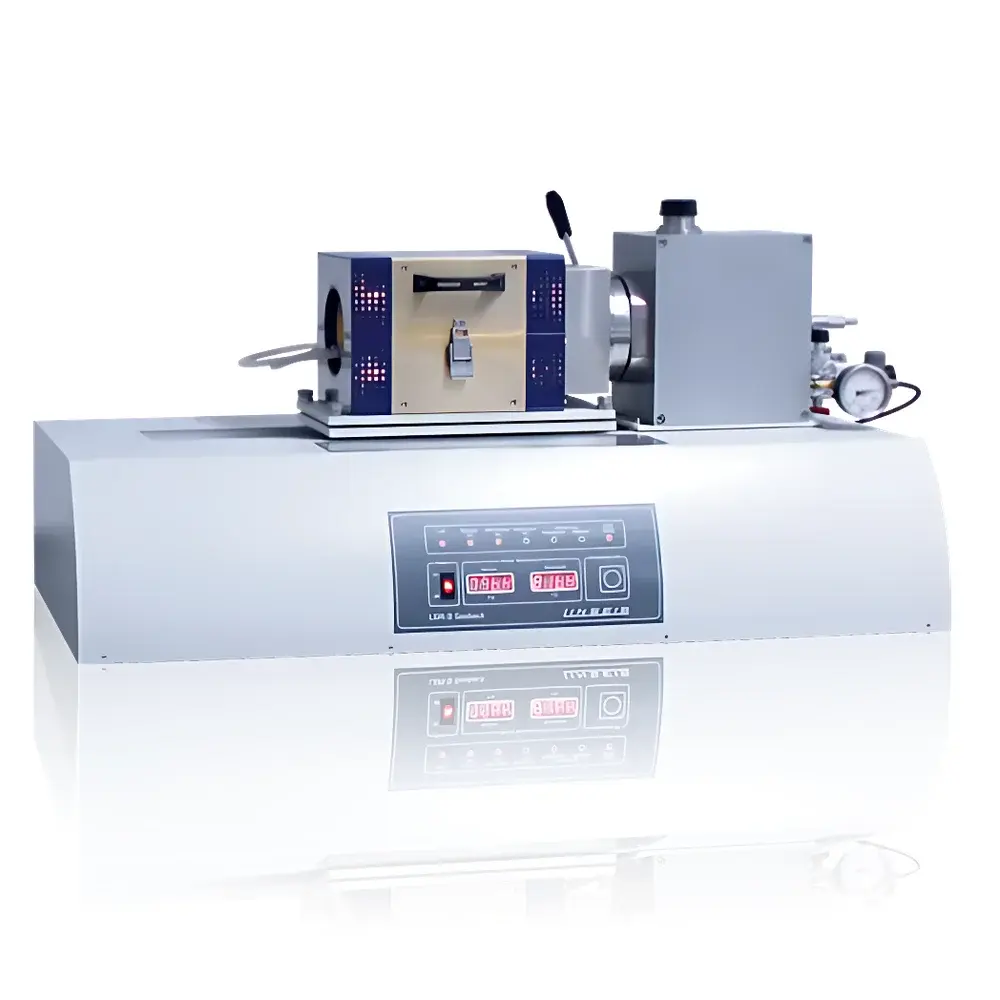
LINSEIS LSR-3 (LSR L31) Seebeck Coefficient and Electrical Resistivity Analyzer
| Brand | LINSEIS |
|---|---|
| Origin | Germany |
| Model | LSR-3 (LSR L31) |
| Temperature Range | –100 °C to 1500 °C (configurable via interchangeable furnace modules) |
| Measurement Methods | Static DC Seebeck method / Slope method (Seebeck) |
| Seebeck Range | 1 µV/K to 5000 µV/K |
| Electrical Conductivity Range | 0.01 to 2 × 10⁵ S/cm |
| Furnace Options | IR furnace (RT–800 °C / RT–1100 °C), resistance furnace (RT–1500 °C), cryo furnace (–100 °C to 500 °C) |
| Atmosphere Compatibility | Inert, reducing, oxidizing, vacuum (recommended: low-pressure He) |
| Electrode Materials | Ni (–100 °C to 500 °C), Pt (–100 °C to 1500 °C) |
| Sample Geometry Support | Bulk rods (2–5 mm² cross-section, ≤23 mm length, ≤6 mm diameter), discs (10/12.7/25.4 mm Ø), thin films (with optional film adapter) |
| Thermocouple Types | K, S, C |
| Inter-thermocouple Spacing | 4 mm, 6 mm, 8 mm |
| Mandatory Cooling | Integrated water-cooling system |
| Optional Modules | Hammar Method ZT module (LSR-4), Impedance Spectroscopy for TEGs, Low-Temperature Cryo Kit (LN₂-cooled), High-Resolution Camera-Assisted Resistance Imaging, High-Resistance Adapter |
Overview
The LINSEIS LSR-3 (LSR L31) Seebeck Coefficient and Electrical Resistivity Analyzer is a modular, high-precision thermoelectric characterization platform engineered for rigorous physical property evaluation of bulk, thin-film, and layered thermoelectric materials. It operates on the fundamental principles of the static direct-current Seebeck effect and four-point probe resistivity measurement—both standardized under ASTM E1577 and ISO 14405 for thermoelectric material qualification. The system employs dual-sensor thermal gradient generation across a precisely defined sample length, enabling simultaneous acquisition of thermoelectric voltage (ΔV) and temperature differential (ΔT) to compute the Seebeck coefficient (S = –ΔV/ΔT) with traceable calibration against NIST-traceable reference standards. Electrical resistivity is determined via true four-terminal sensing to eliminate contact resistance artifacts, ensuring compliance with IEC 60404-5 for magnetic and thermoelectric material testing protocols. Designed for laboratory environments requiring reproducible, GLP-compliant data generation, the LSR-3 integrates seamlessly into workflows aligned with FDA 21 CFR Part 11–enabled software architectures when paired with optional audit-trail modules.
Key Features
- Modular furnace architecture supporting three interchangeable heating/cooling systems: infrared furnace (RT–800 °C or RT–1100 °C), high-temperature resistance furnace (RT–1500 °C), and liquid nitrogen–cooled cryogenic furnace (–100 °C to 500 °C)
- Precise thermal gradient control with ±0.1 K stability over 4–8 mm inter-thermocouple spacing (K-, S-, or C-type selectable)
- Low-drift current source (0–160 mA standard; 220 mA optional) with sub-μA resolution for accurate resistivity quantification
- Vertical sample mounting configuration with dual-electrode clamping and interchangeable electrode sets (Ni for low/mid-temperature, Pt for high-temperature operation)
- Optional high-resolution camera-assisted resistance mapping for spatially resolved conductivity profiling on inhomogeneous or patterned thin films
- Mandatory integrated water-cooling system ensures thermal stability of electronics and furnace housing during extended high-temperature runs
- Configurable sample holders for cylindrical rods (≤6 mm Ø, ≤23 mm L), disc-shaped specimens (10/12.7/25.4 mm Ø), and thin films (via dedicated film adapter with edge-contact geometry)
Sample Compatibility & Compliance
The LSR-3 accommodates diverse thermoelectric material forms including doped Bi₂Te₃, PbTe, SiGe alloys, skutterudites, half-Heuslers, and emerging oxide-based ceramics. Its design conforms to ASTM D7984 for thermoelectric module characterization and supports validation against NIST Standard Reference Material (SRM) 3451 (Bi₂Te₃), certified up to 390 K. For elevated-temperature validation, the system utilizes certified Constantan (Cu–Ni alloy) reference samples—NIST-traceable and stable up to 800 °C—enabling calibration continuity beyond SRM 3451’s operational ceiling. All furnace atmospheres are compatible with inert (Ar, N₂), reducing (5% H₂/95% Ar), oxidizing (air, O₂), and high-vacuum (<10⁻³ mbar) environments; low-pressure helium is recommended for optimal thermal homogeneity and reduced convection errors. Data integrity meets ISO/IEC 17025 requirements for accredited testing laboratories when operated with documented SOPs and periodic verification using reference materials.
Software & Data Management
Control and analysis are performed via LINSEIS ThermoSoft™ v6.x, a Windows-based application compliant with 21 CFR Part 11 when configured with electronic signatures, role-based access control, and full audit-trail logging. The software enables automated multi-cycle temperature ramping with user-defined dwell times, real-time ΔV/ΔT synchronization, and automatic S and ρ calculation per ASTM E1577 Annex A1. Raw data export is supported in CSV, TXT, and HDF5 formats for third-party analysis (e.g., MATLAB, Python Pandas). Calibration files are digitally signed and version-controlled; instrument metadata—including furnace type, thermocouple model, electrode configuration, and atmospheric conditions—is embedded directly into each dataset header. Optional IQ/OQ documentation packages support GMP-regulated R&D facilities.
Applications
The LSR-3 serves as a primary tool for thermoelectric materials development across academia and industrial R&D. Typical use cases include: high-temperature stability assessment of SiGe alloys for space-grade radioisotope thermoelectric generators (RTGs); low-temperature performance screening of nanostructured Bi₂Te₃ thin films for wearable micro-generators; compositional optimization of Cu₂Se-based composites via Seebeck-resistivity trade-off mapping; and interfacial resistance quantification at grain boundaries using localized four-probe configurations. When upgraded to LSR-4 configuration, it enables direct ZT determination via the Harman method on single-leg elements and AC impedance spectroscopy on commercial Peltier modules (TEGs), eliminating reliance on separate laser flash analysis (LFA) instruments for thermal conductivity input. This capability supports rapid iteration in thermoelectric module co-design, particularly for automotive waste-heat recovery and IoT energy-harvesting applications.
FAQ
Can the LSR-3 measure thermal conductivity directly?
No—the base LSR-3 measures only Seebeck coefficient and electrical resistivity. Thermal conductivity must be supplied externally (e.g., from an LFA instrument) to compute ZT. However, the LSR-4 upgrade adds Harman-method thermal conductivity derivation for homogeneous bulk samples.
What sample preparation is required for thin-film measurements?
Films must be deposited on insulating substrates (e.g., Al₂O₃, quartz) and contacted via sputtered Ti/Au pads or lithographically defined electrodes. The optional film adapter provides edge-contact geometry to minimize substrate shunt effects.
Is vacuum compatibility validated to specific pressure levels?
Yes—the system achieves and maintains pressures down to 10⁻³ mbar using integrated turbomolecular pumping; leak rate is verified per ISO 20483 Class II specifications.
How is temperature calibration performed across the full –100 °C to 1500 °C range?
Calibration uses fixed-point references: melting points of In (156.6 °C), Sn (231.9 °C), Zn (419.5 °C), Al (660.3 °C), Ag (961.8 °C), and Au (1064.2 °C), supplemented by ITS-90 interpolation polynomials for intermediate ranges.
Does the system support automated long-term stability testing?
Yes—software-defined soak protocols allow continuous monitoring at fixed temperatures for up to 168 hours, with drift tracking of Seebeck coefficient and resistivity at user-specified intervals.



