
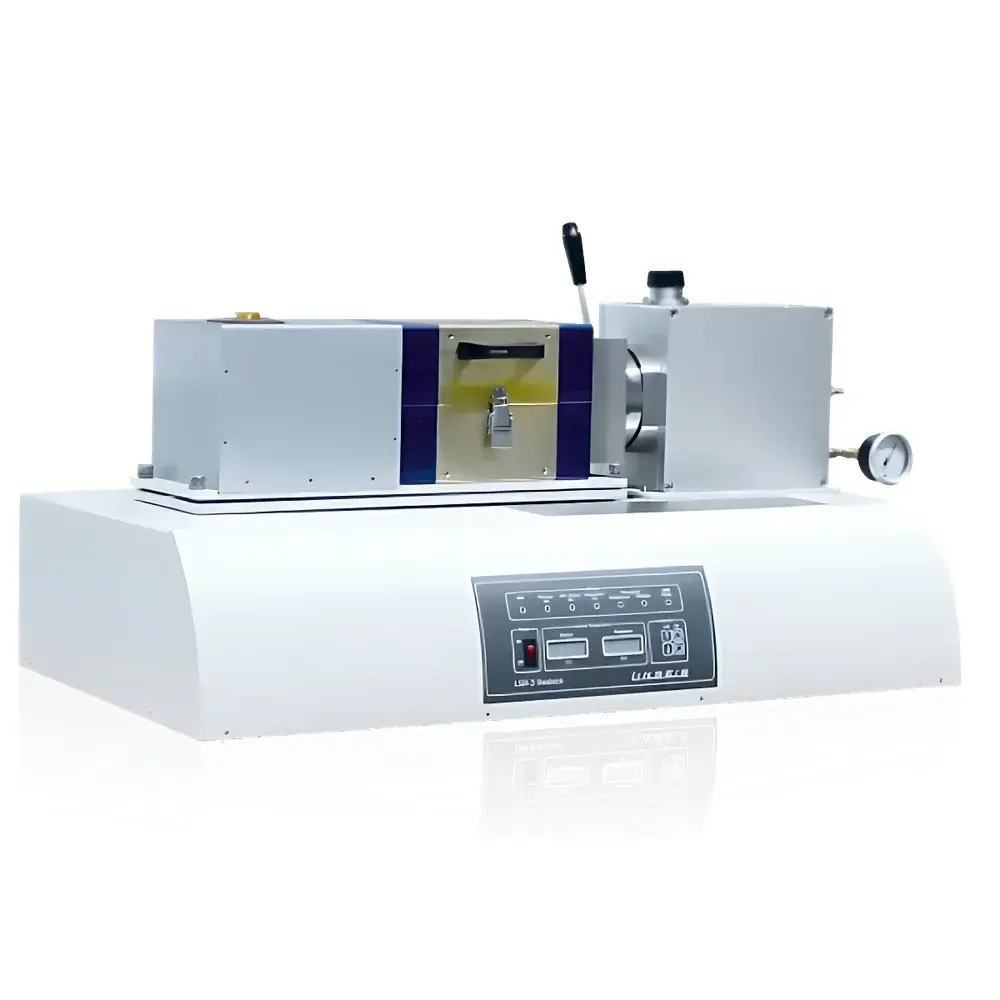
LINSEIS LZT-Meter (LZT L33) Integrated Thermoelectric Property Analyzer
| Brand | LINSEIS |
|---|---|
| Origin | Germany |
| Model | LZT-Meter (LZT L33) |
| Thermal Conductivity Measurement Method | Laser Flash Analysis (LFA) |
| Thermal Diffusivity Range | 0.01 – 1000 mm²/s |
| Laser Source | Nd:YAG (25 J/pulse) |
| Pulse Width | 0.01 – 5 ms |
| Temperature Range | –100 °C to 1100 °C |
| Atmosphere Options | Inert, Reducing, Oxidizing, Vacuum |
| Seebeck Coefficient Range | 1 µV/K – 250 mV/K (Static DC Method) |
| Electrical Conductivity Range | 0.01 – 2×10⁵ S/cm |
| Sample Geometry | Disc-shaped (10, 12.7, 25.4 mm diameter) or Cylindrical/Rectangular (2–5 mm × 6–23 mm) |
| Detection | InSb / MCT Detectors |
| Furnace Options | IR Furnace (RT–800 °C / 1100 °C), Cryo Furnace (–100 °C to 500 °C), High-Temp Furnace (RT–1100 °C) |
| Measurement Principles | Laser Flash Analysis (ASTM E1461), Static DC Seebeck & Four-Terminal Resistivity, Harman Method (Direct ZT), AC Impedance Spectroscopy (TEG Modules) |
Overview
The LINSEIS LZT-Meter (LZT L33) is the world’s first commercially available integrated instrument capable of determining the full thermoelectric figure of merit (ZT) from a single disc-shaped sample within one unified platform. It combines laser flash analysis (LFA) for thermal diffusivity and specific heat capacity with a fully synchronized linear scan resistivity (LSR) system for simultaneous Seebeck coefficient and electrical conductivity measurements. This co-located, multi-physical measurement architecture eliminates inter-instrument calibration drift, thermal history mismatch, and positional uncertainty—critical sources of error when deriving ZT via separate instruments. The system operates on the fundamental principle that ZT = (S²σ/κ)T, where S is the Seebeck coefficient (µV/K), σ is electrical conductivity (S/m), κ is thermal conductivity (W/m·K), and T is absolute temperature (K). By measuring all three numerator and denominator parameters under identical thermal, mechanical, and environmental conditions, the LZT-Meter delivers intrinsically correlated datasets essential for rigorous thermoelectric materials development and validation.
Key Features
- Single-platform ZT determination: Full thermoelectric property characterization (S, σ, α, ρ, κ, ZT) from one sample without transfer or re-mounting.
- Modular furnace architecture: Interchangeable heating modules—including high-resolution IR furnace (RT–1100 °C), cryogenic furnace (–100 °C to 500 °C), and standard high-temp furnace—enabling seamless coverage across –100 °C to 1100 °C.
- Laser flash analysis compliant with ASTM E1461 and ISO 22007-4: Nd:YAG pulse source (25 J/pulse, 0.01–5 ms pulse width), InSb/MCT detection, and dual-sample positioning for reference-based specific heat measurement.
- LSR-4 upgraded electronics: Four-terminal resistivity measurement with low-drift current source (0–160 mA), static DC Seebeck evaluation using precision thermocouple pairs (Type K/S/C), and configurable electrode spacing (4/6/8 mm).
- Direct ZT quantification via Harman method: Real-time voltage decomposition into Ohmic and thermoelectric components during current bias, enabling model-free ZT extraction at discrete temperatures.
- AC impedance spectroscopy module: Optional integration for direct ZT assessment on functional thermoelectric generators (TEGs) or Peltier modules under operational load conditions.
- Controlled atmosphere compatibility: Fully sealed chamber supporting inert (Ar, N₂), reducing (H₂/Ar), oxidizing (air, O₂), and high-vacuum (<10⁻³ mbar) environments; low-pressure helium recommended for optimal thermal diffusivity resolution.
Sample Compatibility & Compliance
The LZT-Meter accommodates disc-shaped samples (10, 12.7, or 25.4 mm diameter) and cylindrical/rectangular specimens (2–5 mm cross-section × 6–23 mm height), with maximum module footprint of 50 × 50 mm. Electrode materials are selected per temperature regime: nickel (–100 °C to 500 °C) and platinum (–100 °C to 1500 °C) ensure stable contact resistance and minimal thermoelectric offset. All measurements adhere to GLP-compliant data acquisition protocols, with timestamped metadata, hardware-calibrated sensor traces, and audit-ready export formats (CSV, HDF5, XML). The system supports 21 CFR Part 11–compliant user access control, electronic signatures, and immutable measurement logs when configured with LINSEIS’ optional compliance software suite. Reference material validation includes NIST SRM 3451 (Bi₂Te₃), enabling traceable calibration across the full temperature and property range.
Software & Data Management
LINSEIS ThermoSoft® v6.2 provides unified control, real-time visualization, and automated ZT synthesis. The software implements iterative curve-fitting algorithms for LFA thermal diffusivity (including Cowan correction and pulse shape deconvolution), differential Seebeck slope analysis, and four-point resistivity correction for contact resistance. All raw signals—laser pulse profile, IR detector response, thermocouple voltage gradients, and current-source output—are time-synchronized and stored with sub-millisecond resolution. Export options include ASTM-compliant reports, customizable dashboards for trend analysis, and Python/MATLAB APIs for batch processing and machine learning integration. Data integrity is ensured via SHA-256 hashing of measurement files and automatic backup to network-attached storage (NAS) or cloud repositories.
Applications
The LZT-Meter serves R&D laboratories focused on next-generation thermoelectric materials, including chalcogenides (Bi₂Te₃, PbTe, SnSe), half-Heuslers, skutterudites, conducting polymers, and nanostructured composites. It enables structure–property correlation studies across synthesis batches, doping gradients, and annealing histories. Typical use cases include: validation of ZT enhancement strategies (e.g., phonon scattering via grain boundary engineering); benchmarking against NIST reference standards; in-situ degradation analysis under thermal cycling; and direct ZT mapping of segmented TEG legs. Its cryogenic capability supports emerging low-temperature applications such as quantum thermoelectrics and dilution refrigerator waste-heat recovery. The Harman method implementation is particularly valuable for rapid screening of prototype compositions where traditional multi-step ZT derivation introduces cumulative uncertainty exceeding ±15%.
FAQ
Does the LZT-Meter require separate calibration for LFA and LSR modules?
No. All subsystems share a common thermal reference frame and synchronized timing engine; calibration is performed once per furnace configuration using certified reference materials (e.g., NIST SRM 736, SRM 3451).
Can thin films or flexible substrates be measured?
Yes—optional foil/film adapters enable vertical clamping between electrodes; minimum thickness supported is 25 µm with surface roughness <0.5 µm Ra.
Is water cooling mandatory?
Yes. The Nd:YAG laser and high-power IR furnace require continuous deionized water circulation (flow rate ≥4 L/min, inlet temp ≤22 °C) for thermal stability and detector longevity.
What atmospheres are validated for high-temperature operation above 800 °C?
High-purity argon (99.999%) and vacuum (<10⁻³ mbar) are fully qualified up to 1100 °C; oxidizing atmospheres are limited to ≤600 °C due to platinum electrode oxidation kinetics.
How is thermal contact resistance minimized during Seebeck measurement?
Spring-loaded needle contacts provide uniform pressure (1.2 N ±0.1 N) and self-aligning geometry; contact resistance is monitored in real time and excluded from final S and ρ calculations via four-terminal correction.



