
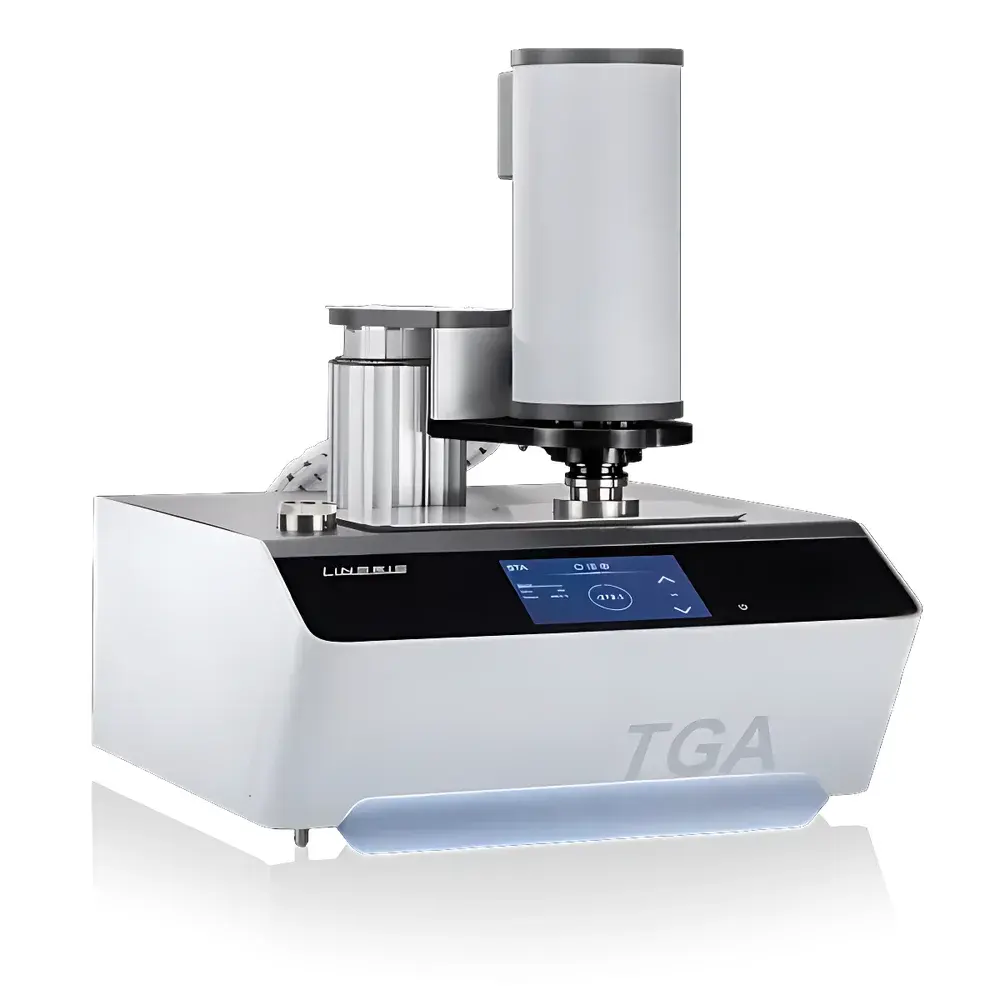
LINSEIS TGA L81 High-Performance Thermogravimetric Analyzer
| Brand | LINSEIS |
|---|---|
| Origin | Germany |
| Model | TGA L81 |
| Temperature Range | –150 to 2400 °C |
| Balance Sensitivity | 0.1 µg |
| Maximum Sample Mass | 25 g |
| Vacuum Tightness | 10⁻² mbar |
| Optional DTA Calculation | Yes |
| Interface | USB |
| Compatibility | MS and/or FTIR for Evolved Gas Analysis (EGA) |
Overview
The LINSEIS TGA L81 is a high-precision, modular thermogravimetric analyzer engineered for rigorous thermal stability and compositional analysis across an exceptional temperature range—from cryogenic conditions at –150 °C up to ultra-high temperatures of 2400 °C. Operating on the fundamental principle of continuous mass measurement under controlled thermal and atmospheric conditions, the TGA L81 quantifies minute changes in sample weight as a function of temperature or time. Its robust dual-furnace architecture—available in standard and high-resolution (HIRES) configurations—enables reproducible detection of mass changes down to 0.1 µg, supporting both routine quality control and advanced research in materials degradation, decomposition kinetics, oxidation behavior, and filler content determination. The system’s vacuum-tight design (10⁻² mbar base pressure) ensures inert, oxidative, reductive, or reactive gas environments with minimal background interference—critical for studies requiring strict atmosphere control, such as carbonization, metal oxidation, or polymer pyrolysis.
Key Features
- Ultra-broad temperature capability: –150 °C to 2400 °C, selectable via interchangeable furnace modules (e.g., low-temp cryo, medium-temp quartz, high-temp graphite or tungsten)
- High-sensitivity microbalance with 0.1 µg resolution (TGA L81 HIRES variant) and 25 g maximum load capacity—optimized for both macro-scale industrial samples and micro-analytical research specimens
- Vacuum-sealed, gas-tight sample chamber compatible with inert (N₂, Ar), oxidative (O₂, air), reductive (H₂, forming gas), and corrosive atmospheres
- Integrated DTA calculation module enabling pseudo-differential thermal analysis without additional sensors—providing qualitative insight into endothermic/exothermic transitions aligned with mass-loss events
- Modular coupling interface for real-time evolved gas analysis (EGA) with quadrupole mass spectrometry (MS) and/or Fourier-transform infrared spectroscopy (FTIR)
- USB-based digital communication with embedded electronics; no external DAQ required
Sample Compatibility & Compliance
The TGA L81 accommodates diverse sample geometries and chemistries through an extensive portfolio of crucibles—including Pt, Au, Ag, Al₂O₃, graphite, W, stainless steel (high-pressure rated), and custom geometries. Its mechanical and thermal design conforms to ISO 11358-1:2014 (Plastics — Thermogravimetry — Part 1: General principles) and ASTM E1131–22 (Standard Test Method for Compositional Analysis by Thermogravimetry). When operated with validated methods and audit-trail-enabled software (optional GLP/GMP-compliant mode), the instrument supports regulatory submissions under FDA 21 CFR Part 11 requirements. All furnace modules undergo individual calibration traceable to NIST-certified reference materials (e.g., Ni, Cu, and CaC₂O₄·H₂O for temperature; certified metal standards for mass).
Software & Data Management
Acquisition and analysis are managed via LINSEIS’ proprietary ThermoSoft™ platform—a Windows-based application supporting multi-step temperature programs (ramp, hold, modulated), automatic baseline correction, derivative (DTG) computation, peak deconvolution, and kinetic modeling (e.g., Friedman, Ozawa-Flynn-Wall). Raw data files are stored in vendor-neutral ASCII format with full metadata (gas flow rates, pressure logs, furnace PID settings). The software includes built-in report templates compliant with ISO/IEC 17025 documentation requirements and supports export to CSV, Excel, and Origin-compatible formats. Optional modules enable automated method validation, electronic signatures, and secure user-role management for regulated environments.
Applications
The TGA L81 delivers quantitative insight across academia and industry: determining carbonate content in construction binders (e.g., gypsum, limestone, and cementitious systems); quantifying moisture, volatiles, polymer matrix, and inorganic residue in composites; characterizing thermal stability of battery cathode materials (LiCoO₂, NMC); assessing catalyst coke formation and regeneration cycles; evaluating char yield in biochar production; and verifying filler loading in elastomers and thermoplastics. As demonstrated in field-degraded gypsum analysis, the instrument distinguishes subtle compositional shifts—such as reduced CaCO₃ content in cracked façade plasters (11.5–13.7% vs. 33.2% in intact reference)—directly linking thermal decomposition profiles to formulation integrity and environmental aging mechanisms.
FAQ
What temperature calibration standards are recommended for the TGA L81?
Certified reference materials including nickel (Curie point: 354 °C), copper (melting point: 1084.62 °C), and calcium oxalate monohydrate (decomposition steps at 160–500 °C) are used for routine calibration.
Can the TGA L81 operate under dynamic vacuum without gas purging?
Yes—the vacuum-tight chamber supports static vacuum operation down to 10⁻² mbar; optional turbomolecular pumping extends base pressure to 10⁻⁶ mbar for ultra-high-purity applications.
Is DTA calculation sufficient for enthalpy quantification?
No—DTA calculation provides semi-quantitative transition identification only; absolute enthalpy values require dedicated DSC or heat-flux calorimetry instrumentation.
How is data integrity ensured during long-duration experiments (e.g., >100 h)?
The system employs redundant sensor monitoring, automatic drift compensation algorithms, and timestamped event logging—all recorded with checksum-verified binary metadata to support GLP audit trails.
Are custom furnace geometries available for specialized sample holders?
Yes—LINSEIS offers OEM-designed furnaces for horizontal/vertical configurations, high-pressure cells (up to 200 bar), and simultaneous TGA-DSC hybrid modules upon request.



