
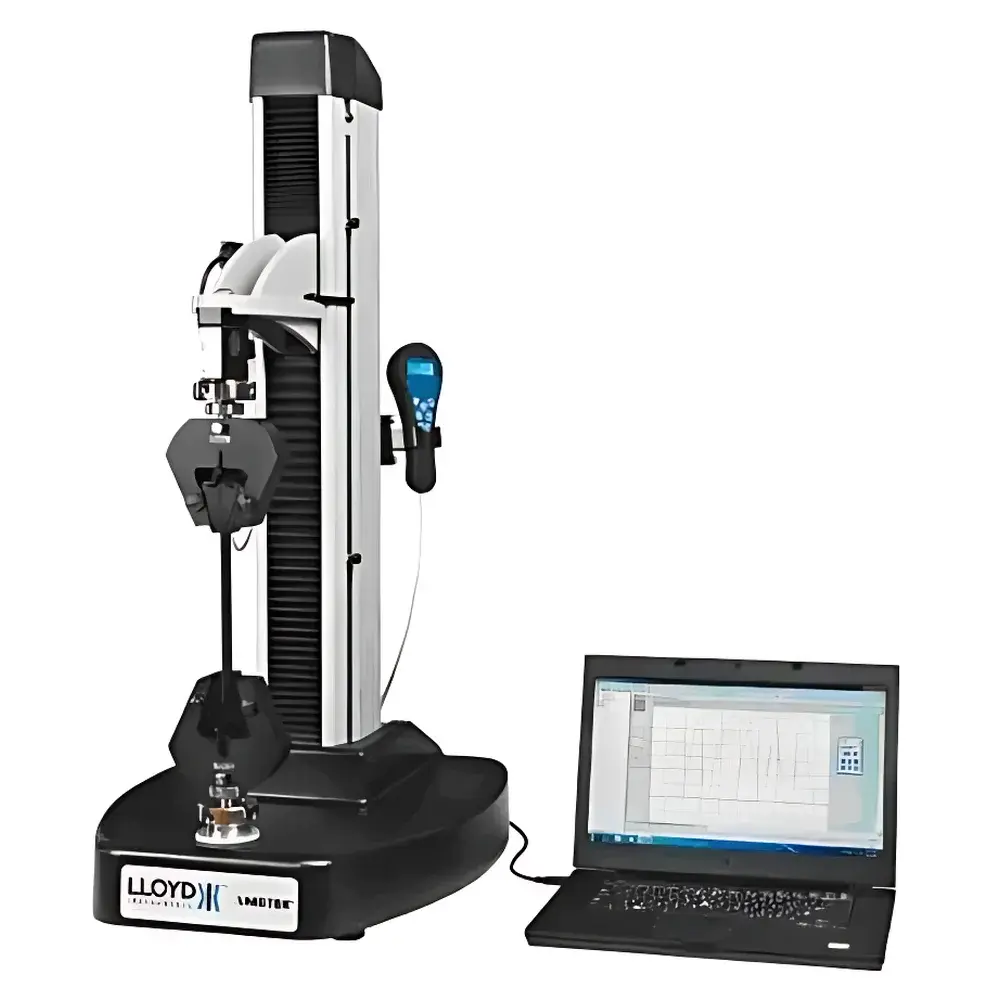
LLOYD LS-1 Advanced Single-Column Universal Testing Machine
| Brand | LLOYD |
|---|---|
| Origin | USA |
| Model | LS-1 |
| Load Capacity | ≤ 1 kN (225 lbf) |
| Crosshead Travel (Standard) | 500 mm (19.7 in) |
| Crosshead Travel (Extended) | 750 mm (29.5 in) |
| Speed Range | 0.01–2032 mm/min |
| Control Options | Integrated Handheld Panel & NEXYGEN Plus Software |
| Frame Stiffness | Enhanced Mechanical Rigidity with Digital Compensation |
| Compliance | ASTM E4, ASTM E8, ISO 6892-1, ISO 527, USP <1041>, FDA 21 CFR Part 11 Ready |
Overview
The LLOYD LS-1 Advanced Single-Column Universal Testing Machine is a precision-engineered electromechanical system designed for static tensile, compression, flexure, peel, and shear testing of metals, polymers, composites, elastomers, adhesives, biomedical specimens, and thin-film materials. Built upon AMETEK’s legacy in materials characterization, the LS-1 implements a high-rigidity single-column architecture coupled with closed-loop servo control and real-time digital displacement compensation—enabling traceable, repeatable force-displacement measurements under ISO 7500-1 Class 1 accuracy requirements. Its modular design supports rapid fixture interchangeability and integrates seamlessly into regulated laboratory environments where method reproducibility, audit readiness, and long-term calibration stability are critical.
Key Features
- Enhanced mechanical frame stiffness achieved through optimized aluminum extrusion geometry and reinforced crosshead guidance—reducing deflection-induced error during high-force ramping or cyclic loading.
- Wide dynamic speed range from 0.01 mm/min (for creep and relaxation studies) to 2032 mm/min (for high-rate impact-simulated tests), delivered via a brushless DC servo motor with integrated encoder feedback and adaptive torque management.
- Dual-mode control architecture: intuitive operation via the backlit handheld controller for routine QA checks, and full-featured test sequencing, real-time data streaming, and post-processing via NEXYGEN Plus software—validated for compliance with FDA 21 CFR Part 11 electronic record and signature requirements.
- Digitally compensated displacement measurement using high-resolution linear encoders (±0.5 µm resolution) and software-based thermal drift correction—ensuring sub-micron positional fidelity across ambient temperature fluctuations (15–30 °C).
- Modular load cell integration supporting interchangeable transducers (e.g., 5 N, 50 N, 500 N, 1 kN) with automatic recognition and auto-ranging—minimizing manual scaling errors and enabling seamless multi-range testing within a single protocol.
Sample Compatibility & Compliance
The LS-1 accommodates specimens ranging from microtensile coupons (0.5 mm wide) to standard ASTM D638 Type I plastic bars and ISO 527-2 multipurpose specimens. Standard grips include pneumatic wedge-action clamps, roller-type tensile fixtures, and three-point bend fixtures with adjustable span; optional accessories include environmental chambers (-70 °C to +250 °C), video extensometry systems, and solvent-resistant sealing enclosures. The system conforms to key international standards including ASTM E4 (verification of force-measuring instruments), ASTM E8/E21 (tensile testing of metallic materials), ISO 6892-1 (metallic materials – tensile testing at ambient temperature), and USP (mechanical testing of pharmaceutical packaging). All firmware and software modules undergo periodic validation per GLP/GMP-aligned IQ/OQ protocols.
Software & Data Management
NEXYGEN Plus serves as the unified platform for test definition, execution, visualization, and reporting. It supports customizable test methods (e.g., preload-to-break, ramp-hold-relax, multi-step cyclic profiles), automated pass/fail evaluation against user-defined limits, and export of raw ASCII/CSV datasets with full metadata tagging (operator ID, timestamp, calibration certificate ID, environmental conditions). Audit trails record all parameter changes, result modifications, and user logins in tamper-evident format. Data archives comply with 21 CFR Part 11 requirements—including electronic signatures, role-based access control, and secure database encryption (AES-256). Integration with LIMS and ERP systems is supported via OPC UA and RESTful API interfaces.
Applications
- Quality control of medical device components (sutures, catheter shafts, stent crimping force)
- Mechanical validation of polymer films used in flexible electronics and barrier packaging
- Tensile strength and elongation-at-break assessment of biodegradable scaffolds per ISO 10993-12
- Adhesion strength quantification of pressure-sensitive tapes and laminated composites
- Compression testing of pharmaceutical tablets (hardness, friability, capping tendency)
- Dynamic fatigue characterization of elastomeric seals under variable amplitude loading
FAQ
What load cell options are compatible with the LS-1?
The LS-1 supports factory-calibrated load cells ranging from 5 N to 1 kN, each featuring TEDS (Transducer Electronic Data Sheet) for plug-and-play recognition and auto-scaling.
Is the system suitable for ISO 17025-accredited laboratories?
Yes—the LS-1 includes documented uncertainty budgets, traceable calibration certificates (NIST-traceable), and full metrological validation packages required for ISO/IEC 17025 accreditation.
Can NEXYGEN Plus generate PDF reports compliant with internal SOPs?
Absolutely—users define report templates with company logos, regulatory headers, statistical summaries, and graphical overlays; outputs are digitally signed and archived with immutable timestamps.
Does the LS-1 support third-party extensometers?
Yes—via analog voltage input (±10 V) and digital TTL trigger interface; compatibility confirmed with major vendors including MTS, Instron, and HBM video extensometers.
What maintenance intervals are recommended for long-term reliability?
Preventive maintenance is scheduled every 12 months or 2000 operational hours—covering drive belt tension verification, encoder alignment check, load cell zero-drift assessment, and firmware integrity validation.



