
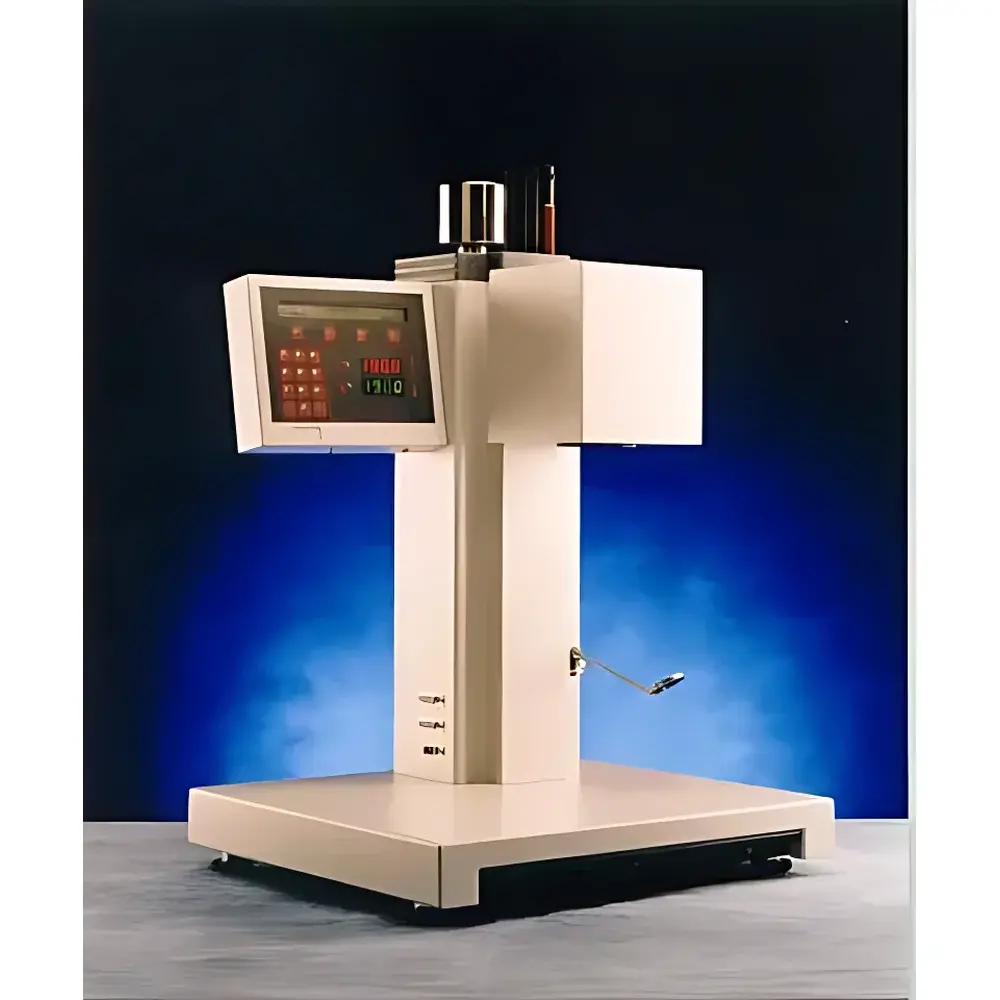
LLOYD MFI10 Automated Melt Flow Indexer
| Brand | LLOYD |
|---|---|
| Origin | United Kingdom |
| Model | MFI10 |
| Compliance Standards | BS 2782-7:1994 Method 720A, ISO 1133-1:2011, ASTM D1238 Methods A & B, ASTM D3364, DIN 53735, NF T51-016, UNE 53098, UNI 5640–74 |
| Temperature Control Accuracy | ±0.2 °C |
| Load Range | 0.325–21.6 kg (standard weights supplied per ISO/ASTM), |
| Sample Diameter | 9.55 ±0.025 mm |
| Die Dimensions | 2.095 ±0.005 mm diameter × 8.00 ±0.025 mm length |
| Data Reproducibility | CV ≤ 1.5% (per ISO 1133 repeatability requirement) |
| Software | Nexygen v5.x with GLP-compliant audit trail and 21 CFR Part 11 optional modules |
Overview
The LLOYD MFI10 Automated Melt Flow Indexer is a precision-engineered instrument designed for the quantitative determination of melt mass-flow rate (MFR) and melt volume-flow rate (MVR) of thermoplastic polymers under standardized thermal and mechanical conditions. Based on the fundamental principle of extrusion rheometry—where molten polymer is forced through a calibrated die under controlled temperature and defined dead-load compression—the MFI10 delivers repeatable, traceable, and standards-aligned results essential for quality control, material specification verification, and process development in rubber and plastic manufacturing. Unlike manual indexers requiring operator intervention for cut timing and weight measurement, the MFI10 integrates motorized piston actuation, automatic specimen cutting via programmable timer or real-time flow detection, and digital mass acquisition via high-resolution load cell, thereby eliminating human variability and enabling unattended operation across multi-sample test sequences.
Key Features
- Automated piston displacement and specimen cutting: Programmable cut intervals (0.1–999.9 s) or flow-triggered cuts based on real-time extrudate detection.
- High-stability temperature control system: PID-regulated heating block with dual-zone thermal profiling, achieving ±0.2 °C uniformity over the 100–400 °C operating range (typical setpoints: 190 °C for PE, 230 °C for PP, 300 °C for PC).
- Calibrated die assembly: Precision-ground stainless-steel die (2.095 ±0.005 mm ID × 8.00 ±0.025 mm L) and interchangeable barrel (9.55 ±0.025 mm ID), certified to ISO 1133 and ASTM D1238 dimensional tolerances.
- Integrated mass measurement: High-resolution (0.001 g) digital balance synchronized with cut events, supporting both gravimetric (MFR) and volumetric (MVR) calculation modes.
- Modular load application: Standard weight set compliant with ISO 1133 Annex A (e.g., 2.16 kg, 5.00 kg, 10.00 kg, 21.60 kg), with optional auxiliary loading mechanism for non-standard loads up to 25 kg.
- Rugged industrial housing: Stainless-steel enclosure with thermal shielding, CE-marked electrical safety, and IP20-rated protection for laboratory environments.
Sample Compatibility & Compliance
The MFI10 accommodates standard granular, pelletized, or powdered thermoplastics—including polyethylene (PE), polypropylene (PP), polycarbonate (PC), ABS, PS, and engineering resins—with nominal sample mass between 3.5–7.0 g. It supports both single-cut and multi-cut protocols per test cycle, enabling direct calculation of MFR (g/10 min) and MVR (cm³/10 min). The instrument is fully compliant with international regulatory and industry standards: ISO 1133-1:2011 (determination of MFR/MVR), ASTM D1238 Methods A (mass-flow) and B (volume-flow), BS 2782-7:1994, DIN 53735, and NF T51-016. Its design and validation documentation support GMP/GLP-aligned laboratories, and optional Nexygen software modules provide full 21 CFR Part 11 compliance—including electronic signatures, audit trails, and role-based access control—for regulated pharmaceutical packaging and medical device polymer qualification.
Software & Data Management
Nexygen v5.x software serves as the central interface for method configuration, real-time monitoring, automated reporting, and data archival. Users define test parameters—including temperature ramp profiles, load selection, cut strategy, and dwell time—via intuitive wizard-driven templates aligned with ISO/ASTM test methods. All raw data (temperature vs. time, load vs. time, cut timestamps, mass readings) are logged at ≥1 Hz resolution and stored in encrypted .nxg binary format with embedded metadata (operator ID, instrument serial, calibration certificate expiry). Export options include CSV, PDF test reports with graphical overlays, and XML for LIMS integration. Audit trail functionality records every user action (method edit, result override, calibration event) with timestamp and user context, satisfying internal QA requirements and external inspections per ISO/IEC 17025 Clause 7.7.
Applications
- Raw material acceptance testing against supplier specifications (e.g., PE HD5002, PP H110MA).
- In-process monitoring during extrusion and injection molding to detect batch-to-batch viscosity drift.
- Stabilizer and filler compatibility assessment—quantifying MFR shifts after UV exposure or thermal aging per ISO 188 or ASTM D3045.
- Recycled polymer stream characterization, where MFR serves as a proxy for molecular weight degradation.
- Regulatory dossier preparation for FDA 510(k) submissions involving polymer-based medical devices.
- Research into polymer degradation kinetics using accelerated oven aging followed by MFI trend analysis.
FAQ
What standards does the MFI10 support out-of-the-box?
The MFI10 is pre-configured for ISO 1133-1:2011, ASTM D1238 Methods A and B, BS 2782 Part 7, DIN 53735, and NF T51-016. Custom method templates can be created for other national standards via Nexygen.
Can the MFI10 measure MVR without a melt density input?
Yes—when configured for MVR mode, the instrument calculates volume flow directly from piston displacement rate using a calibrated linear encoder; melt density is only required for MFR→MVR conversion or vice versa.
Is calibration traceable to national standards?
Temperature calibration is performed using NIST-traceable PRTs; die and barrel dimensions are verified with metrology-grade optical comparators and certified reference gauges, with full calibration certificates provided.
How often does the die require cleaning or replacement?
Under routine use with clean virgin resins, the die should be inspected and ultrasonically cleaned after every 20–30 tests; replacement is recommended after 500 cumulative test cycles or upon dimensional deviation exceeding ±0.003 mm.
Does the system support remote diagnostics or firmware updates?
Yes—via secure Ethernet connection, authorized service engineers can initiate remote diagnostics, perform firmware upgrades, and verify calibration status without onsite visitation.






