
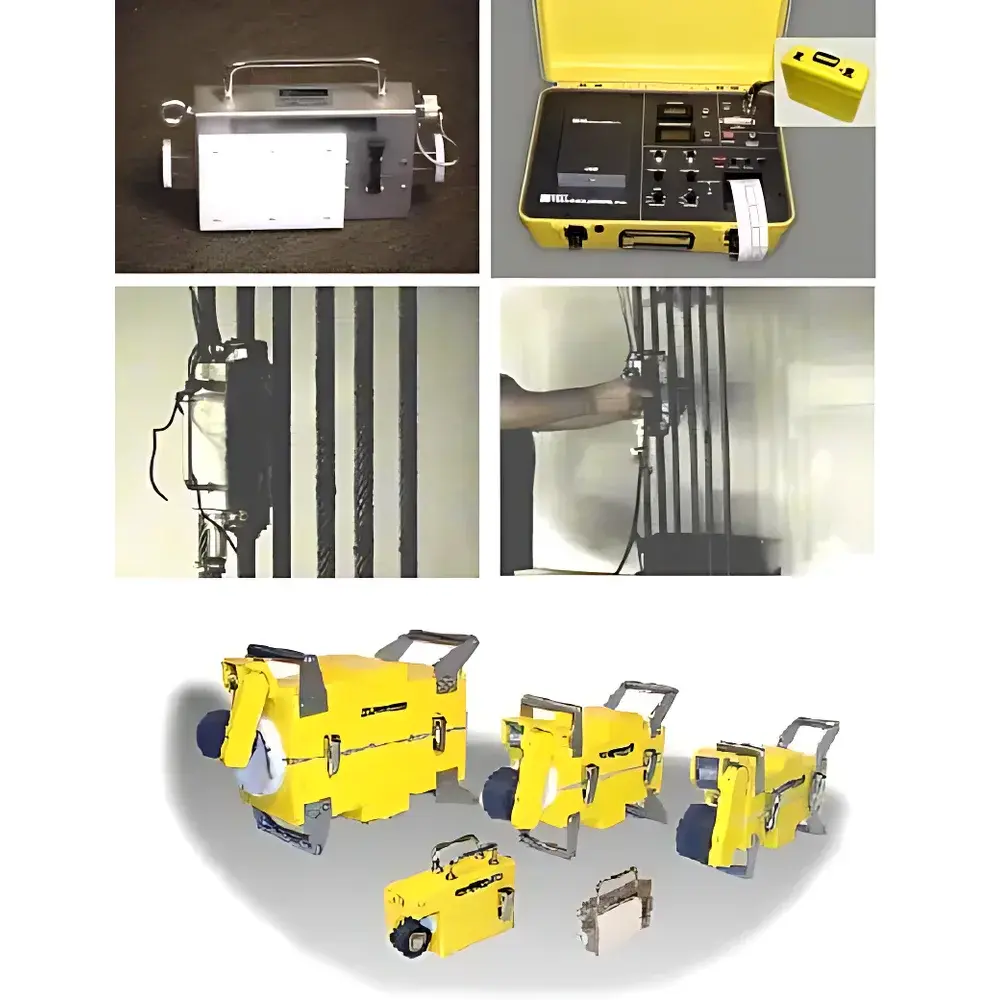
LMA-CC-7503 Portable Electromagnetic Wire Rope Non-Destructive Testing (NDT) System with Dual-Mode LF/LMA Analysis
| Origin | USA |
|---|---|
| Manufacturer Type | Authorized Distributor |
| Import Status | Imported |
| Model | LMA-CC-7503 |
| Pricing | Upon Request |
Overview
The LMA-CC-7503 is a portable, battery-powered electromagnetic non-destructive testing (NDT) system engineered for quantitative and qualitative assessment of steel wire ropes in safety-critical lifting, transport, and mooring applications. It operates on the principle of magnetic flux leakage (MFL) and induced current analysis to detect two distinct classes of degradation: Localized Flaws (LF), such as broken wires and pitting corrosion; and Loss of Metallic Area (LMA), representing cumulative cross-sectional loss due to uniform corrosion, wear, or fatigue-induced metal loss. Unlike conventional single-mode instruments, the LMA-CC-7503 delivers simultaneous, independent dual-channel signal acquisition—enabling real-time correlation between surface-localized anomalies and volumetric metal loss. Its architecture conforms to ASTM E1571–22 (Standard Practice for Electromagnetic Examination of Ferromagnetic Steel Wire Ropes) and supports traceable compliance with ISO 4309:2017 (Cranes — Wire ropes — Care and maintenance, inspection and discard) and EN 12927–3 (Lifts — Safety rules for the construction and installation of lifts — Part 3: Electric lifts). Designed for field deployment in mines, offshore platforms, ski lifts, elevators, and naval anchor systems, it provides metrologically robust data under variable environmental loads—including oil contamination, humidity up to 95% RH, and ambient temperatures from 0 °C to 55 °C.
Key Features
- Dual-mode electromagnetic sensing: Simultaneous detection and differentiation of LF (broken wires, localized pits) and LMA (cross-sectional area loss ≥0.1% resolution over ≥50 mm measurement length)
- Velocity-independent signal amplitude: Maintains consistent sensitivity across rope speeds from 0.003 to 3 m/s—critical for manual pull-through or motorized traverse operations
- Modular detector-controller architecture: Compatible with LMA-75 through LMA-400 detector variants (rope diameter range: 19 mm to 102 mm), all interfacing with the CC-03 controller
- Ruggedized field design: Detector housing sealed with polyurethane encapsulation (IP67-rated); controller housed in transparent, waterproof polycarbonate enclosure (405 × 330 × 178 mm; 9 kg)
- Integrated dual-channel thermal/digital recorder: Prints synchronized LMA and LF waveforms on proprietary chart paper with metric/imperial distance indexing
- Onboard distance counter: Digital display calibrated in meters or yards; optional wheel-based encoder for positional traceability
- Low-noise operation: Internal Ni-Cd battery pack (14 cells) eliminates AC line interference—essential in electrically noisy industrial zones (e.g., crane motor bays, drilling rigs)
- Compact detector profile: LMA-75 unit measures only 38 mm in thickness—optimized for confined elevator shaft access and tight-spool installations
Sample Compatibility & Compliance
The LMA-CC-7503 accommodates round-strand, rotation-resistant, and compacted wire ropes with diameters from 19 mm (LMA-75) up to 113 mm (LMA-CC-7503 full-system configuration). Detectors feature interchangeable UHMW-PE guide bushings (ID: 10 mm, 13 mm, 16 mm, 19 mm) and spring-loaded clamping fixtures for stable centering. Surface condition tolerance includes grease, paint, light rust, and thin polymer coatings—no pre-cleaning required per ASTM E1571 Section 7.3. All hardware meets IEC 61000-6-2 (immunity) and IEC 61000-6-3 (emissions) standards. Data output complies with FDA 21 CFR Part 11 requirements when paired with optional certified data acquisition software (DAS-LMA v3.x), supporting electronic signatures, audit trails, and secure export to CSV/PDF formats.
Software & Data Management
The CC-03 controller provides analog and digital outputs via D-Sub 37-pin connector (D37F), enabling integration with third-party DAQ systems or OEM control panels. Optional DAS-LMA software (Windows 10/11 compatible) offers waveform overlay, statistical trend analysis (LMA % loss vs. rope length), automated pass/fail thresholding per ISO 4309 Annex B, and report generation compliant with GLP/GMP documentation standards. Raw binary data files include timestamp, GPS metadata (when external module attached), and calibration checksums. Firmware updates are delivered via USB interface with version-locked cryptographic signing to ensure integrity during field servicing.
Applications
- Elevator and escalator traction rope inspection per ASME A17.1/CSA B44 requirements
- Mine hoist rope certification in accordance with MSHA 30 CFR Part 56.19000 series
- Offshore mooring line integrity verification for API RP 2SK and NORSOK standard compliance
- Naval vessel anchorage cable surveillance under MIL-STD-130 traceability protocols
- Ski lift haul rope lifecycle management aligned with CEN/TS 16228-2
- Bridge cable stay inspection where access constraints prohibit ultrasonic or radiographic methods
- Crane wire rope in-service monitoring per OSHA 1926.251(c)(1) and ANSI B30.5
FAQ
What is the minimum detectable LMA percentage, and how is calibration verified?
The system achieves 0.1% LMA resolution over a minimum 50 mm evaluation length. Calibration is performed using NIST-traceable reference ropes with certified artificial defects (notch grooves, machined area reductions) and validated annually per ISO/IEC 17025-accredited procedures.
Can the instrument operate while the rope is under tension?
Yes—electromagnetic coupling remains stable at working loads up to 80% of minimum breaking force (MBF), provided rope lay geometry is not distorted. Tension-induced elongation does not affect LMA quantification accuracy.
Is operator certification required for regulatory acceptance?
Personnel must hold Level 2 certification per ISO 9712 or ASNT SNT-TC-1A for wire rope NDT, with documented training on LMA-CC-7503 operational parameters, signal interpretation, and report generation.
How is data integrity maintained during extended field use?
All recordings include embedded CRC-32 checksums; battery-backed real-time clock ensures temporal validity; controller firmware enforces write-once logging to prevent post-acquisition modification.
Does the system support multi-rope parallel scanning?
No—the LMA-CC-7503 is configured for single-rope, axial-scan mode. Multi-rope assessment requires sequential inspection with repositioning and session-level metadata tagging.



