
Loligo Systems Fish and Aquatic Invertebrate Respirometry System
| Brand | Loligo Systems |
|---|---|
| Origin | Denmark |
| Model | Fish and Aquatic Invertebrate Respirometry System |
| Oxygen Measurement Principle | Intermittent-Flow Respirometry with Fluorescence-Based Optical DO Sensing |
| Channel Configurations | 1-, 4-, or 8-channel modular setups |
| Oxygen Sensor Range | 0–100% O₂ (0–45 ppm) |
| Detection Limit | 15 ppb |
| Temperature Compensation | Real-time Pt1000 (−50 to +180 °C, ±0.15 °C) |
| Salinity & Atmospheric Pressure Compensation | Yes |
| Data Output | Excel (.xlsx) and raw ASCII (.txt) |
| Software | AutoResp v5.x with SMR, Pcrit, and MO₂ rate calculation |
| Respiratory Chamber Materials | Acrylic or borosilicate glass |
| Chamber Diameter Options | 9–45 mm (small invertebrates) or 62–240 mm (teleosts, elasmobranchs, embryos) |
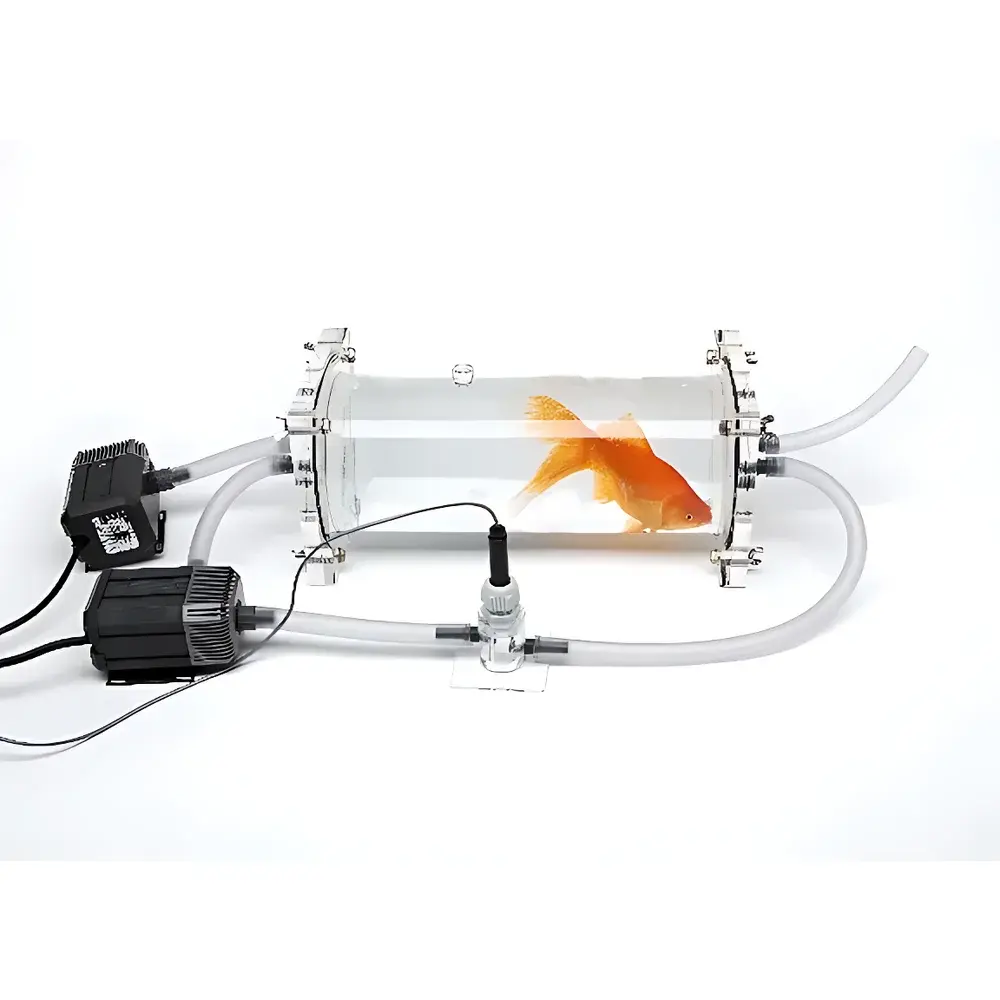
| Flow Control | Dual-submersible-pump architecture (circulation + exchange) |
| Communication | Bluetooth 4.0 LE for pump control and sensor signal acquisition |
| Environmental Modules | Optional temperature, dissolved oxygen, CO₂/pH regulation units |
Overview
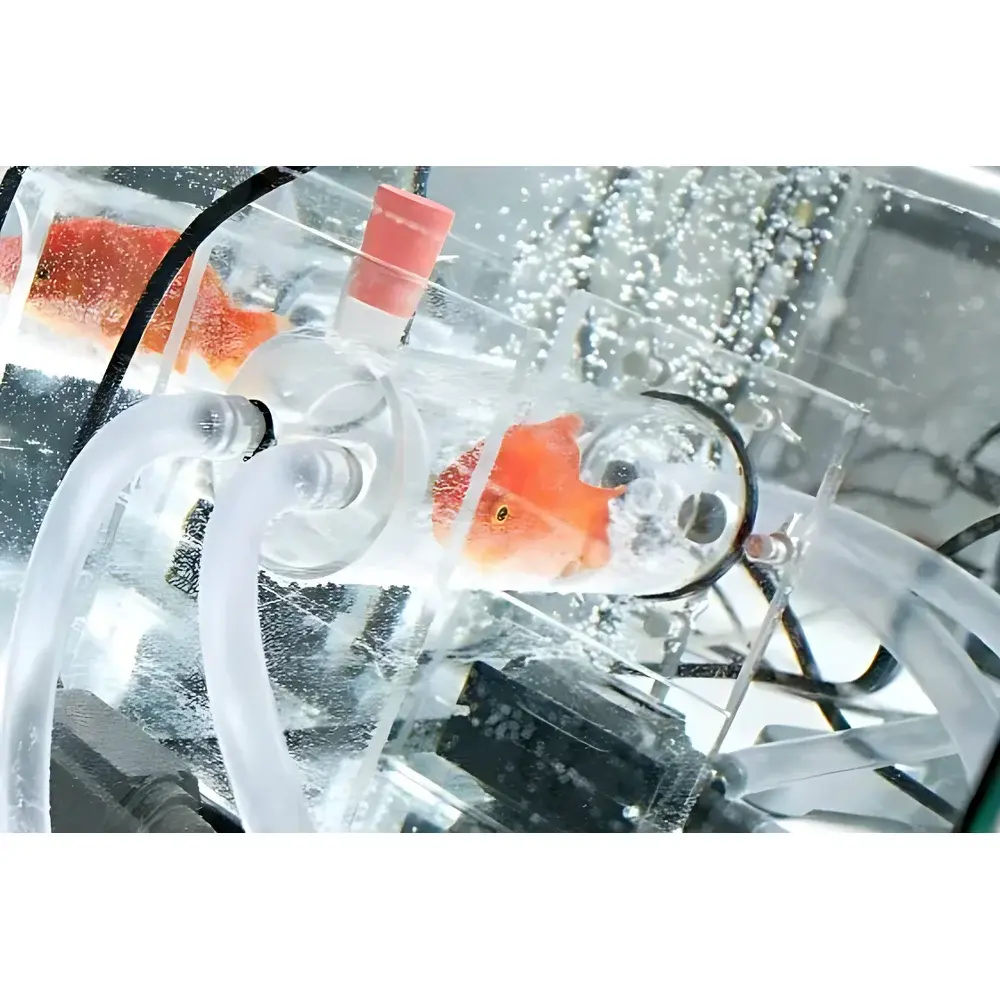
The Loligo Systems Fish and Aquatic Invertebrate Respirometry System is a rigorously validated, research-grade intermittent-flow respirometry platform engineered for high-fidelity measurement of oxygen consumption rates (MO₂) in aquatic organisms across ontogenetic and taxonomic scales. Developed in close collaboration with the University of Copenhagen and Aalborg University, the system implements a controlled, time-resolved intermittent-flow methodology—distinct from both continuous-flow (flow-through) and static-closed respirometry—to deliver simultaneous advantages of temporal resolution, metabolic stability, and experimental duration scalability. At its core, the system relies on fluorescence-quenching optical oxygen sensing via fiber-optic probes, eliminating electrode drift, zero oxygen consumption during measurement, and insensitivity to electromagnetic interference or redox-active compounds commonly present in biological media. Each respiratory cycle consists of three precisely timed phases: (1) closed-phase measurement (typically 3–8 min), during which dissolved oxygen declines linearly due to organismal respiration; (2) exchange phase (30–60 s), where ambient water is actively flushed into the chamber via an exchange pump; and (3) equilibration/wait phase (to restore baseline O₂ and minimize handling artifacts). This architecture enables sustained monitoring over hours to days while preserving second-scale detection of transient metabolic shifts—such as those induced by acute stress, feeding, hypoxia exposure, or locomotor activation.
Key Features
- Intermittent-flow respirometry architecture enabling long-duration experiments (>72 h) with sub-minute temporal resolution for dynamic MO₂ profiling.
- Fluorescence-based optical dissolved oxygen sensors with <15 ppb detection limit, real-time temperature/salinity/barometric compensation, and no oxygen consumption during sensing.
- Modular multi-channel configurations (1-, 4-, or 8-channel) supporting parallel measurements across individuals, life stages, or treatment groups—ideal for statistical replication and comparative physiology studies.
- Dual-pump fluid management system: a circulation pump maintains homogeneous water mixing and laminar flow across the sensor surface; an exchange pump enables rapid, programmable chamber flushing without manual intervention.
- Customizable respiratory chambers fabricated from optically transparent, chemically inert acrylic or borosilicate glass—available in diameters from 9 mm (for zebrafish larvae or daphnids) to 240 mm (for adult salmonids or cephalopods), with length and geometry tailored to species morphology and behavioral constraints.
- Bluetooth 4.0 LE communication protocol decouples hardware control from data acquisition, eliminating underwater cabling, reducing mechanical noise, and improving experimental hygiene and setup flexibility.
- Integrated swimming respirometry capability via motorized swim tunnels compatible with critical swimming speed (Ucrit) protocols and activity-metabolism coupling analysis.
Sample Compatibility & Compliance
The system accommodates a broad phylogenetic and ontogenetic range: teleost and elasmobranch fish (larvae to adults), crustaceans (e.g., crabs, shrimp), mollusks (bivalves, gastropods), echinoderms, cnidarians, zooplankton, fish eggs and embryos, and benthic macroinvertebrates. Chamber design supports both standard metabolic rate (SMR) assessment under post-absorptive, post-handling recovery conditions and active metabolic rate (AMR) quantification during controlled locomotion. All components comply with ISO 8692 (freshwater toxicity testing), ASTM D5210 (oxygen demand measurement), and EU Water Framework Directive monitoring guidelines. The AutoResp software supports audit-trail-enabled data logging aligned with GLP principles, including user authentication, timestamped parameter changes, and immutable raw-data archiving—facilitating regulatory submissions under EPA, EMA, and OECD test guidelines.
Software & Data Management
AutoResp v5.x provides fully automated experiment orchestration, real-time visualization, and standardized post-processing. It calculates instantaneous MO₂ (mg O₂·kg⁻¹·h⁻¹) directly from the slope of the linear O₂ decline phase, normalized to chamber volume and animal mass. Integrated algorithms compute biologically meaningful endpoints: standard metabolic rate (SMR), factorial aerobic scope, critical oxygen tension (Pcrit), and metabolic recovery kinetics. Users may adjust measurement/exchange intervals on-the-fly, apply moving-average smoothing, and export calibrated time-series data in native .xlsx format alongside timestamped .txt files for third-party statistical analysis (R, Python, PRISM). The software supports FDA 21 CFR Part 11-compliant electronic signatures when deployed on validated Windows environments, with optional password-protected configuration locking and change-history logs.
Applications
This system serves as a foundational tool in aquatic ecophysiology, environmental toxicology, aquaculture R&D, and climate change biology. Peer-reviewed applications include: quantifying metabolic costs of wastewater effluent exposure in bluegill sunfish (Environ. Sci. Technol. 2018); assessing intraspecific divergence in metabolic scope and aging phenotypes across aridity gradients in annual killifish (Evolution 2016); evaluating thermal performance curves and hypoxia tolerance in Atlantic cod under ocean warming scenarios; determining embryonic metabolic thresholds in response to microplastic exposure; and validating feed efficiency metrics in commercial salmonid production systems. Its precision and modularity make it equally suitable for undergraduate teaching labs and high-throughput screening in pharmaceutical or agrochemical development pipelines requiring aquatic vertebrate/invertebrate safety assessment.
FAQ
How does intermittent-flow respirometry improve upon traditional closed-chamber methods?
It eliminates cumulative CO₂ buildup and waste metabolite accumulation—key confounders in prolonged closed-system assays—while retaining high temporal resolution through repeated short-duration measurement windows.
Can the system measure metabolic rates in unstressed, freely swimming fish?
Yes—when configured with motorized swim tunnels and synchronized flow control, it supports Ucrit trials and activity-dependent AMR quantification under ecologically relevant hydrodynamic conditions.
Is calibration traceable to international standards?
Oxygen sensors are factory-calibrated against NIST-traceable gas mixtures and aqueous standards; field recalibration uses two-point (0% and 100% air-saturated) protocols with temperature-compensated saturation tables per ISO 5814.
What level of technical support is provided for method validation?
Loligo Systems supplies application notes, SOP templates, and remote assistance for assay optimization—including chamber volume verification, pump timing validation, and MO₂ calculation error propagation analysis.
Are there published methodological benchmarks for this system?
Yes—the system’s performance characteristics, including repeatability (CV 0.999 over 0–20 mg·L⁻¹), and inter-laboratory reproducibility, are documented in peer-reviewed validation studies cited in Comparative Biochemistry and Physiology Part A (2021) and Journal of Experimental Biology (2019).



