
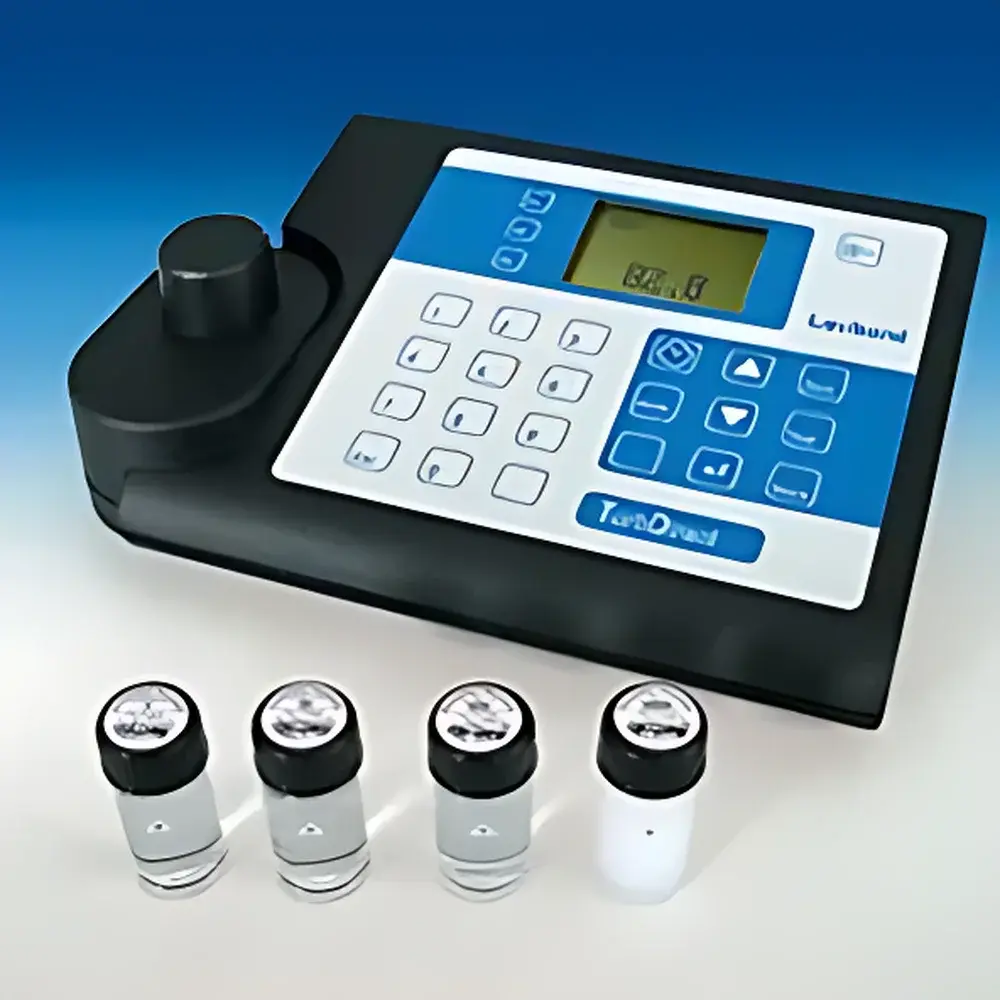
Lovibond ET760910 Advanced Portable Turbidimeter
| Brand | Lovibond (Tintometer) |
|---|---|
| Origin | United Kingdom |
| Model | ET760910 |
| Measurement Range | 0.01–1100 NTU (auto-ranging) |
| Accuracy | ±2% or ±0.01 NTU (0–0.05 NTU) |
| Resolution | 0.01 NTU (0.02–9.99 NTU), 0.1 NTU (10.0–99.9 NTU), 1 NTU (100–1100 NTU) |
| Principle | Nephelometric turbidity measurement at 90° detection angle |
| Light Source | Infrared LED (860 nm) |
| Calibration | Four-point calibration (1, 10, 100, 1000 NTU) with factory and user-defined standards |
| Compliance | ISO 7027 |
| Display | Graphical LCD with multilingual interface (English, German, French, Italian, Spanish) |
| Data Storage | 1000 measurements with timestamp, sample ID, and operator code |
| Interface | RS232 (9-pin D-sub), ASCII output |
| Power | Rechargeable NiCd battery pack (7×AA, 750 mAh) |
| Operating Environment | 5–40 °C, 30–90% RH (non-condensing) |
| Dimensions (main unit) | 265 × 195 × 70 mm |
| Weight (incl. batteries & calibration set) | ~1000 g |
| Certifications | CE marked |
| Warranty | 24 months limited warranty (excludes consumables, misuse, unauthorized modification, or field damage beyond normal operational conditions) |
Overview
The Lovibond ET760910 Advanced Portable Turbidimeter is a precision-engineered nephelometric instrument designed for reliable, repeatable turbidity quantification in both laboratory and field environments. Based on the internationally recognized ISO 7027 standard, it employs 90° scattered light detection using an 860 nm infrared LED source—minimizing interference from sample color, fluorescence, or absorbance. This optical architecture ensures high specificity to particulate scattering events, delivering traceable results across a broad dynamic range of 0.01 to 1100 NTU. Its microprocessor-controlled auto-ranging system dynamically selects optimal gain and integration time per measurement, eliminating manual scale selection while preserving resolution at low-turbidity levels (e.g., drinking water compliance testing) and robustness at high-turbidity applications (e.g., wastewater influent screening). The device is calibrated traceably to primary formazin standards and supports dual-mode calibration—factory pre-set points and user-defined reference suspensions—enabling metrological continuity in regulated settings.
Key Features
- ISO 7027-compliant 90° nephelometric detection with 860 nm infrared LED illumination for color-independent measurement
- Four-point calibration protocol (1, 10, 100, 1000 NTU) with configurable user standards for method-specific validation
- Auto-ranging measurement engine with three-tier resolution: 0.01 NTU (0.02–9.99), 0.1 NTU (10.0–99.9), and 1 NTU (100–1100)
- Graphical LCD display supporting five languages (English, German, French, Italian, Spanish) with intuitive icon-driven navigation
- Integrated data logging for up to 1000 measurements, each tagged with date/time stamp, sample ID, and operator code
- Ruggedized housing with IP65-rated sealed keypad—resistant to acids, solvents, and moisture; suitable for industrial hygiene or environmental fieldwork
- RS232 serial interface (9-pin D-sub) enabling direct connection to printers, LIMS, or PC-based data acquisition software (ASCII format)
- Low-power architecture: 7×AA NiCd rechargeable battery pack (750 mAh) provides >20 hours of continuous operation; CR2032 backup battery maintains real-time clock during power cycling
Sample Compatibility & Compliance
The ET760910 accepts standard 24 mm round glass cuvettes (supplied), ensuring compatibility with established turbidity reference materials and interlaboratory comparison protocols. Its optical path geometry and IR source suppress errors induced by chromophoric dissolved substances—a critical advantage when analyzing colored effluents, fruit juices, or pharmaceutical suspensions. The instrument meets CE marking requirements and conforms fully to ISO 7027:2016 for instrument performance, calibration traceability, and reporting structure. While not inherently 21 CFR Part 11 compliant out-of-the-box, its audit-ready data log (with immutable timestamps and operator identifiers) serves as foundational evidence for GLP/GMP-aligned quality systems. Optional firmware updates—delivered via secure internet download—maintain alignment with evolving regulatory interpretations and method revisions.
Software & Data Management
Data export occurs via RS232 in ASCII format, permitting seamless ingestion into spreadsheet applications, statistical process control (SPC) platforms, or validated laboratory information management systems (LIMS). Each stored record includes numeric turbidity value, measurement date/time (synchronized via internal RTC), unique sample registration number, and operator identifier—facilitating full chain-of-custody documentation. Firmware upgrades are performed using proprietary Lovibond desktop software, which verifies digital signatures prior to installation to ensure integrity and version control. No cloud dependency is required; all configuration, calibration history, and measurement logs reside locally within non-volatile memory, satisfying data sovereignty requirements in regulated jurisdictions.
Applications
- Drinking water quality assurance (compliance with WHO/EPA/WHO guidelines for <0.1 NTU at point-of-use)
- Wastewater treatment plant monitoring: raw influent, secondary clarifier effluent, and tertiary filtration validation
- Pharmaceutical manufacturing: clarity testing of parenteral solutions per USP and EP 2.2.1
- Food & beverage QC: juice stability assessment, beer haze analysis, dairy processing line verification
- Environmental field studies: surface water turbidity mapping, sediment transport modeling, and stormwater runoff characterization
- Educational laboratories: teaching core principles of light scattering, calibration hierarchy, and metrological uncertainty
FAQ
Does the ET760910 require annual recalibration by an accredited lab?
No—routine user-performed four-point calibration using supplied standards satisfies ISO 7027 verification requirements. However, periodic third-party verification (e.g., annually or per internal SOP) is recommended for GxP environments.
Can the device measure samples with high absorbance or intense color?
Yes—the 860 nm infrared source significantly reduces spectral interference from visible-range chromophores, making it suitable for tea, wine, or dyed industrial fluids where visible-light turbidimeters yield erroneously low values.
Is the RS232 interface compatible with modern Windows/macOS systems?
Yes—when used with a USB-to-serial adapter (FTDI or CP2102 chipset), the instrument integrates with standard terminal emulators or custom Python/Node.js scripts for automated batch reporting.
What is the expected service life of the infrared LED source?
The 860 nm LED is rated for >100,000 hours of operation under typical usage conditions, effectively eliminating source replacement as a maintenance concern over the instrument’s operational lifetime.
How is measurement uncertainty quantified for this model?
Total expanded uncertainty (k=2) is derived from manufacturer specifications: ±0.01 NTU floor error + ±2% relative error dominates below 0.05 NTU; above 500 NTU, ±3% relative error governs. Combined standard uncertainty accounts for repeatability (n=5, CV <0.8%), calibration standard uncertainty (±0.5% k=2), and temperature drift (<0.02 NTU/°C).



