
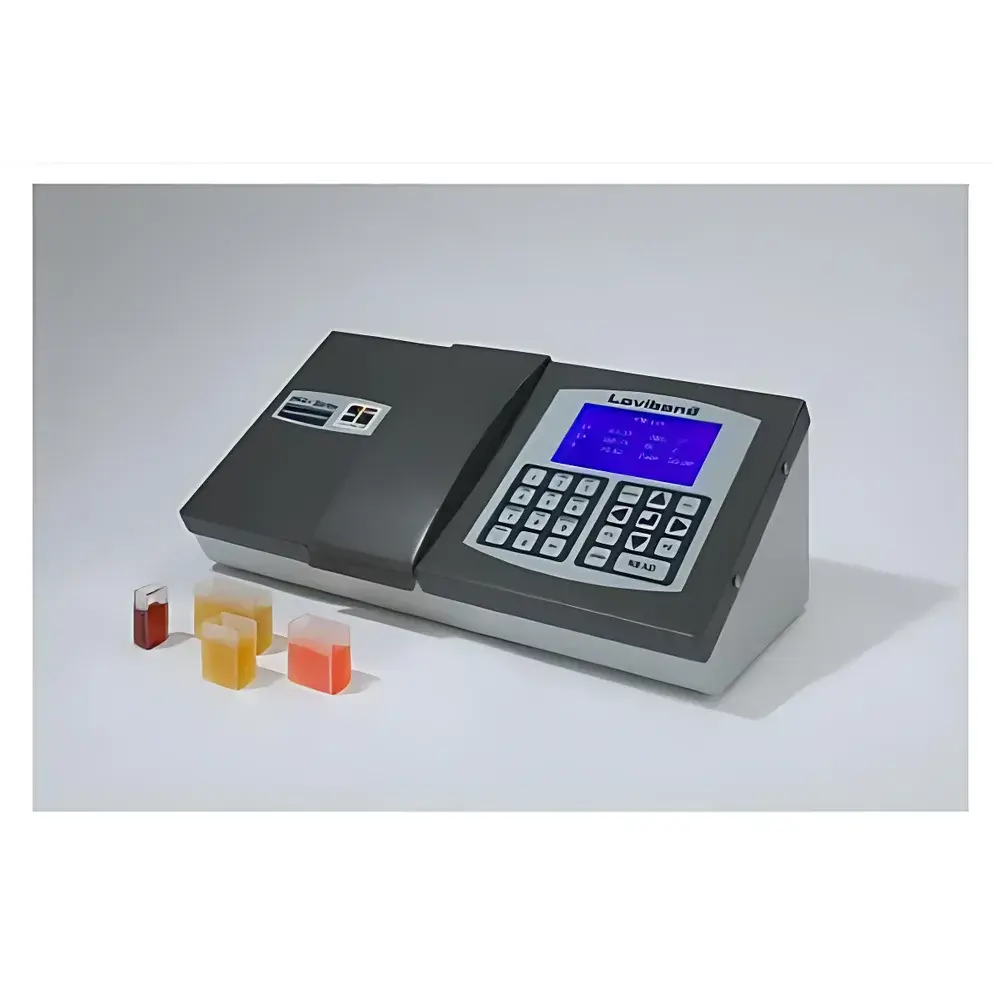
Lovibond PFXi195/9 Automated Colorimeter
| Brand | Lovibond (Tintometer Ltd.) |
|---|---|
| Origin | United Kingdom |
| Model | PFXi195/9 |
| Measurement Principle | Tristimulus Filter-Based Photometry |
| Light Source | Tungsten Halogen Lamp |
| Standard Cuvette | 10 mm Pathlength Glass Cell |
| Supported Color Scales | Lovibond®, Hunter Lab, CIELAB (L*C*h°), CIE XYZ, CIE Yellowness Index (YI), CIE Whiteness Index (WI), Spectral Data Output (31-point, 400–700 nm) |
| Interface | RS-232 & USB |
| Software Included | RCMSi Calibration & Data Management Suite for Windows |
| Compliance | ISO 4630 (Petroleum Products), ISO 27677 (Beer), AOAC Official Methods, ASTM D1209/D5386/D6290 |
| Calibration | Factory-Calibrated with NIST-Traceable Standards |
| Dimensions | 280 × 220 × 180 mm |
| Weight | 4.2 kg |
Overview
The Lovibond® PFXi195/9 Automated Colorimeter is a benchtop tristimulus color measurement instrument engineered for precision, repeatability, and regulatory compliance in quality control laboratories across food & beverage, petrochemical, pharmaceutical, and chemical manufacturing sectors. Based on filter-based photometric detection using a stabilized tungsten-halogen light source and precision interference filters aligned to the CIE 1931 standard observer function, the PFXi195/9 delivers objective, operator-independent color quantification without reliance on human visual assessment. Unlike subjective visual comparison methods or low-resolution RGB sensors, this instrument captures spectral reflectance/transmittance data at 31 discrete wavelengths from 400 nm to 700 nm—enabling full spectral reconstruction, derivative index calculation (e.g., Yellowness Index per ASTM D1209, Whiteness Index per CIE 116), and cross-scale correlation (Lovibond®, Hunter Lab, CIELAB L*C*h°, CIE XYZ). Its optical architecture is optimized for transparent liquid samples, including oils, solvents, syrups, beverages, and clarified process streams, with minimal pathlength dependency due to fixed 10 mm cuvette geometry and integrated stray-light suppression.
Key Features
- Automated measurement cycle with single-button operation—no user interpretation or manual scale alignment required
- Preloaded color scales compliant with international standards: ISO 4630 (ASTM D1500 for petroleum), ISO 27677 (beer color), AOAC 920.124 (sugar solutions), ASTM D5386 (liquid color by spectrophotometry)
- RCMSi (Routine Calibration Management System) software enables automated calibration verification, drift monitoring, and audit-ready calibration logs traceable to NIST-certified reference standards
- Integrated tungsten-halogen lamp with factory-replacement module—stable output over >2,000 hours; lamp status monitored in real time
- RS-232 and USB interfaces support direct integration into LIMS environments and automated report generation
- Self-diagnostic startup sequence verifies optical path integrity, detector linearity, and filter wheel positioning prior to each measurement
Sample Compatibility & Compliance
The PFXi195/9 is validated for use with clear, low-turbidity liquids requiring standardized transmission color evaluation. Compatible sample types include mineral oils, edible fats, vegetable oils, ethanol solutions, pharmaceutical solvents, fruit juices (clarified), and polymer melts (when filtered and cooled). It conforms to Good Laboratory Practice (GLP) requirements through built-in electronic audit trail functionality within RCMSi software—including timestamped operator ID, calibration event history, and raw spectral data archiving. Instrument design meets IEC 61010-1 safety standards for laboratory electrical equipment, and firmware supports 21 CFR Part 11-compliant user access controls when deployed in FDA-regulated environments. All factory calibrations are traceable to National Institute of Standards and Technology (NIST) reference materials, with documentation provided per ISO/IEC 17025 guidelines.
Software & Data Management
RCMSi software (included on Windows-compatible installation disc) provides full instrument control, method configuration, statistical analysis (mean, SD, CV%, trend charts), and export to CSV, PDF, or XML formats. The software enforces role-based access (administrator, analyst, reviewer) and maintains immutable records of all measurement sessions, calibration actions, and system diagnostics. Raw 31-point spectral datasets can be exported for third-party multivariate analysis (e.g., PCA, PLS regression) or integration into enterprise QA databases. Optional network licensing allows centralized deployment across multiple instruments in shared lab environments, with synchronized firmware updates and method library distribution.
Applications
- Quality assurance of edible oils (e.g., Refined Soybean Oil per ISO 12228-1, Palm Oil per ISO 17932)
- Petroleum product grading (kerosene, diesel, lubricants) per ASTM D1500 and ISO 4630
- Beer and malt beverage color verification per EBC or SRM scales (ISO 27677)
- Pharmaceutical excipient clarity testing (e.g., USP Color of Solutions)
- Chemical intermediate purity assessment via color deviation thresholds
- Process consistency monitoring in continuous production lines using automated trigger-based sampling
FAQ
What color scales are pre-installed on the PFXi195/9?
Lovibond®, Hunter Lab, CIELAB (L*C*h°), CIE XYZ, CIE Yellowness Index (YI), CIE Whiteness Index (WI), and spectral transmittance (31-point, 400–700 nm).
Is the instrument suitable for opaque or turbid samples?
No—it is designed exclusively for transparent, low-absorbance liquid samples. Turbid or particulate-laden samples require filtration or alternative instrumentation such as a spectrophotometer with integrating sphere.
How is calibration traceability documented?
Each unit ships with a Certificate of Conformance listing NIST-traceable calibration points; RCMSi software generates printable calibration reports with date, operator ID, standard ID, and deviation values.
Can measurement data be exported to LIMS?
Yes—via RS-232 or USB, using configurable ASCII or XML output protocols compatible with major LIMS platforms including Thermo Fisher SampleManager, LabVantage, and STARLIMS.
What is the expected lifetime of the tungsten-halogen lamp?
Rated for ≥2,000 hours of continuous operation; lamp replacement is tool-free and guided by on-screen prompts in RCMSi.




