
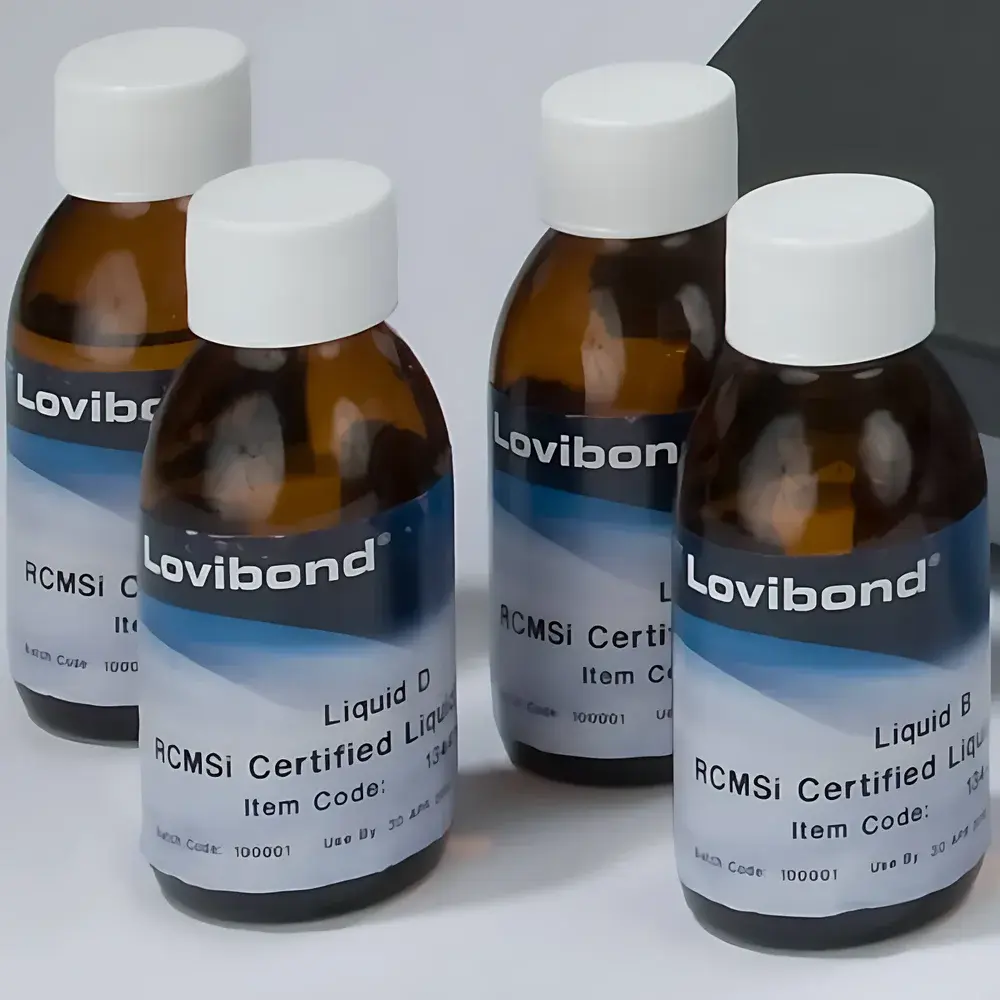
Lovibond® RYBN & AOCS/ASTM/Gardner/Pt-Co Color Calibration Standards
| Brand | Lovibond® (Tintometer Ltd.) |
|---|---|
| Origin | United Kingdom |
| Product Type | Certified Liquid Color Reference Standards |
| Compliance | AOCS, ASTM D1209/D5386/D6166, ISO 6271, EBC 1.3, Gardner ASTM D1544, Pt-Co (APHA/Hazen) ASTM D1209, Saybolt ASTM D156 |
| Format | 5¼" (133 mm) cylindrical glass cells |
| Shelf Life | 12 months from date of manufacture |
| Traceability | NIST-traceable spectrophotometric validation |
| Packaging | Individually labeled, amber glass vials with tamper-evident seals |
| Uncertainty | ±0.1 color unit (RYBN), ±1 APHA unit (Pt-Co), ±0.2 Gardner unit |
Overview
Lovibond® RYBN & AOCS/ASTM/Gardner/Pt-Co Color Calibration Standards are a comprehensive suite of certified liquid reference materials engineered for traceable, repeatable calibration and verification of benchtop and portable colorimeters, spectrophotometers, and visual color comparison instruments. These standards operate on the principle of absorption-based colorimetry: each solution exhibits a precisely defined spectral transmittance profile across the visible range (380–780 nm), enabling instrument validation against internationally recognized color scales. Designed and manufactured under ISO/IEC 17025-accredited conditions at Tintometer Ltd.’s UK facility, these standards serve as primary or secondary references in quality control laboratories across edible oil refining, pharmaceutical excipient testing, polymer resin production, wastewater analysis, and chemical manufacturing—where regulatory compliance (e.g., FDA 21 CFR Part 11, EU GMP Annex 11) mandates documented instrument performance verification.
Key Features
- Multi-scale certification: Each standard is quantitatively validated against AOCS-Tintometer®, ASTM (D1209, D5386, D6166), EBC 1.3, Gardner (ASTM D1544), Pt-Co/APHA/Hazen (ASTM D1209), and Saybolt (ASTM D156) color scales—enabling cross-method correlation and method transfer studies.
- Rigorous stability assurance: All liquids undergo accelerated aging and real-time shelf-life monitoring; color stability is guaranteed for 12 months when stored unopened at 15–25°C, protected from direct light and thermal cycling.
- Traceable metrology: Every batch includes a Certificate of Analysis (CoA) listing actual measured values (e.g., Lovibond® RYBN: 2.1R, 11.0Y, 0.5N ±0.1; Pt-Co: 50 APHA ±1), uncertainty budgets, measurement wavelength (typically 455 nm for Pt-Co, 430 nm for Gardner), and NIST-traceable calibration path.
- Consistent cell geometry: Supplied in standardized 5¼” (133 mm) pathlength cylindrical glass cells—ensuring optical alignment compatibility with Lovibond® Model F, PFXi series, HunterLab, X-Rite, and other major-brand colorimeters requiring fixed-path cuvettes.
- Controlled formulation integrity: Solutions use high-purity, UV-stabilized dyes dissolved in optically matched solvents (e.g., deionized water for Pt-Co; isopropanol/water blends for RYBN); no particulates, phase separation, or microbial growth observed over shelf life.
Sample Compatibility & Compliance
These standards are validated for use with transmission-mode color measurement systems operating in absorbance or transmittance mode. They comply with the physical and metrological requirements of multiple international test methods: ASTM D1209 (Pt-Co), ASTM D5386 (liquid color by tristimulus colorimetry), ASTM D6166 (vegetable oil color), AOCS Cd 13d-97 (Tintometer® scale), EBC 1.3 (beer color), and ISO 6271 (plastics). Each standard is assigned a unique batch number linked to full analytical records archived for ≥10 years—supporting GLP and GMP audit readiness. The CoA reports measurement uncertainty per ISO/IEC Guide 98-3 (GUM), and all production adheres to ISO 9001:2015 and ISO/IEC 17025:2017 requirements.
Software & Data Management
While the standards themselves are physical reference materials, their integration into digital QA workflows is supported via Tintometer’s ColorSoft Pro and Lovibond® Connect platforms. These software tools enable automated calibration logging, trend analysis of instrument drift (e.g., baseline shift >0.3 APHA units), and electronic generation of 21 CFR Part 11-compliant audit trails—including user authentication, timestamped calibration events, and electronic signatures. Raw spectral data (380–780 nm at 1 nm intervals) is exportable in CSV or XML format for third-party statistical process control (SPC) systems.
Applications
- Verification of colorimeter accuracy prior to ASTM D1209 Pt-Co analysis of purified water, pharmaceutical solvents, or glycerin.
- Calibration of AOCS-approved instruments used in soybean oil bleaching process control (AOCS Cd 13d-97).
- Benchmarking of Gardner scale measurements for alkyd resins and varnishes per ASTM D1544.
- Validation of Lovibond® RYBN readings during edible oil deodorization optimization.
- Supporting ISO 8519-1:2021 conformance for color measurement system verification in accredited labs.
FAQ
Are these standards suitable for calibrating spectrophotometers with variable pathlengths?
Yes—when used with the supplied 133 mm cell, they provide fixed-path validation. For variable-path instruments, correction factors based on Beer-Lambert law can be applied using the certified absorbance value at 455 nm.
Do you provide replacement certificates if the original CoA is lost?
Yes—certificates are digitally archived; replacements with identical metrological content can be issued upon batch number verification.
Can these standards be reused after opening?
No—once opened, exposure to ambient light, oxygen, and temperature fluctuations may induce measurable color drift beyond stated uncertainty; they are intended for single-use verification.
How frequently should instrument calibration be performed using these standards?
Per ISO/IEC 17025 and internal QA protocols: before each analytical session, after maintenance, and at defined time intervals (e.g., every 4 hours for high-throughput QC labs).
Is there a difference between “Lovibond® RYBN” and “AOCS-Tintometer®” color designations?
No—Lovibond® RYBN is the proprietary nomenclature; AOCS-Tintometer® refers to the same scale adopted by the American Oil Chemists’ Society as an official method (AOCS Cd 13d-97).





