
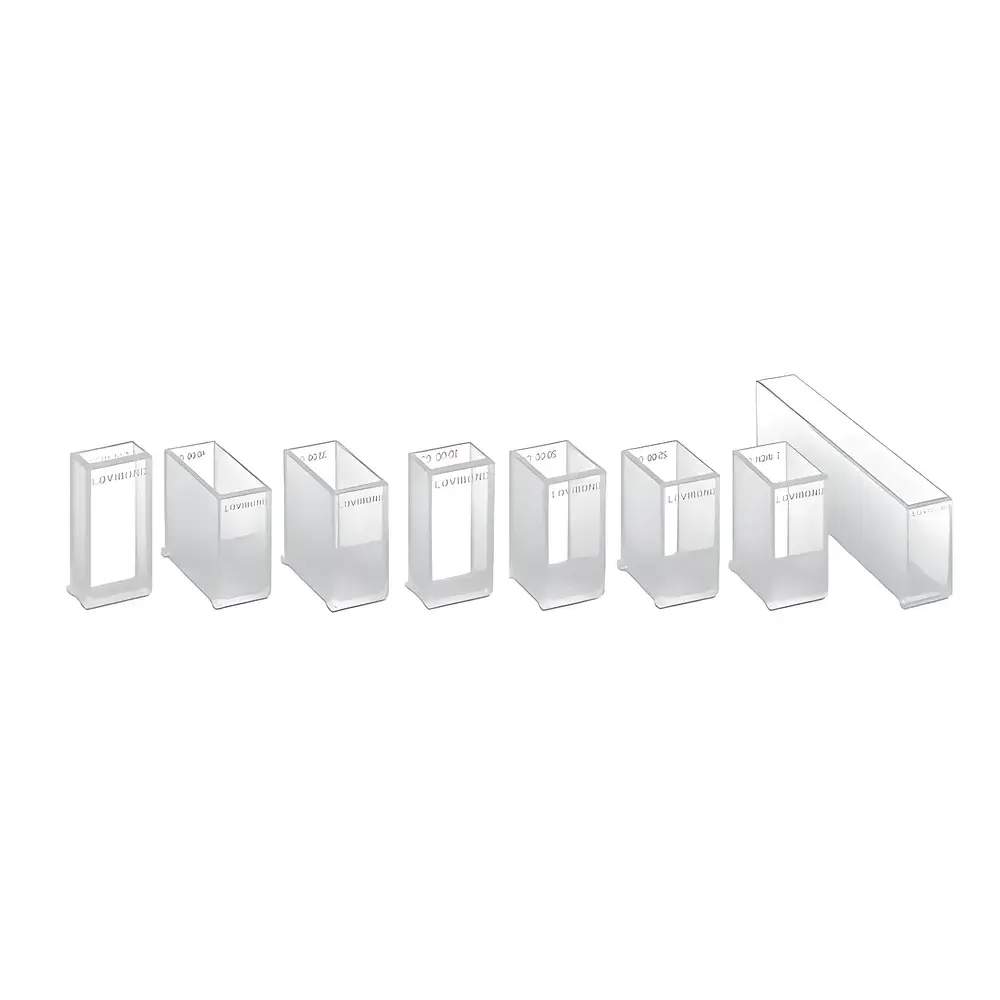
Lovibond W600/W680 Optical Glass and Borosilicate Cuvettes
| Brand | Lovibond (Tintometer) |
|---|---|
| Origin | United Kingdom |
| Material | Optical Glass (W600, W680) or Borosilicate Glass (W600-B) |
| Dimensions | 21 mm × 40 mm (W600 series) |
| Max. Operating Temperature | 40 °C (optical glass), 100 °C (borosilicate) |
| Compatible Instruments | Lovibond PFXi/PFX-195, 880, 950, 995, Model F, Comparator 2000+, Comparator 3000 |
| Pathlength Options | 2.5 mm to 6" (6.35 mm to 152.4 mm), including fractional inch and metric increments |
| Light Path Tolerance | ±0.05 mm per ISO 3664:2009 reference compliance |
Overview
Lovibond® W600 and W680 cuvettes are precision-engineered optical cells designed for consistent, traceable color measurement in accordance with standardized visual and instrumental colorimetric methods. Manufactured in the United Kingdom by Tintometer Ltd — the original developer of the Lovibond Color Scale — these cuvettes serve as critical metrological interfaces between sample and instrument. The W600 series is available in two material variants: high-transmittance optical glass (W600/OG) for ambient-to-moderate temperature applications (≤40 °C), and heat-resistant borosilicate glass (W600/B) rated for sustained exposure up to 100 °C. The W680 series employs optical glass optimized for longer pathlengths and use with Lovibond Comparator systems (2000+ and 3000), where dimensional stability and spectral neutrality across the visible range (380–780 nm) are essential. All cuvettes adhere to strict dimensional tolerances aligned with ISO 3664:2009 for viewing conditions and ASTM D1209/D5386 for platinum-cobalt and APHA/Hazen color scales.
Key Features
- Precision-molded optical glass (W600/OG, W680/OG) and borosilicate glass (W600/B) with ≤0.1% absorbance deviation across 400–700 nm
- Controlled pathlength options from 2.5 mm to 6 inches (6.35–152.4 mm), calibrated to ±0.05 mm per unit
- Standardized external dimensions: W600 (21 mm × 40 mm cross-section), W680 (17 mm × 75 mm) — ensuring mechanical compatibility with Lovibond spectrophotometric and comparator instrument holders
- Chemically inert surface finish compliant with ISO 8549-2 for optical cell cleaning protocols; resistant to dilute acids, alkalis, and organic solvents under standard handling
- Batch-certified dimensional and optical homogeneity documentation supplied with each order for GLP/GMP traceability
- Non-reflective ground edges and precision-polished optical faces minimize stray light and Fresnel reflection artifacts
Sample Compatibility & Compliance
These cuvettes support liquid, transparent, and low-turbidity samples used in water quality (e.g., chlorine, iron, manganese), petrochemical (ASTM D1500), food & beverage (AOAC 971.21), and pharmaceutical (USP ) testing. The W600/B variant enables direct thermal equilibration of viscous or temperature-sensitive samples (e.g., molten polymers, hot syrups) within PFXi-series instruments equipped with optional heating modules. All units comply with ISO/IEC 17025 calibration chain requirements when used with Lovibond-certified reference standards. Instrument-specific constraints apply: PFXi/PFX-195 accommodates maximum 50 mm pathlength; Comparator 3000 accepts only W680-format cuvettes due to fixed-stage geometry.
Software & Data Management
While cuvettes themselves are passive optical components, their specifications are embedded in Lovibond’s proprietary software platforms (e.g., PFX iQ Suite v5.2+, Color iQ Cloud). Pathlength selection automatically adjusts concentration algorithms for APHA, Pt-Co, Gardner, Saybolt, and ASTM D1500 calculations. Audit trails record cuvette ID (via engraved batch code), pathlength, material type, and calibration date — satisfying FDA 21 CFR Part 11 requirements for electronic records when paired with validated instrument firmware. Raw transmittance data exported via CSV retains cuvette metadata for third-party statistical process control (SPC) integration.
Applications
- Quantitative color assessment of potable water, wastewater, and industrial effluents per ISO 7887 and EPA Method 180.1
- Quality control of edible oils, syrups, resins, and solvents using Lovibond® Color Scales (Red, Yellow, Blue, etc.)
- Stability monitoring of photochemical reactions via time-resolved absorbance at fixed wavelengths (420 nm, 470 nm, 520 nm)
- Validation of spectrophotometer baseline drift through repeated air/reference measurements with matched-path cuvettes
- Calibration verification of comparator-based field kits in environmental and agricultural laboratories
FAQ
Are W600 and W680 cuvettes interchangeable across Lovibond instrument platforms?
No. W600 cuvettes (21 mm × 40 mm) are mechanically and optically specified for PFX-series automated colorimeters and Model F. W680 cuvettes (17 mm × 75 mm) are dimensionally unique to Comparator 2000+ and 3000 visual comparators. Substitution compromises alignment, light path consistency, and result reproducibility.
Can I autoclave W600/B borosilicate cuvettes?
No. While rated for continuous immersion at 100 °C, autoclaving subjects them to rapid thermal cycling and steam pressure exceeding design limits. Sterilization must be performed via dry-heat oven (120 °C, 2 h) or chemical immersion (70% ethanol, 15 min), followed by Class 100 laminar flow drying.
Do these cuvettes require annual recalibration?
Cuvettes are reference-grade passive optics and do not drift over time if handled per ISO 8549-2. However, periodic verification against a NIST-traceable reference cuvette (e.g., Lovibond P/N 600-REF-10) is recommended every 6 months in regulated environments.
Is pathlength selection governed by sample absorbance or regulatory method?
Both. Regulatory standards (e.g., ASTM D1209) specify required pathlengths for defined concentration ranges. Instrument software enforces pathlength-appropriate absorbance thresholds (0.1–1.0 AU) to maintain Beer-Lambert linearity and minimize photometric noise.
What cleaning protocol preserves optical integrity?
Rinse immediately after use with Type I deionized water (≥18.2 MΩ·cm), followed by acetone rinse and nitrogen purge. Avoid abrasive wipes, ultrasonic baths, or alkaline detergents. Store vertically in dust-free cuvette trays with desiccant.



