
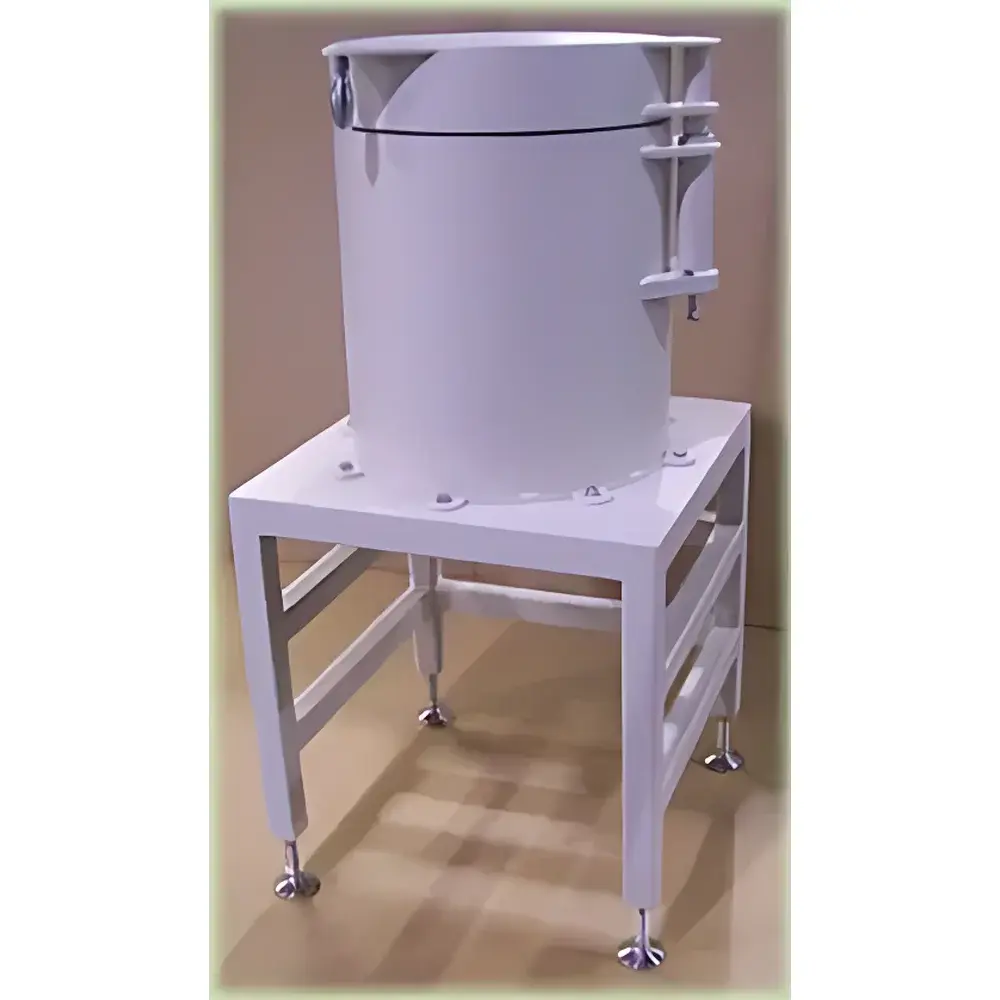
Low-Background Lead Shielding Chamber LX710 / LX715 Series
| Origin | Jiangsu, China |
|---|---|
| Manufacturer Type | Authorized Distributor |
| Origin Category | Domestic (China) |
| Model | LX710 / LX715 |
| Pricing | Available Upon Request |
| Instrument Type | Radiation Dose Rate Meter / Low-Background Counting Chamber |
| Outer Layer | 1 cm Low-Carbon Steel |
| Middle Layer | 10 cm Low-Background Lead (4π shielding) |
| Inner Layer | 3 mm Oxygen-Free Copper |
| Door Mechanism | Top-Mounted Horizontal Sliding Lever System |
| Internal Cavity Dimensions | Φ307 mm × 404 mm |
| Footprint | 65 cm × 65 cm (< 0.43 m²) |
| Table Load Capacity | Standard Steel Counting Table with ±15 cm Adjustable Feet |
| Net Weight | 1,100 kg |
| Background Performance (LX710) | ≤2.0 cps (50 keV–2 MeV, measured with 40% relative efficiency HPGe detector) |
| Background Performance (LX715) | ≤1.2 cps (50 keV–2 MeV, measured with 40% relative efficiency HPGe detector) |
| Lead Options | Electrolytically refined virgin lead (Pb-210 < 0.5 Bq/kg) or aged low-background lead (≥2 half-lives of Pb-210, i.e., ≥44 years storage) |
Overview
The LX710 and LX715 Low-Background Lead Shielding Chambers are engineered for ultra-low-background gamma-ray spectrometry in nuclear physics, environmental radioactivity monitoring, and radiological materials characterization. These chambers operate on the principle of passive radiation attenuation through high-density, low-activity shielding mass—specifically optimized multi-layer geometry combining low-carbon steel, ultra-pure lead, and oxygen-free copper. The 4π geometry ensures isotropic attenuation of ambient gamma photons across all solid angles, while the graded-Z shielding design (steel → lead → copper) effectively suppresses both high-energy gamma rays and secondary X-rays generated via lead fluorescence. Each chamber is cast as a monolithic unit using vacuum-assisted continuous pouring to eliminate internal voids, microcracks, or density gradients—critical for eliminating localized shielding weaknesses that compromise background performance. Designed for integration with high-resolution gamma detectors—including ORTEC and CANBERRA high-purity germanium (HPGe) systems, as well as NaI(Tl), LaBr3(Ce), and other scintillation-based spectrometers—the LX7 series meets stringent requirements for low-background counting environments where detection sensitivity is governed by intrinsic chamber background rather than detector resolution.
Key Features
- Monolithic low-background lead casting process ensures uniform density (>11.3 g/cm³) and eliminates interlayer seams or porosity—critical for consistent attenuation performance across full energy range (50 keV to 3 MeV).
- Graded shielding architecture: 1 cm low-carbon steel (mechanical support + neutron moderation), 10 cm low-background lead (primary gamma attenuation), and 3 mm oxygen-free copper (X-ray absorption from lead K-shell fluorescence).
- Top-mounted horizontal sliding door with precision lever actuation enables rapid, repeatable access without vertical lift mechanisms—minimizing mechanical vibration and contamination risk during sample insertion.
- Compact footprint (65 cm × 65 cm) accommodates standard laboratory benchtop space while maintaining sufficient internal volume (Φ307 mm × 404 mm) for detector mounting and sample positioning.
- Adjustable steel counting table with ±15 cm leveling feet ensures detector alignment stability under varying floor conditions; table surface is electropolished for ease of decontamination.
- Dual lead sourcing options: electrolytically refined virgin lead (Pb-210 activity < 0.5 Bq/kg) and naturally aged lead (≥44 years storage, allowing Pb-210 decay to equilibrium with unsupported Ra-226).
Sample Compatibility & Compliance
The LX710 and LX715 chambers are compatible with standard 3-inch and 4-inch diameter HPGe cryostats (e.g., ORTEC GEM series, CANBERRA BE series), as well as 2″ × 2″ and 3″ × 3″ NaI(Tl) and LaBr3(Ce) detectors. Detector integration is facilitated by interchangeable lead collars and custom-machined lead plugs designed to match flange dimensions and cold finger clearances. All chambers comply with ISO 8529-1:2021 (Reference neutron and photon fields—Part 1: Characteristics and methods of production) for background field characterization, and support GLP-compliant documentation per IEC 61000-4-3 (EMC immunity) and ASTM E1452-22 (Standard Guide for Preparation of Low-Background Alpha and Beta Counting Chambers). Background certification reports include spectral data collected over ≥72 h using traceable NIST SRM 4355B (KCl) and IAEA RGU-1 reference materials.
Software & Data Management
While the LX7 chamber itself is a passive shielding device, it is fully compatible with industry-standard gamma spectroscopy software platforms—including ORTEC GammaVision®, Canberra Genie™ 2000, and Mirion’s InterWinner—enabling automated background subtraction, peak fitting, and activity calculation per ISO 11929:2019 (Determination of characteristic limits and confidence intervals). When used in regulated environments (e.g., EPA Method 901.1, ASTM D3648), the chamber supports audit-ready data workflows compliant with FDA 21 CFR Part 11 requirements when paired with validated acquisition software featuring electronic signatures, audit trails, and secure user authentication.
Applications
- Environmental monitoring of soil, water, and air particulate filters for natural radionuclides (K-40, U-238 series, Th-232 series) and anthropogenic isotopes (Cs-137, Co-60, Am-241).
- Radiochemical purity assessment of radiopharmaceuticals (e.g., Tc-99m, Lu-177, Ga-68) per USP and EP 2.2.82.
- Fundamental nuclear physics experiments requiring sub-1.5 cps background in the 50–2000 keV region, including double-beta decay searches and dark matter candidate screening.
- Calibration and validation of portable radiation survey instruments against primary standards in accredited laboratories (ISO/IEC 17025).
- Decommissioning and waste characterization in nuclear facilities per IAEA RS-G-1.7 guidelines.
FAQ
What is the difference between LX710 and LX715 in terms of background performance?
The LX715 achieves ≤1.2 cps (50 keV–2 MeV) due to its 10 cm outer layer of virgin low-background lead combined with an inner 5 cm layer of ≥44-year-old aged lead, whereas the LX710 delivers ≤2.0 cps using a symmetric 5 cm + 5 cm configuration.
Can the chamber be customized for non-standard detector geometries?
Yes—custom lead collars, internal copper liners, and aperture inserts are available upon request, subject to mechanical feasibility review and lead casting lead time.
Is the chamber suitable for alpha spectrometry applications?
While primarily optimized for gamma spectrometry, the LX7 series can be adapted for low-energy alpha measurements when coupled with a PIPS detector and nitrogen-purged internal atmosphere—additional copper lining and radon suppression protocols are recommended.
How is background certification performed and documented?
Each unit undergoes ≥72-hour background spectrum acquisition using a calibrated 40% HPGe detector; raw spectra, efficiency curves, and uncertainty budgets are provided in PDF and ASCII format per ISO/IEC 17025 Annex A.3.
Does the chamber require periodic recertification or maintenance?
No active maintenance is required; however, annual background verification is recommended for GLP/GMP environments, and surface wipe tests for removable contamination should follow ANSI N13.12-2021 protocols.







