
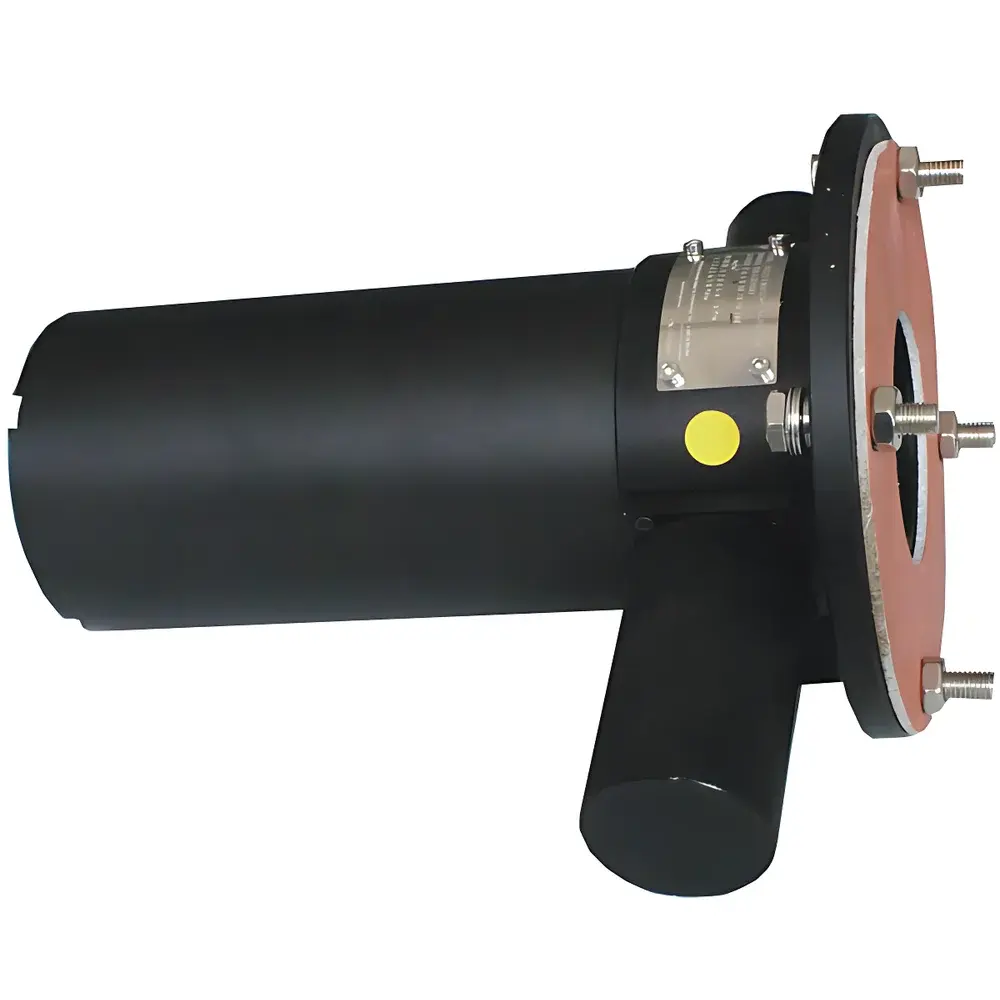
TH-LRD-801 Tianhong Portable Opacity & Particulate Matter (PM) Monitor
| Brand | Tianhong |
|---|---|
| Origin | Hubei, China |
| Model | TH-LRD-801 |
| Instrument Type | Portable Flue Gas Particulate Monitor |
| Measurement Principle | Laser Backscatter (90° scattering geometry) |
| PM Concentration Range | 0.1–10,000 mg/m³ (expandable) |
| Accuracy | ≤ ±5% of reading |
| Sensitivity | ≤ ±2% F.S. |
| Zero Drift | ≤ ±2.0% F.S./24 h |
| Span Drift | ≤ ±2.0% F.S./24 h |
| Response Time (T₉₀) | ≤ 5 s |
| Output Signals | 0–5 V DC / 4–20 mA analog |
| Operating Temperature of Sensor Baseplate | < 50 °C (maintained via integrated purge-cooling airflow) |
| Lens Cleaning | Automated pulsed air purge system |
| Temperature Compensation | Built-in NTC thermistor-based real-time compensation |
Overview
The TH-LRD-801 is a portable, in-situ optical particulate matter (PM) monitor engineered for continuous or spot measurement of smoke and dust concentration in industrial flue gas streams. It operates on the principle of laser backscatter photometry at a fixed 90° detection angle, enabling high-sensitivity, real-time quantification of suspended particulates across a wide dynamic range (0.1–10,000 mg/m³). Unlike filter-based gravimetric methods, this instrument delivers rapid, non-contact measurement with minimal maintenance—ideal for compliance verification, process optimization, and emission source testing under ISO 16911-1, EPA Method 9, and GB/T 16157–1996 regulatory frameworks. Its compact form factor, integrated thermal management, and dual analog output channels support seamless integration into existing CEMS architectures or standalone field deployment.
Key Features
- Laser-based backscatter detection with factory-calibrated optical path geometry ensures consistent sensitivity across the full measurement range.
- Active sensor baseplate cooling and pulsed lens-cleaning airflow system maintain optical clarity and thermal stability—critical for long-term repeatability in high-temperature, high-humidity flue environments.
- Onboard temperature compensation algorithm (NTC-driven) corrects for refractive index variations induced by flue gas temperature fluctuations, reducing systematic bias in PM signal interpretation.
- Dual analog outputs (0–5 V DC and 4–20 mA) provide compatibility with PLCs, SCADA systems, and data loggers without external signal conditioning.
- Ruggedized aluminum housing rated IP65 for dust and water resistance; operating ambient temperature range: –10 °C to +50 °C.
- Self-diagnostic firmware continuously monitors laser intensity, detector responsivity, and airflow pressure—flagging deviations beyond predefined thresholds via status LED and output fault codes.
Sample Compatibility & Compliance
The TH-LRD-801 is validated for use in dry or moderately moist flue gases with particulate loading up to 10,000 mg/m³ and stack temperatures ≤ 200 °C (with optional high-temp probe extension). It is not intended for corrosive gas matrices containing >50 ppm HCl, HF, or SO₃ without upstream conditioning. The instrument complies with Chinese national standard GB/T 16157–1996 for stationary source emission monitoring and aligns with the performance criteria outlined in ISO 16911-1 (Part 1: Manual and automatic determination of dust mass concentration). While not certified to EN 15267 or MCERTS, its metrological characteristics—including ≤±5% accuracy, ≤5 s T₉₀ response, and <2.0% F.S./24 h drift—meet typical requirements for Tier 2 CEMS validation per EU Directive 2010/75/EU Annex VI.
Software & Data Management
The TH-LRD-801 operates as a standalone transducer with no embedded display or onboard storage. Configuration and calibration are performed using the proprietary Tianhong PC Utility (Windows-based), which supports zero/span adjustment, linearization curve upload, and diagnostic log export (CSV format). All calibration events—including date, operator ID, reference standard used, and before/after deviation—are recorded with timestamp and stored locally. When integrated into a compliant data acquisition system, the instrument supports audit-trail functionality meeting GLP and basic GMP documentation requirements. Raw analog outputs are compatible with third-party historian platforms (e.g., OSIsoft PI, Ignition SCADA) for time-series trending, alarm generation, and regulatory reporting.
Applications
- Real-time verification of electrostatic precipitator (ESP) and baghouse filtration efficiency in coal-fired power plants.
- Stack testing during boiler commissioning and periodic performance audits per local environmental authority mandates.
- Portable monitoring of cement kiln, waste incinerator, and metal smelting exhaust ducts for opacity and PM trend analysis.
- Supporting QA/QC protocols in industries subject to China’s “Blue Sky Defense Campaign” enforcement actions.
- Field validation of continuous emission monitoring systems (CEMS) during relative accuracy test audits (RATA).
FAQ
What measurement principle does the TH-LRD-801 employ?
It uses laser backscatter photometry at a fixed 90° scattering angle to detect changes in light intensity caused by suspended particulates in the flue gas stream.
Is the instrument suitable for wet-stack applications?
It is designed for use in flue gases with moderate moisture content; however, condensation-prone environments require upstream heated sampling lines or dilution probes to prevent optical interference.
Does it meet US EPA or EU MCERTS certification requirements?
No—it is not EPA-certified under PS-11 or MCERTS-approved, but its technical specifications satisfy many Tier 2 comparative testing and engineering verification use cases.
How often does the sensor require calibration?
Zero calibration is recommended before each field use; span calibration is advised every 30 days or after exposure to extreme particulate loading or thermal shock.
Can the analog outputs be configured for different scaling ranges?
Yes—the 4–20 mA and 0–5 V outputs are programmable via the PC utility to match user-defined concentration spans (e.g., 0–500 mg/m³ or 0–5000 mg/m³) without hardware modification.







