
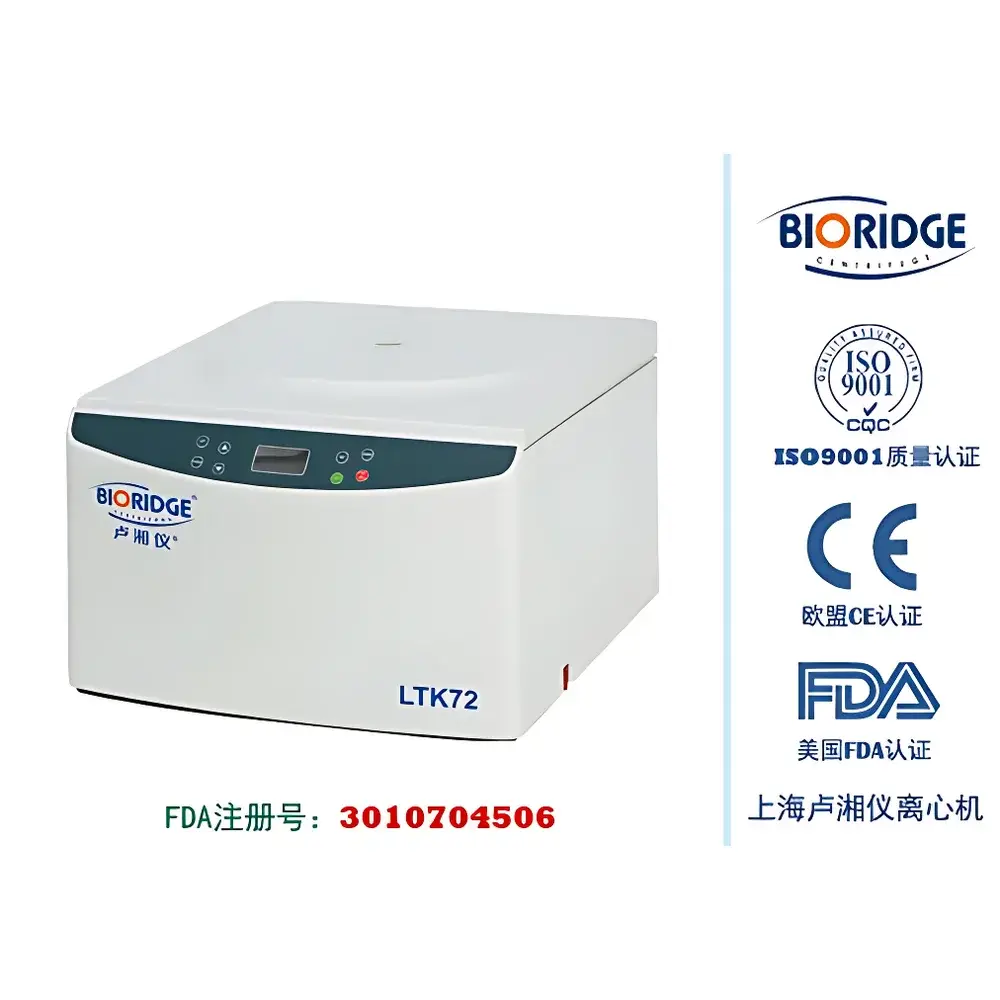
LTK72 Auto-Decapping Centrifuge by Lu Xiangyi (BIORIDGE)
| Brand | Lu Xiangyi / BIORIDGE |
|---|---|
| Origin | Shanghai, China |
| Model | LTK72 |
| Instrument Type | Benchtop Centrifuge |
| Speed Range | 0–4300 rpm |
| Max RCF | 3582 × g |
| Capacity | 72 tubes (18 × 4 configuration) of 5 mL / 7 mL / 10 mL vacuum blood collection tubes |
| Tube Length Compatibility | 81 mm and 106 mm |
| Timer Range | 1–99 min |
| Noise Level | <65 dB(A) |
| Dimensions (L×W×H) | 460 × 540 × 340 mm |
| Net Weight | 28 kg |
| Safety Features | Electronic door lock, automatic imbalance detection, overspeed protection, lid interlock |
| Vibration Damping | Optimized passive damping system with auto-balance compensation |
| Power Supply | AC 220 V, 50 Hz, 10 A |
Overview
The LTK72 Auto-Decapping Centrifuge is a purpose-engineered benchtop centrifuge designed specifically for clinical laboratories processing vacuum blood collection tubes. Unlike conventional centrifuges requiring manual cap removal post-spin, the LTK72 integrates mechanical decapping functionality directly into the centrifugation workflow—leveraging controlled inertial displacement and gravity-assisted separation during deceleration. The device operates on a fixed-angle horizontal rotor architecture optimized for standard 5–10 mL vacuum tubes (e.g., EDTA, serum separator, lithium heparin), enabling simultaneous centrifugation and cap detachment in a single cycle. Its core design addresses three critical clinical pain points: operator exposure risk during manual decapping, sample re-mixing due to post-centrifugal agitation, and throughput bottlenecks in high-volume hematology workflows. Engineered for compliance with ISO 15189 pre-analytical requirements and aligned with CLSI GP44-A4 guidelines for specimen handling, the LTK72 supports traceable, standardized blood fractionation prior to downstream analysis.
Key Features
- Integrated auto-decapping mechanism: Achieves >90% cap separation success rate across two standardized tube lengths (81 mm and 106 mm) without external tools or manual intervention.
- Horizontal swing-out rotor with 72-position capacity (18 × 4 configuration), supporting interchangeable adapters for 5 mL, 7 mL, and 10 mL vacuum tubes.
- Dual-parameter real-time display: Simultaneous readout and setpoint control of rotational speed (rpm) and relative centrifugal force (RCF, ×g), facilitating method reproducibility across user-defined protocols.
- Electronically interlocked safety lid: Prevents operation unless fully engaged; automatically halts rotation if opened mid-cycle.
- Passive vibration suppression system: Multi-layer elastomeric mounting combined with dynamic mass-balancing ensures stable operation at maximum load (≤65 dB[A] acoustic emission).
- Comprehensive protection suite: Microprocessor-monitored safeguards against rotor imbalance, overspeed, overheating, and lid failure—each triggering immediate shutdown with fault-code logging.
Sample Compatibility & Compliance
The LTK72 is validated for use with commercially available vacuum blood collection tubes meeting ISO 6710 specifications, including but not limited to BD Vacutainer®, Greiner Bio-One Vacuette®, and Sarstedt Monovette® formats. It accommodates standard tube diameters (13 mm and 16 mm) and wall thicknesses typical of polyethylene terephthalate (PET) and glass-based containers. All operational parameters—including acceleration/deceleration profiles, dwell time, and final brake sequence—are calibrated to preserve plasma/serum layer integrity per CLSI H20-A3 recommendations. The instrument meets IEC 61010-1:2010 safety standards for laboratory electrical equipment and carries CE marking under the EU Medical Device Regulation (MDR) Annex XVI classification for ancillary specimen preparation devices. Full audit trails—including cycle timestamp, speed, duration, and error logs—are retained onboard for GLP/GMP-aligned quality documentation.
Software & Data Management
While the LTK72 operates via an embedded microcontroller interface without external PC dependency, its firmware supports exportable CSV log files via USB port (optional accessory). Each run record includes date/time stamp, selected program ID, actual vs. set rpm/RCF, elapsed time, and any triggered safety events. Firmware versioning adheres to ISO 13485:2016 change control protocols, with revision history accessible through service mode. For laboratories operating under FDA 21 CFR Part 11 requirements, optional firmware upgrade enables electronic signature capture and role-based access control (admin/operator tiers), ensuring compliant data integrity for regulated environments.
Applications
- Routine serum and plasma separation in hospital core labs and outpatient clinics.
- Pre-analytical automation for immunoassay, coagulation testing, and clinical chemistry platforms requiring capped-tube input.
- Blood bank preprocessing where cap integrity must be preserved until aliquoting or storage.
- Research biobanking workflows demanding minimal operator contact to reduce cross-contamination risk.
- Point-of-care satellite labs needing compact, self-contained centrifugation with integrated decapping—eliminating secondary benchtop decappers.
FAQ
What tube lengths does the LTK72 support?
The LTK72 is configured for two standard vacuum tube lengths: 81 mm and 106 mm, covering the majority of globally distributed blood collection systems.
Is the decapping process dependent on centrifuge speed or duration?
No—the decapping action occurs solely during the controlled deceleration phase and is independent of spin speed or time; it relies on inertial release within the engineered basket geometry.
Can the LTK72 be used with non-vacuum tubes or microcentrifuge tubes?
It is not validated for non-vacuum formats, conical-bottom tubes, or tubes outside the 5–10 mL volume range; adapter compatibility is limited to specified vacuum tube geometries.
Does the instrument provide RCF calibration certificates?
Yes—each unit ships with a factory-verified RCF calibration report traceable to NIM (National Institute of Metrology, China), with optional annual recalibration services available.
How is maintenance performed for the decapping mechanism?
The basket assembly requires only periodic visual inspection and cleaning with isopropyl alcohol; no lubrication or part replacement is needed under normal usage conditions (≤500 cycles/month).



