
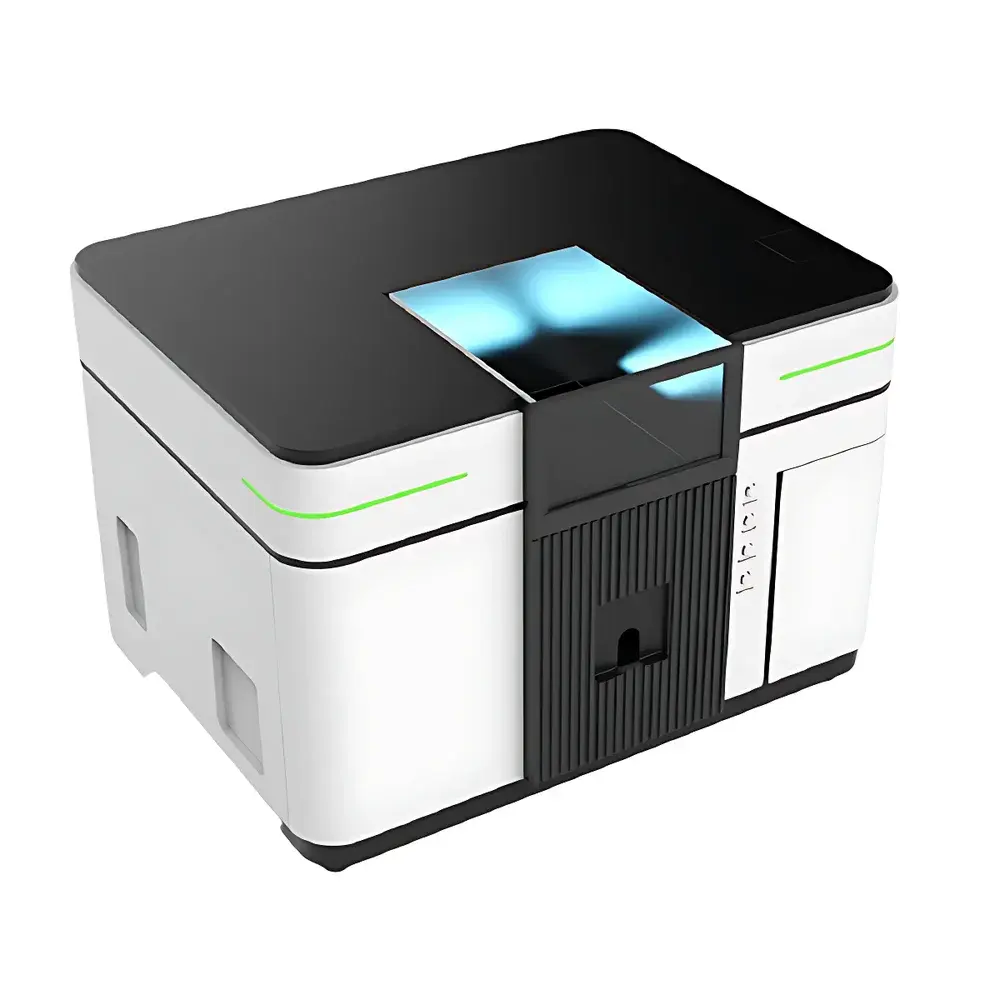
Luban Instruments LAS-200A Flame Atomic Absorption Spectrometer
| Brand | Yoke |
|---|---|
| Origin | Shanghai, China |
| Manufacturer Type | Original Equipment Manufacturer (OEM) |
| Instrument Type | Flame AAS |
| Monochromator | Plane Grating (1800 lines/mm, blazed at 250 nm) |
| Optical System | Single-beam Czerny-Turner |
| Detector | Photomultiplier Tube (PMT) |
| Background Correction | D₂ Lamp + Self-Absorption Method |
| Spectral Bandwidth | 0.1, 0.2, 0.4, 0.7, 1.4, 2.0 nm (6-step automatic switching) |
| Wavelength Range | 185–900 nm |
| Lamp Positions | 8 |
| Optical Platform | 20-mm-thick monolithic aluminum vibration-isolated mounting base |
| Atomizer | Titanium combustion head with motorized vertical positioning |
Overview
The Luban Instruments LAS-200A Flame Atomic Absorption Spectrometer is a benchtop analytical instrument engineered for quantitative elemental analysis of liquid samples in the concentration range from sub-ppb to low ppm. It operates on the fundamental principle of atomic absorption spectroscopy: ground-state free atoms in a flame absorb characteristic radiation emitted by a hollow cathode lamp (HCL) or electrodeless discharge lamp (EDL), with absorbance directly proportional to analyte concentration per the Beer–Lambert law. Designed for routine laboratory environments—including environmental testing labs, food safety QA/QC facilities, pharmaceutical R&D centers, and metallurgical process control—the LAS-200A employs a robust single-beam Czerny-Turner optical configuration with a high-efficiency plane grating (1800 grooves/mm, blazed at 250 nm) to deliver high spectral resolution and long-term photometric stability. Its integrated 20-mm solid aluminum optical platform minimizes thermal drift and mechanical vibration effects, ensuring consistent signal baseline performance over extended operational cycles.
Key Features
- Intelligent gas control system with real-time pressure monitoring, automatic ignition sequence, and flame failure shutdown—compliant with EN 61010-1 safety requirements for laboratory instrumentation.
- Automated wavelength scanning and peak search algorithm enables rapid lamp alignment and spectral line centering without manual intervention.
- Dual-mode background correction: simultaneous use of deuterium arc lamp (D₂) for broadband correction and self-absorption method for narrow-line interference—enhancing accuracy in complex matrices such as soil digests or biological fluids.
- Eight-position lamp turret with memory-based parameter recall: each lamp position stores optimized current, slit width, burner height, and integration time for repeatable method execution.
- Motor-driven titanium atomizer assembly with programmable vertical positioning—ensures optimal nebulization efficiency and flame geometry for maximum sensitivity across diverse elements (e.g., Ca, Cu, Fe, Zn, Pb).
- Automatic energy balancing and high-voltage optimization during lamp warm-up—reducing warm-up time and improving inter-day reproducibility.
Sample Compatibility & Compliance
The LAS-200A supports aqueous and dilute acid-digested samples compatible with standard flame AAS protocols. It accommodates common sample introduction systems including concentric glass nebulizers and all-glass spray chambers. The instrument meets essential regulatory design criteria for GLP-compliant laboratories: full audit trail capability (via optional software), electronic signature support, and data integrity safeguards aligned with FDA 21 CFR Part 11 principles. While not certified to ISO/IEC 17025 out-of-the-box, its optical and electronic architecture conforms to foundational metrological requirements referenced in ISO 11043 (Atomic Absorption Spectrometry — General Requirements) and ASTM E1990 (Standard Practice for Calibration of Flame Atomic Absorption Spectrophotometers).
Software & Data Management
Controlled via Windows-based instrument software, the LAS-200A provides intuitive method setup, real-time spectrum visualization, multi-point calibration curve generation (linear, quadratic, or forced-zero), and QC flagging (e.g., drift alerts, lamp energy warnings). Raw absorbance and concentration data are stored in vendor-neutral CSV format; optional database modules support LIMS integration through ODBC connectivity. All measurement records include embedded metadata: date/time stamp, operator ID, lamp serial number, integration parameters, and background correction mode—enabling traceability required under ISO/IEC 17025 Clause 7.7 and USP .
Applications
- Environmental monitoring: quantification of heavy metals (Cd, Cr, Ni, Pb) in drinking water per EPA Method 7000B.
- Food and beverage quality control: determination of essential minerals (Ca, Mg, Fe, Zn) in dairy products, infant formula, and fortified cereals per AOAC Official Method 984.27.
- Pharmaceutical excipient testing: trace metal impurity screening in APIs and carriers in accordance with ICH Q2(R2) and USP /.
- Geological and mining labs: rapid analysis of ore leachates and tailings solutions for process optimization.
- Educational laboratories: teaching core AAS theory, calibration techniques, and matrix effect evaluation.
FAQ
What flame gases are supported by the LAS-200A?
Air-acetylene and nitrous oxide-acetylene flames are fully configurable via the gas control module; N₂O-C₂H₂ operation requires optional high-temperature burner head.
Is the instrument compatible with hydride generation or graphite furnace accessories?
No—the LAS-200A is dedicated to flame atomization only; it does not support external atomizer interfaces or retrofit kits for alternative atomization methods.
How is wavelength calibration verified?
Calibration is performed using holmium oxide or didymium filters; factory-installed wavelength verification routines support periodic user checks per ASTM E1990 Section 6.3.
Can multiple users access instrument methods with role-based permissions?
Yes—software supports user-defined accounts with configurable access levels (e.g., operator, supervisor, administrator) for method editing, calibration, and report export functions.
What maintenance intervals are recommended for optimal performance?
Nebulizer cleaning every 8 hours of continuous use; burner head inspection after 500 analyses; annual PM including grating alignment verification and PMT dark current assessment.
Related Products




