
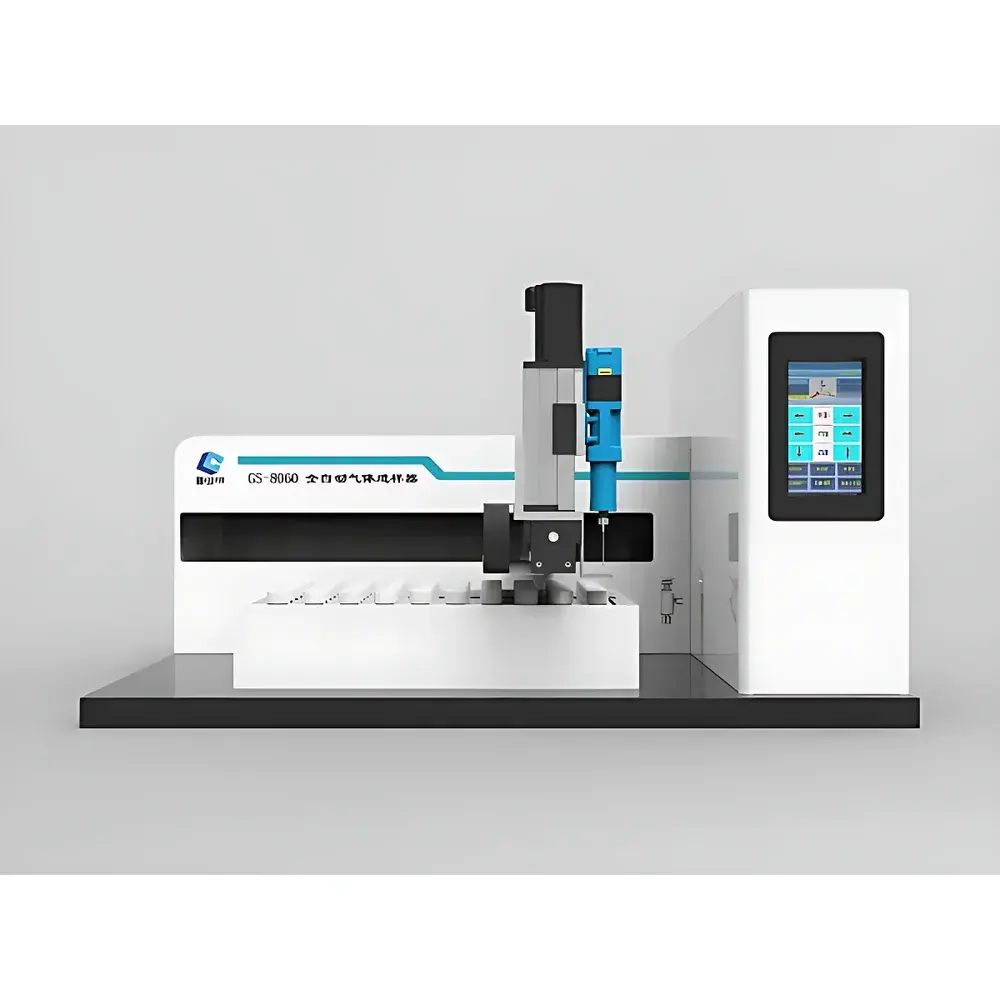
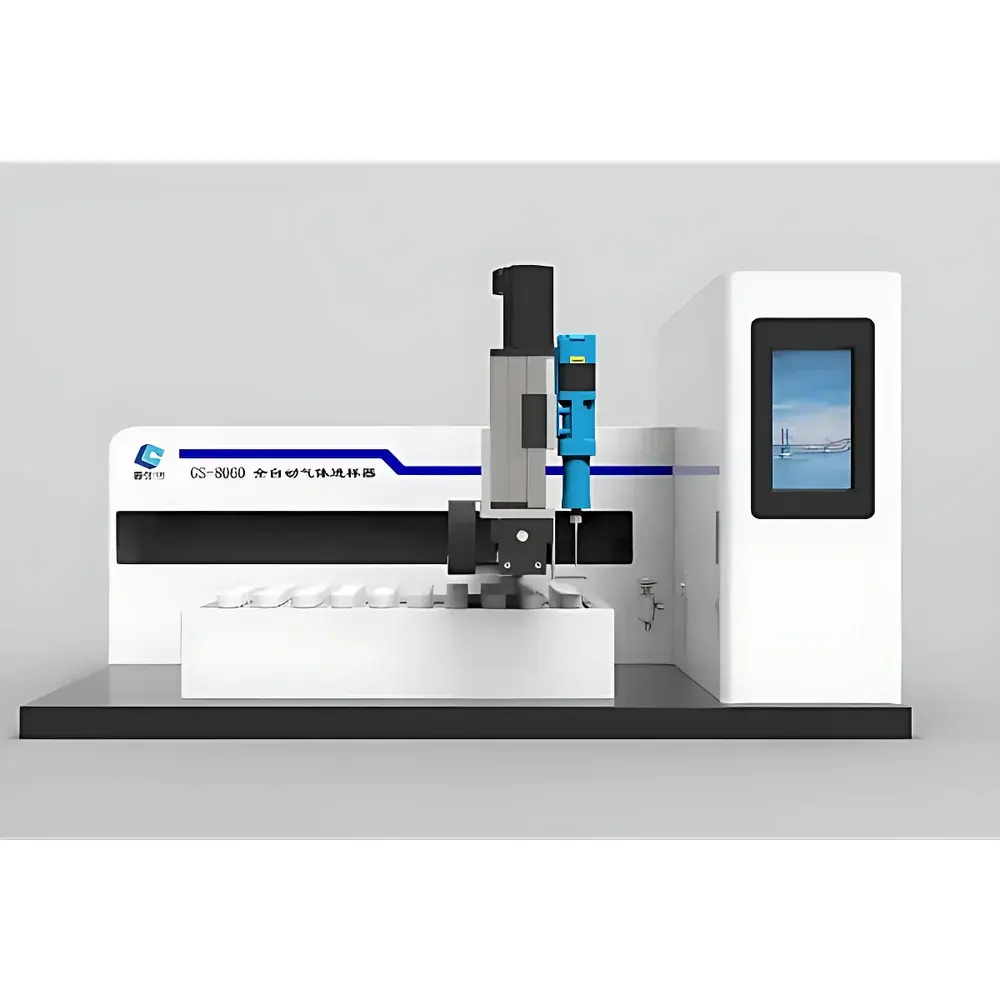
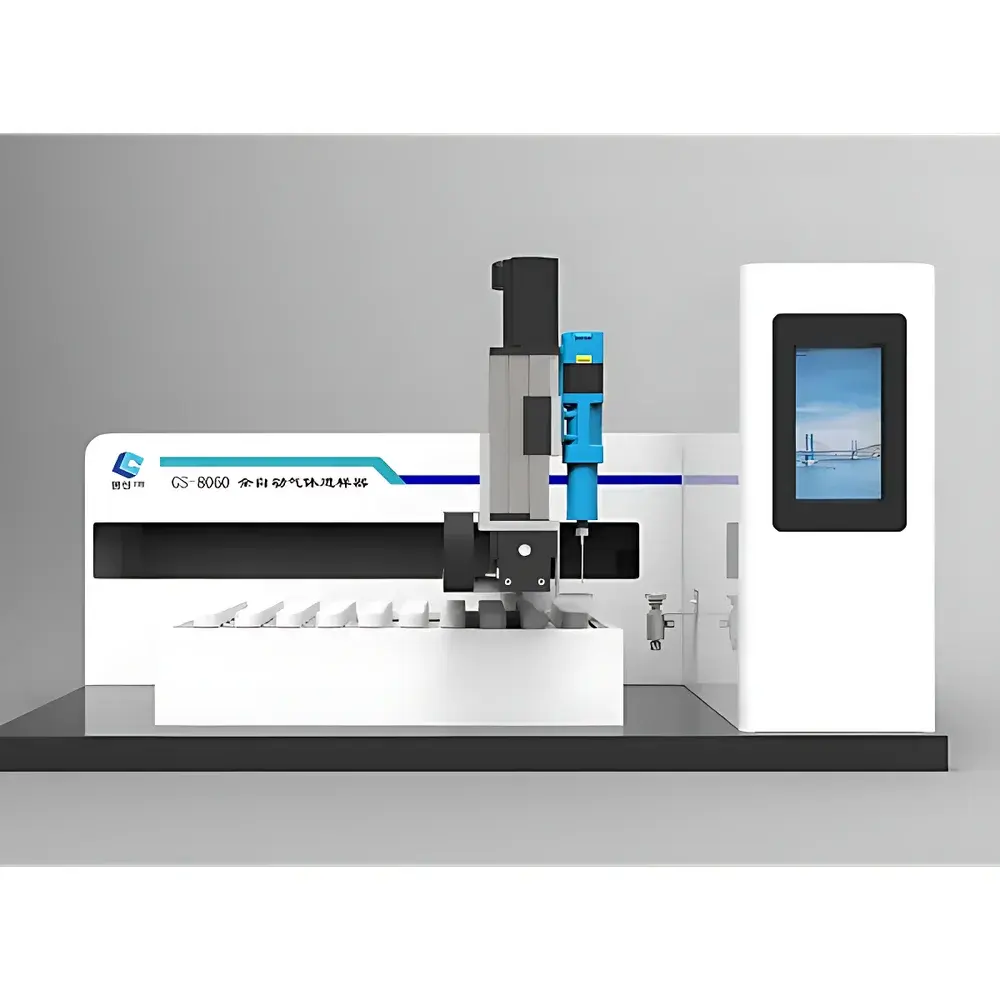
Luchuang GS-8060 Fully Automated Micro-Gas Syringe Autosampler
| Brand | Luchuang |
|---|---|
| Origin | Shandong, China |
| Manufacturer Type | Direct Manufacturer |
| Instrument Type | Gas Chromatography Autosampler |
| Maximum Sample Capacity | 60–120 vials |
| Minimum Injection Volume | 0.1–5 mL |
| Standard Loop Volume | 1000 µL |
| Positioning Accuracy | <0.3 mm |
| Motion Architecture | XYZ Three-Axis |
| Needle Wash Mode | XYZ Three-Axis Cleaning |
| Integrated Purge Function | Yes |
| Observation Window | Yes |
| Built-in Filtration Module | Yes |
Overview
The Luchuang GS-8060 Fully Automated Micro-Gas Syringe Autosampler is an engineered solution for precise, high-throughput gas-phase sample introduction into gas chromatography (GC) systems. Designed specifically for headspace analysis and direct gas injection applications, it employs a syringe-based sampling mechanism coupled with a robust six-port valve and inert quantitative loop architecture. Unlike conventional loop-based autosamplers, the GS-8060 integrates a high-precision micro-syringe pump capable of volumetric accuracy ≤1% (full stroke) and repeatability <0.3%, enabling trace-level quantitation in compliance with ASTM D3703, ISO 11423, and USP . Its XYZ three-axis motion system ensures reproducible needle placement across standard 50 mL headspace vials (Ø30 mm × H100 mm), supporting both clockwise and counterclockwise sequence programming for flexible method development. The unit operates under ambient to elevated pressure conditions—including zero-pressure and slight negative-pressure sampling—via corrosion-resistant fluidic pathways constructed from PTFE, Hastelloy, and fused silica components.
Key Features
- 7-inch industrial touchscreen interface with dual-control capability: local operation and remote PC-based software supervision for unattended 24/7 GC integration
- XYZ three-axis robotic arm with 0.0025 mm positional resolution and sub-microliter injection precision (1 µL minimum step size)
- Inert, chemically resistant sampling path featuring a stainless-steel syringe barrel, ceramic plunger seal, and integrated six-port valve with 1000 µL standard loop
- Automated XYZ wash cycle between injections using solvent-compatible rinse ports; programmable multi-step wash protocols
- Integrated purge function with adjustable flow rate and dwell time to eliminate carryover; validated cross-contamination reduction <0.01%
- Optical observation window for real-time visual verification of syringe movement, needle insertion depth, and vial sealing integrity
- Built-in particulate filtration module upstream of the syringe inlet to prevent blockage during long-term operation with complex gas matrices
- Rated mechanical lifetime exceeding 1 million cycles at room temperature, validated per IEC 61000-4-2 ESD and IEC 60068-2 environmental stress testing
Sample Compatibility & Compliance
The GS-8060 is optimized for 50 mL crimp-top or screw-cap headspace vials conforming to ASTM D6866 and ISO 17025 vial geometry specifications (Ø30 mm × H100 mm). It supports both pressurized and vacuum-assisted sampling modes, accommodating volatile organic compounds (VOCs), dissolved gases (e.g., O2, CO2, CH4), and reactive species such as H2S and NH3. All wetted materials comply with USP Class VI biocompatibility standards and exhibit minimal adsorption for polar analytes. The system meets GLP audit requirements with full electronic log recording, user-access level control (admin/operator/guest), and timestamped event history—including vial position, injection volume, purge duration, and error flags. Data integrity adheres to FDA 21 CFR Part 11 guidelines through optional digital signature integration and audit trail export.
Software & Data Management
The embedded control firmware supports bidirectional communication via RS-232, USB, and Ethernet (TCP/IP), enabling seamless integration with Agilent, Thermo Fisher, Shimadzu, and PerkinElmer GC platforms. Method files store complete sequence parameters—including vial map coordinates, injection volume ramp profiles, wash solvent selection, and thermal equilibration timing—and are exportable in CSV and XML formats. Software includes built-in QC tracking: automatic calculation of relative standard deviation (RSD) across replicate injections, drift compensation alerts, and calibration curve validation against NIST-traceable standards. Raw event logs are retained for ≥12 months and support forensic reconstruction of instrument activity per ISO/IEC 17025 clause 7.9.
Applications
- Environmental monitoring: quantification of landfill gas composition (CH4, CO2, NMHC) per EPA Method TO-15 and ASTM D5502
- Pharmaceutical residual solvent analysis (ICH Q2(R2)) in lyophilized products and excipients using static headspace-GC/FID
- Food & beverage quality control: determination of ethanol, acetaldehyde, and diacetyl in fermented beverages per AOAC 971.21
- Chemical manufacturing: on-line process gas analysis for reactor off-gas streams, including H2, CO, CO2, and light hydrocarbons
- Materials science: outgassing profiling of polymers and composites under thermal desorption-GC/MS protocols
FAQ
Does the GS-8060 support custom vial formats beyond 50 mL headspace vials?
Yes—through user-defined coordinate mapping and adjustable Z-axis travel limits, the system accommodates vials ranging from 10 mL to 100 mL, provided mechanical clearance and septum penetration depth are verified.
Is the syringe pump calibration traceable to national metrology institutes?
Factory calibration is performed using gravimetrically verified reference weights per ISO/IEC 17025; NIST-traceable calibration certificates are available upon request.
Can the filtration module be bypassed for ultra-high-purity applications?
The filter is installed in a quick-release manifold; removal is permitted when analyzing certified reference gases or when using pre-filtered sample streams.
What maintenance intervals are recommended for long-term reliability?
Syringe seals require replacement every 250,000 cycles or annually (whichever occurs first); six-port valve rotor seal replacement is advised every 500,000 cycles.
Does the system support method transfer between different GC platforms?
Yes—method files are platform-agnostic; only instrument-specific trigger signals (TTL or contact closure) require reconfiguration during integration.




