
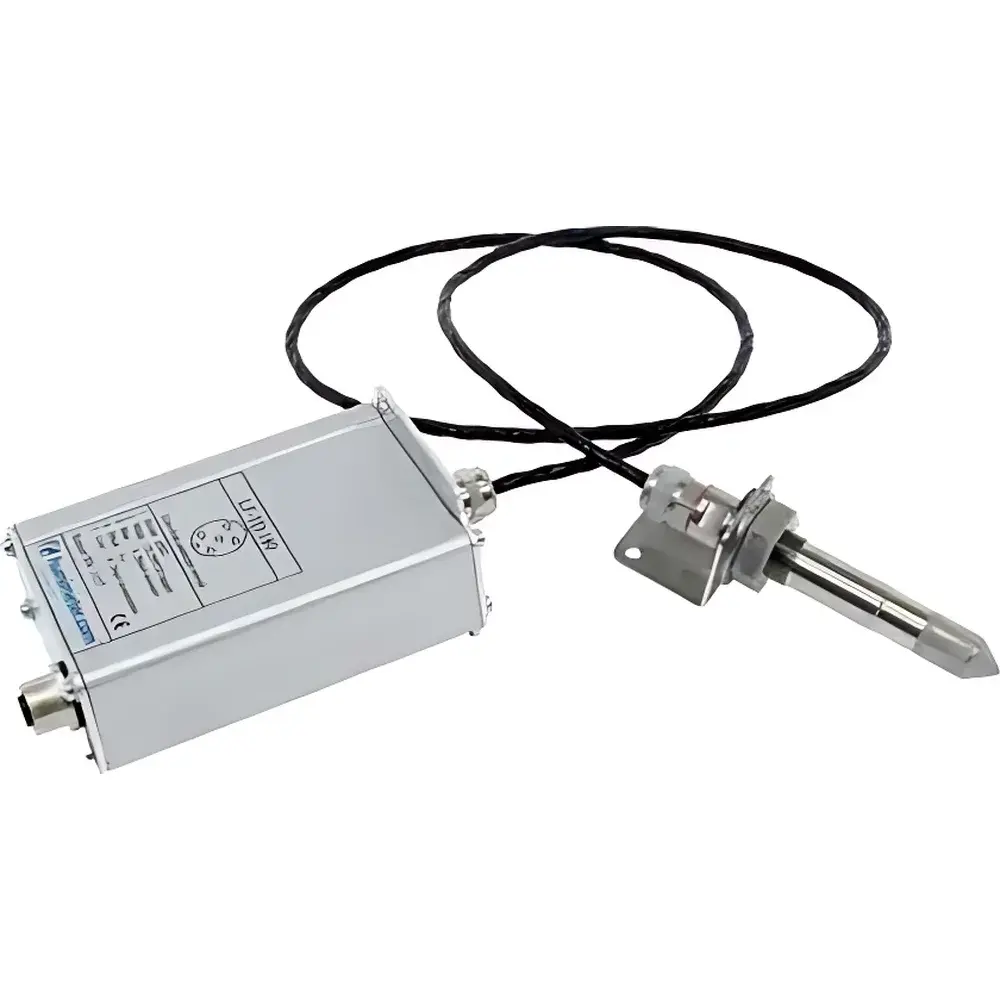
Lufft LF-TD 180 High-Temperature Humidity Transmitter
| Origin | Austria |
|---|---|
| Manufacturer Type | Authorized Distributor |
| Origin Category | Imported |
| Model | LF-TD 180 |
| Instrument Type | Thermo-Hygrometer |
| Humidity Range | 0–100 % RH |
| Temperature Range | –20 °C to +180 °C |
| Humidity Accuracy | ±2.0 % RH (10–90 % RH) |
| Temperature Accuracy | ±0.3 °C (+10 to +60 °C) |
| Output Signals | Dual 4–20 mA (RH and Temp, separately scaled) |
| Power Supply | 12–29 VDC (nominal 24 VDC) |
| Sensor Head Material | Stainless steel |
| Electronics Housing Material | Anodized aluminum |
| IP Rating | IP65 |
| Probe Dimensions | Ø12 mm × 100 mm |
| Electronics Dimensions | 70 mm (W) × 32 mm (H) × 120 mm (D) |
| Cable Length | 1 m (5-pin sensor connector) |
Overview
The Lufft LF-TD 180 High-Temperature Humidity Transmitter is an industrial-grade thermo-hygrometer engineered for continuous, reliable monitoring of relative humidity (RH) and temperature in thermally demanding environments. Based on capacitive polymer sensing technology, the LF-TD 180 delivers stable, traceable measurements under sustained exposure up to +180 °C — a critical capability for process-critical applications where conventional hygrometers fail. Unlike standard ambient-range sensors, its dual-channel architecture separates sensing and signal conditioning functions: the stainless-steel probe head operates continuously at temperatures up to +150 °C, while the electronics module (rated to +85 °C) maintains signal integrity and long-term calibration stability. Designed for integration into HVAC control systems, drying ovens, sterilization tunnels, and climate-controlled storage facilities, the LF-TD 180 complies with fundamental metrological requirements for industrial process monitoring and supports audit-ready documentation when configured with optional data logging interfaces.
Key Features
- Capacitive polymer humidity sensor with factory 6-point RH calibration traceable to national standards
- Stainless-steel probe head with sintered stainless-steel protective cap (IP65-rated) for resistance to mechanical abrasion and condensation ingress
- Dual independent 4–20 mA analog outputs — one scaled linearly to 0–100 % RH, the other to –20 °C to +180 °C — enabling direct connection to PLCs, DCS, or SCADA systems without external signal conditioning
- Robust anodized aluminum electronics housing suitable for panel mounting or DIN-rail installation
- Wide operating voltage range (12–29 VDC) with reverse-polarity and overvoltage protection
- Optional local display module for real-time RH and temperature readout at the point of measurement
- Configurable relay output (dry contact) for threshold-based humidity alarm activation or process interlock
Sample Compatibility & Compliance
The LF-TD 180 is compatible with gaseous media across non-corrosive, low-particulate industrial atmospheres — including dry air, nitrogen, compressed air, steam-diluted air, and inert process gases. It is not intended for direct immersion, high-velocity abrasive gas streams, or environments containing volatile organic compounds (VOCs), strong acids, or alkalis that may degrade the polymer sensing layer. The device meets EN 61326-1 (EMC for industrial environments) and conforms to RoHS 2011/65/EU. While not certified as intrinsically safe, it may be deployed in Zone 2 classified areas when installed per IEC 60079-14 guidelines. Calibration certificates are supplied with NIST-traceable reference data, supporting compliance with ISO/IEC 17025-accredited laboratory practices and GMP-relevant environmental monitoring protocols (e.g., EU Annex 1, FDA Guidance for Environmental Monitoring in Sterile Manufacturing).
Software & Data Management
The LF-TD 180 supports multiple digital communication options via optional interface modules: RS232 (ASCII protocol), USB (virtual COM port), Bluetooth (requires USB adapter), Modbus RTU (RS485), PROFINET, and Ethernet (TCP/IP). When connected to Lufft’s proprietary configuration software (available for Windows), users can perform field calibration verification, adjust output scaling, configure relay hysteresis, set alarm thresholds, and export timestamped measurement logs. All digital interfaces support full audit trail functionality — including user login history, parameter change logs, and firmware version tracking — aligning with FDA 21 CFR Part 11 requirements for electronic records and signatures when deployed in regulated pharmaceutical or food manufacturing settings.
Applications
- Real-time humidity control in industrial drying ovens (wood, ceramics, composites)
- Environmental monitoring inside autoclaves and depyrogenation tunnels (pharmaceutical primary packaging)
- Climate validation in seed storage vaults, grain silos, and animal feed processing lines
- Process air moisture monitoring in paper coating, ink drying, and textile heat-setting operations
- Condition monitoring of compressed air systems upstream of sterile filtration units
- Validation of lyophilizer chamber purge cycles and shelf temperature uniformity mapping
FAQ
What is the maximum continuous operating temperature of the sensor probe?
The stainless-steel probe head is rated for continuous operation up to +150 °C; transient exposure to +180 °C is permissible for ≤30 minutes per cycle.
Can the LF-TD 180 be calibrated in-house?
Yes — using a certified humidity generator and reference thermometer, provided the calibration procedure follows ISO 5518 and includes at least three points across the RH range (e.g., 33 %, 65 %, 95 % RH) and two temperature points within the operational span.
Is the 4–20 mA output intrinsically safe?
No — the standard output is non-IS. For hazardous area use, an approved intrinsic safety barrier must be installed between the transmitter and the control system.
Does the device support HART communication?
No — HART is not supported. Digital communication is limited to the listed protocols: RS232, USB, Modbus, PROFINET, and Ethernet.
How often is recalibration recommended?
Annual recalibration is recommended for GxP environments; for general industrial use, verification every 12–24 months against traceable references is sufficient, depending on process criticality and exposure conditions.



