
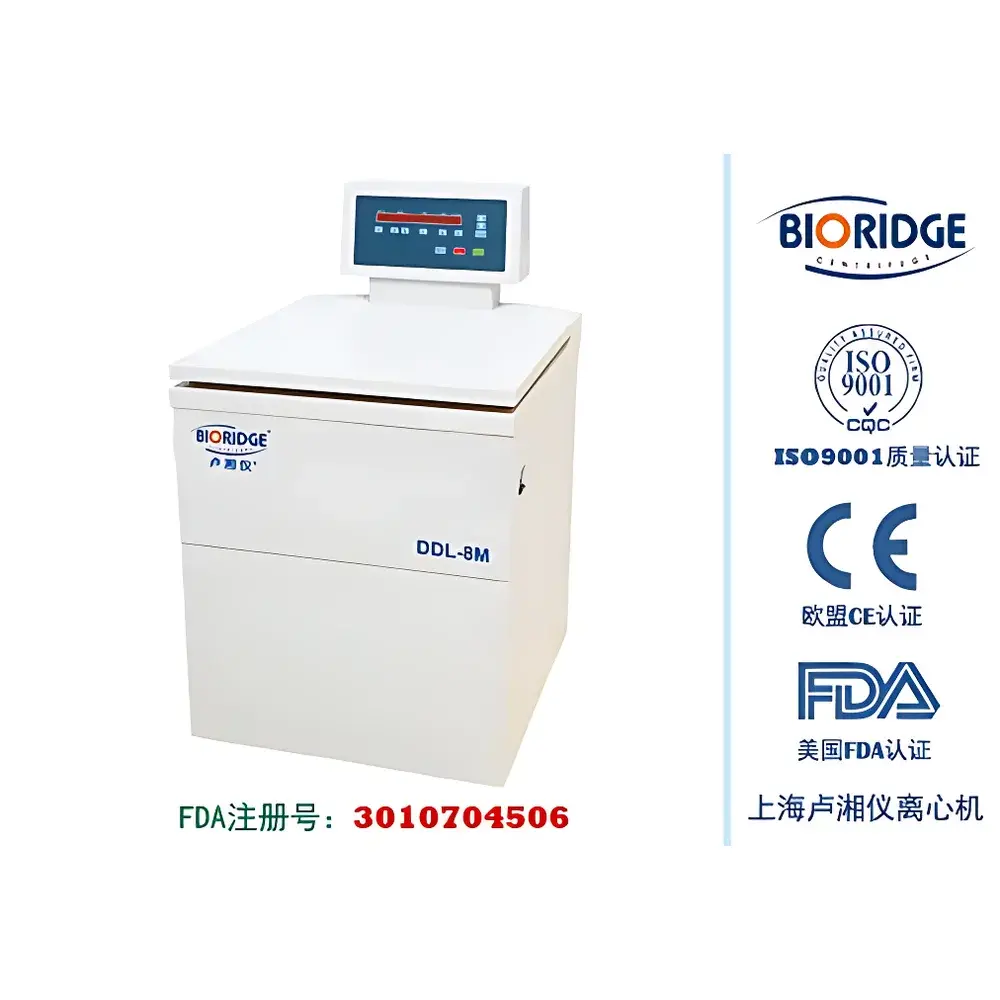
LuXiangYi DDL-8M Low-Speed High-Capacity Refrigerated Centrifuge
| Brand | LuXiangYi / BIORIDGE |
|---|---|
| Origin | Shanghai, China |
| Type | Floor-Standing Refrigerated Centrifuge |
| Max Speed | 8000 rpm |
| Max RCF | 9100 × g |
| Max Capacity | 4 × 750 mL |
| Temperature Range | −20 °C to +40 °C |
| Temp. Accuracy | ±1 °C |
| Speed Accuracy | ±50 rpm |
| Timer Range | 1–99 min |
| Noise Level | <65 dB(A) |
| Dimensions (L×W×H) | 650 × 710 × 1100 mm |
| Net Weight | 170 kg |
| Refrigerant | R404a (non-ozone-depleting) |
| Power Supply | AC 220 V, 50 Hz, 20 A |
Overview
The LuXiangYi DDL-8M Low-Speed High-Capacity Refrigerated Centrifuge is engineered for robust, reproducible separation of large-volume biological samples under precisely controlled thermal conditions. Designed around a high-torque AC frequency-controlled motor and a sealed refrigeration system using environmentally compliant R404a refrigerant, this floor-standing centrifuge delivers stable rotational performance at speeds up to 8000 rpm and maximum relative centrifugal force (RCF) of 9100 × g. Its primary operational domain encompasses low-speed sedimentation of intact cells, organelles, viruses, and macromolecular complexes—making it especially suited for clinical diagnostics, blood banking, vaccine production, biopharmaceutical downstream processing, and environmental sample preparation where thermal stability and volumetric throughput are critical. Unlike ultra-high-speed instruments, the DDL-8M prioritizes gentle yet efficient pelleting of temperature-sensitive biomaterials without inducing shear-induced denaturation or aggregation.
Key Features
- Microprocessor-based control system with intuitive touch-panel interface and dual-display screen showing real-time rpm and RCF values with automatic conversion
- Programmable acceleration/deceleration profiles—10 user-defined ramp curves enable precise control over spin-up and spin-down kinetics to minimize sample disturbance
- Integrated electronic door lock with auto-locking mechanism, overspeed, overtemperature, imbalance, and rotor recognition safety interlocks
- Advanced refrigeration architecture featuring imported high-efficiency compressors and optimized airflow design ensures rapid cooling to −20 °C and tight temperature regulation (±1 °C) across full speed range
- Low-noise operation (<65 dB[A]) achieved via vibration-damped chassis, precision-balanced rotor assemblies, and acoustic insulation
- Non-volatile memory stores up to 10 pre-set protocols with full parameter recall—including time, temperature, speed, and ramp profiles
Sample Compatibility & Compliance
The DDL-8M supports a broad spectrum of sample formats through interchangeable horizontal rotors, including 4 × 750 mL bottles (ideal for cell culture harvest or wastewater clarification), 8 × 100 mL tubes (optimized for plasma fractionation), 4 × 500 mL containers, and multiwell plate carriers (96-well microplates in single or double configurations). All rotors are certified to ISO 13485-compliant manufacturing standards and undergo dynamic balancing verification per IEC 61010-2-020 for laboratory equipment safety. The unit meets electromagnetic compatibility (EMC) requirements under EN 61326-1 and complies with energy efficiency directives applicable to refrigerated lab instrumentation. While not validated for FDA 21 CFR Part 11 out-of-the-box, its audit-trail-capable software architecture supports integration into GLP/GMP environments when deployed with validated LIMS interfaces.
Software & Data Management
The embedded firmware provides native support for protocol cloning, parameter logging, and error-event timestamping. Each run records timestamp, setpoints, actual RCF, chamber temperature history, and fault codes—exportable via USB port in CSV format for traceability. Optional PC connectivity enables remote monitoring and centralized fleet management in multi-instrument labs. Firmware updates are delivered via secure encrypted firmware packages, ensuring version control integrity. All stored methods retain full metadata—including operator ID fields and calibration timestamps—to facilitate internal QA documentation and external regulatory review.
Applications
- Clinical laboratories: Separation of whole blood into packed red cells, platelet-rich plasma, and serum; isolation of PBMCs using density gradient media
- Biopharmaceutical manufacturing: Clarification of mammalian cell culture harvests prior to chromatography; recovery of viral vectors and exosomes
- Environmental testing labs: Concentration of microbial biomass from large-volume water samples (e.g., drinking water, effluent)
- Vaccine development: Harvest and washing of bacterial or yeast expression systems; purification of adjuvant-containing formulations
- Academic research: Subcellular fractionation workflows requiring preservation of mitochondrial or lysosomal integrity
FAQ
What is the minimum operating temperature and how quickly does the chamber reach −20 °C?
The refrigeration system achieves −20 °C within approximately 25 minutes from ambient (25 °C), depending on rotor load and ambient humidity. Pre-cooling functionality allows chamber equilibration before sample loading.
Can the DDL-8M accommodate custom rotors or third-party adapters?
Only factory-certified horizontal rotors and adapters listed in the official accessories catalog are supported. Use of non-approved components voids safety certification and thermal validation.
Is remote diagnostics or service access available?
Yes—the instrument includes RS-232 and optional Ethernet ports enabling remote firmware diagnostics and technical support session initiation with authorized service engineers.
How is rotor lifetime managed and tracked?
Each rotor carries an embedded RFID tag storing serial number, material batch, and cumulative run hours. The host system logs all rotor usage events and alerts users when maintenance intervals or end-of-life thresholds are approached.
Does the unit support continuous operation mode for extended runs?
It supports uninterrupted operation for up to 99 minutes per cycle. For longer processes, sequential program chaining is required, with automatic cooldown pauses between cycles to maintain compressor longevity.



