
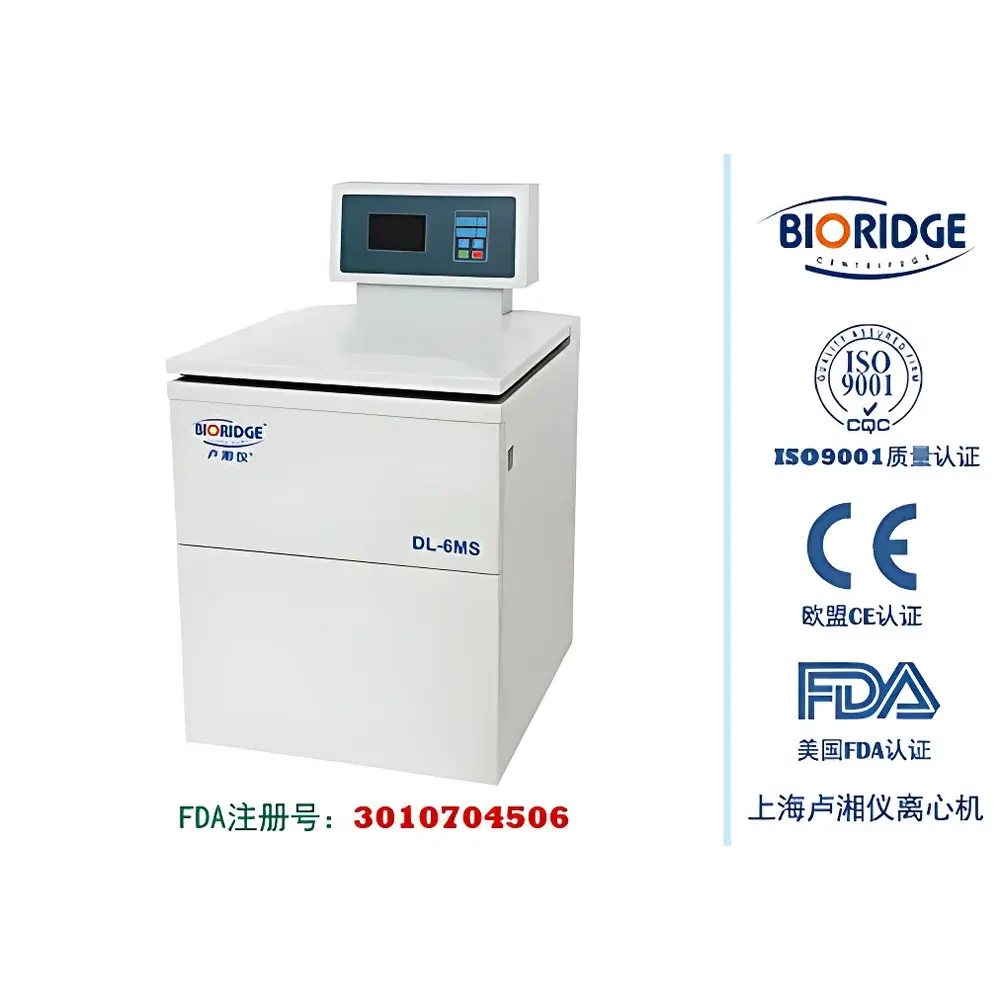
LUXIANGYI DL-6M High-Capacity Low-Speed Refrigerated Centrifuge
| Brand | LUXIANGYI / BIORIDGE |
|---|---|
| Origin | Shanghai, China |
| Model | DL-6M |
| Instrument Type | Floor-Standing Centrifuge |
| Function | Refrigerated Centrifuge |
| Configuration | Horizontal Rotor Centrifuge |
| Application Class | Biological Macromolecule Separation |
| Max Capacity | 1200 mL × 6 |
| Max Speed | 6000 rpm |
| Max RCF | 6680 × g |
| Dimensions (L×W×H) | 710 mm × 840 mm × 1200 mm |
| Temperature Range | −20 °C to +40 °C |
| Temp. Control Accuracy | ±1 °C |
| Noise Level | <65 dB(A) |
| Power Supply | AC 220 V, 50 Hz, 30 A |
| Net Weight | 320 kg |
| Refrigerant | R404a (non-ozone-depleting) |
| Rotor Drive | AC Brushless Frequency-Controlled Motor |
| Speed Accuracy | ±50 rpm |
| Timer Range | 1 min – 99 h 59 min |
| Acceleration/Deceleration Profiles | 10 programmable ramp curves |
Overview
The LUXIANGYI DL-6M High-Capacity Low-Speed Refrigerated Centrifuge is engineered for high-throughput, temperature-sensitive separation tasks in blood banking, biopharmaceutical manufacturing, and large-scale cell culture processing. Designed around a robust horizontal rotor architecture, it operates on the principle of sedimentation-based separation under controlled low-speed centrifugal force—optimized for preserving structural integrity of fragile biological components such as whole blood fractions, peripheral blood mononuclear cells (PBMCs), platelet-rich plasma (PRP), and microbial pellets. Unlike high-speed ultracentrifuges, the DL-6M prioritizes volumetric throughput and thermal stability over extreme g-force generation, making it particularly suited for clinical-grade component separation where reproducibility, batch consistency, and regulatory traceability are critical. Its dual-path refrigeration-heating system enables precise thermal management across the full operating range (−20 °C to +40 °C), essential for maintaining hematocrit stability during red blood cell (RBC) sedimentation or preventing cryoprecipitate denaturation during plasma fractionation.
Key Features
- High-capacity horizontal rotor configuration supporting up to six 1200 mL bottles (total 7.2 L per run), compatible with standard blood collection bags and custom bioreactor harvest vessels.
- AC brushless frequency-controlled motor delivering stable torque at low rotational speeds (up to 6000 rpm), minimizing mechanical vibration and ensuring long-term bearing reliability.
- Imported high-efficiency compressor system using environmentally compliant R404a refrigerant, achieving rapid cooling from ambient to −20 °C in ≤15 minutes under full-load conditions.
- Microprocessor-based control interface with real-time RPM/RCF conversion, automatic parameter recall, and non-volatile memory for up to 10 user-defined protocols.
- Integrated safety architecture including electromagnetic door interlock, rotor imbalance detection, overspeed cutoff, overtemperature alarm, and emergency deceleration on fault detection.
- Programmable acceleration and deceleration profiles (10 preset ramp curves) to reduce shear stress on sensitive samples during spin-up and braking phases.
- Acoustic enclosure design meeting ISO 21501-4 noise emission standards (<65 dB[A] at 1 m distance), suitable for shared laboratory environments requiring low ambient disturbance.
Sample Compatibility & Compliance
The DL-6M accommodates a broad spectrum of primary and secondary containment formats, including polypropylene and polycarbonate centrifuge bottles (50–1200 mL), blood bag assemblies with satellite tubing, and custom-fit adapters for ISO-standardized bioprocessing containers. It supports common anticoagulant systems (CPD, CP2D, EDTA) and maintains compatibility with USP sterility testing workflows when operated under validated cleaning and decontamination procedures. While not certified to IEC 61010-2-020 as a standalone medical device, the system complies with general laboratory equipment safety requirements per EN 61010-1 and meets key performance benchmarks referenced in ASTM F2621 (Standard Practice for Centrifuge Performance Verification) and CLSI EP17-A2 (Evaluation of Detection Capability). Optional IQ/OQ documentation packages are available for GMP-aligned installation and operational qualification.
Software & Data Management
The DL-6M features embedded firmware supporting GLP-compliant audit trails: all parameter changes, run logs, error events, and temperature deviations are timestamped and stored locally for ≥10,000 cycles. Though lacking Ethernet or USB host connectivity in base configuration, optional RS-232 serial output enables integration with LIMS platforms via ASCII-based command protocol (SCPI-compatible subset). All stored methods include RCF calibration offsets, rotor identification codes, and thermal history metadata—facilitating retrospective validation against FDA 21 CFR Part 11 requirements when paired with external electronic signature modules. Firmware updates are performed via SD card slot, ensuring version control without network exposure.
Applications
- Blood bank operations: Efficient separation of packed RBCs, leukocyte-reduced platelets, and fresh frozen plasma (FFP) from whole blood units.
- Biopharmaceutical downstream processing: Clarification of mammalian cell culture harvests prior to depth filtration or chromatography.
- Vaccine production: Pellet recovery of bacterial or yeast expression hosts during antigen purification campaigns.
- Agricultural biotechnology: Large-volume isolation of plant protoplasts or algal biomass from fermentation broth.
- Environmental microbiology: Concentration of waterborne pathogens (e.g., Legionella, Cryptosporidium) for subsequent molecular detection.
FAQ
What is the maximum allowable imbalance tolerance for safe operation?
The DL-6M detects mass asymmetry exceeding ±50 g per bucket position and halts acceleration before reaching set speed.
Can this centrifuge be validated for GMP manufacturing use?
Yes—when supplied with optional qualification documentation (IQ/OQ templates), calibrated thermistors, and third-party RCF verification reports, it meets baseline requirements for Category B equipment under EU Annex 11 and PIC/S PI 007-1.
Is rotor certification included with purchase?
Each horizontal rotor is supplied with individual serial-numbered test certificates confirming fatigue life (≥10,000 cycles at max rated speed) and dimensional compliance to ISO 15189 Annex C specifications.
Does the system support remote monitoring?
Not natively; however, analog voltage outputs (0–10 V) for temperature and speed signals are available via rear-panel terminals for connection to building management systems.
What maintenance intervals are recommended?
Compressor oil inspection every 24 months; refrigerant pressure check annually; rotor cavity cleaning after each use; full mechanical inspection every 5 years or 15,000 runs—whichever occurs first.
Related Products



