
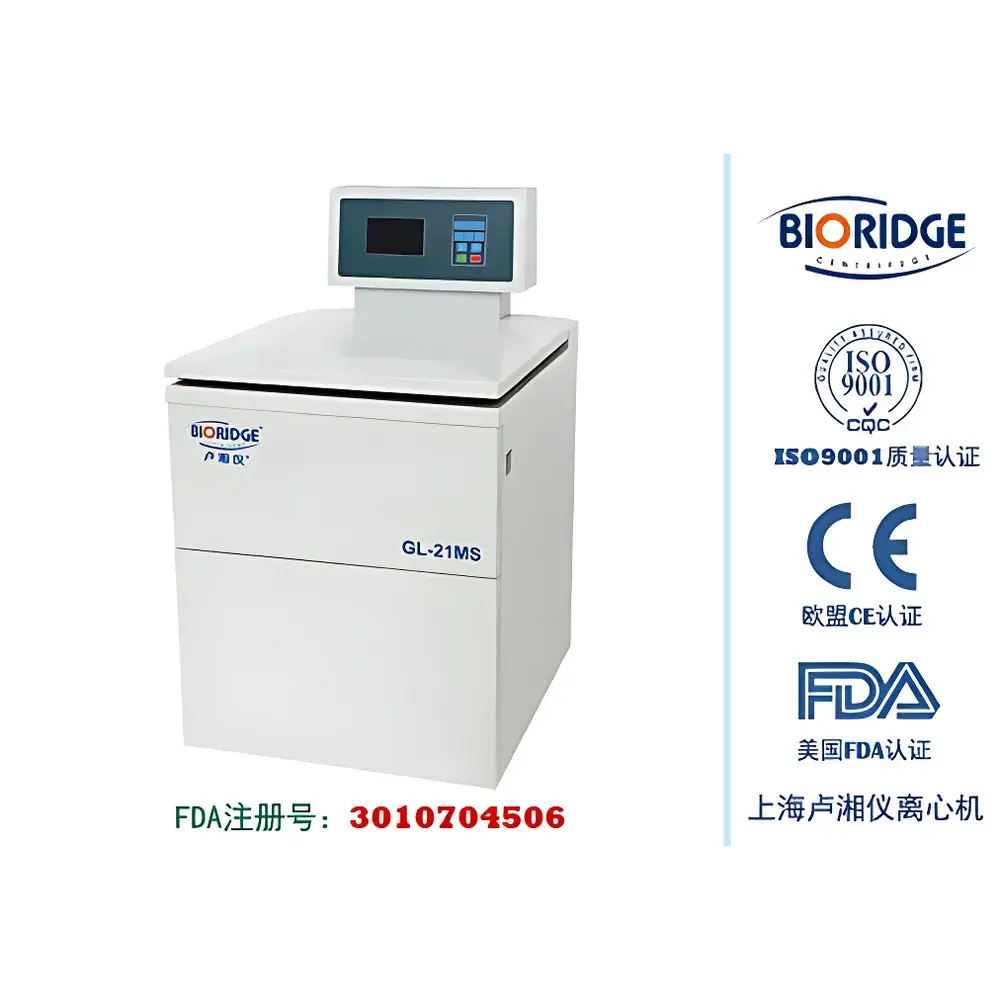
LuXiangYi GL-21M High-Speed Refrigerated Centrifuge
| Brand | LuXiangYi / BIORIDGE |
|---|---|
| Origin | Shanghai, China |
| Model | GL-21M |
| Instrument Type | Benchtop Centrifuge |
| Speed Range | 10,000–30,000 rpm |
| Cooling Function | Refrigerated (–20 °C to +40 °C) |
| Max. Capacity | 6 × 600 mL |
| Max. Speed | 21,000 rpm |
| Max. RCF | 50,400 × g |
| Dimensions (L×W×H) | 710 × 840 × 1200 mm |
| Net Weight | 290 kg |
| Noise Level | <65 dB(A) |
| Power Supply | AC 220 V, 50 Hz, 30 A |
| Temperature Accuracy | ±1 °C |
| Speed Accuracy | ±50 rpm |
| Timer Range | 1 min – 99 h 59 min |
| Refrigerant | R404a (non-ozone-depleting) |
| Compressor | Imported high-performance unit |
| Safety Features | Electronic door lock, overspeed/overtemperature/unbalance detection, automatic fault alarm |
| Acceleration/Deceleration Profiles | 10 programmable ramp curves |
Overview
The LuXiangYi GL-21M High-Speed Refrigerated Centrifuge is an engineered benchtop platform designed for demanding separation workflows in life science laboratories where precise temperature control, high g-force generation, and operational reproducibility are critical. Operating on the principle of sedimentation under controlled centrifugal acceleration, the GL-21M delivers up to 50,400 × g at 21,000 rpm—enabling efficient pelleting of subcellular organelles, viral particles, macromolecular complexes, and nucleic acid preparations. Its refrigerated architecture maintains sample integrity during prolonged runs by stabilizing rotor temperatures between –20 °C and +40 °C with ±1 °C accuracy, making it suitable for heat-sensitive biomolecules including enzymes, antibodies, and RNA. The system employs a high-torque brushless AC frequency-controlled motor coupled with precision-machined rotor assemblies and dynamic balancing algorithms to ensure mechanical stability and low-vibration operation (<65 dB[A]). All structural components—including the reinforced stainless-steel chamber and dual-layer insulated lid—are designed to meet international safety standards for Class II biosafety containment.
Key Features
- Microprocessor-based control system with intuitive touch interface and real-time rpm/RCF conversion display
- Programmable acceleration and deceleration profiles (10 user-defined ramp curves) for optimizing pellet morphology and minimizing sample resuspension
- Imported high-efficiency compressor using environmentally compliant R404a refrigerant, certified per ISO 14001 environmental management guidelines
- Dual-safety interlock system: electronic door latch with auto-locking mechanism plus redundant hardware-based overspeed, overtemperature, and imbalance detection
- Automatic parameter recall and storage of up to 10 pre-set protocols, supporting audit-ready documentation for GLP/GMP environments
- Robust cast-aluminum base and vibration-dampening feet for stable operation on standard laboratory countertops
- FDA 21 CFR Part 11–compatible data logging capability when integrated with optional LUX-CMS software suite
Sample Compatibility & Compliance
The GL-21M accommodates a broad spectrum of sample formats through its extensive catalog of certified rotors—including fixed-angle, horizontal, continuous-flow, and microplate carriers—supporting volumes from 0.2 mL tubes to 3 L processing vessels. Rotors are individually serialized and validated for maximum speed and load capacity per ISO 21501-4 and IEC 61010-2-020 safety requirements. The instrument complies with CE marking directives (2014/30/EU EMC, 2014/35/EU LVD), RoHS 2011/65/EU, and meets essential performance criteria outlined in CLSI EP17-A2 for centrifuge verification. For regulated pharmaceutical applications, rotor certification documents, calibration certificates, and IQ/OQ documentation packages are available upon request to support FDA inspection readiness.
Software & Data Management
While the GL-21M operates autonomously via its embedded controller, optional integration with the LUX-CMS (Centrifuge Management Suite) enables centralized fleet monitoring, remote protocol deployment, and secure electronic recordkeeping. LUX-CMS supports role-based user access, timestamped audit trails, and export of run logs in CSV or PDF format compliant with ALCOA+ principles. All temperature, speed, time, and RCF parameters are logged with millisecond resolution and digitally signed to satisfy 21 CFR Part 11 requirements for electronic signatures and record retention. Raw data files are stored in non-proprietary formats to ensure long-term archival compatibility and third-party analysis interoperability.
Applications
- Isolation of mitochondria, lysosomes, and synaptic vesicles from mammalian tissue homogenates (using NO.1–NO.14 fixed-angle rotors)
- High-yield purification of plasmid DNA and viral vectors via density gradient ultracentrifugation (compatible with NO.23/NO.24 titanium continuous-flow rotors)
- Clarification of bacterial and yeast lysates prior to chromatographic purification
- Processing of clinical blood samples for PBMC isolation and serum/plasma separation under CLIA-certified conditions
- Preparative-scale separation of monoclonal antibodies and recombinant proteins in bioprocessing development labs
- Enzyme activity assays requiring cold-chain preservation throughout centrifugation (e.g., kinase or phosphatase studies)
FAQ
What rotor configurations are certified for maximum speed (21,000 rpm)?
Fixed-angle rotors NO.1 (1.5/2.2 mL × 36), NO.3 (10 mL × 18), and NO.11 (50 mL × 6) are fully validated at 21,000 rpm and 50,400 × g. All rotors undergo annual recalibration and come with individual traceable certificates.
Does the GL-21M support validation for GMP manufacturing environments?
Yes—when equipped with LUX-CMS and operated with documented IQ/OQ protocols, the system satisfies Annex 11 and EU GMP Chapter 4 requirements for computerized system validation in pharmaceutical production.
Can the centrifuge maintain –20 °C at maximum speed?
Yes—the compressor and thermal management system are rated for full-load operation across the entire temperature range; cooling capacity is derated by ≤8% at 21,000 rpm, ensuring stable –20 °C chamber temperature during extended runs.
Are rotor adapters supplied with each rotor, or ordered separately?
All listed adapters (e.g., 0.2 mL, 0.5 mL, 5 mL) are included as standard accessories with their respective rotors. Custom adapter fabrication is available under NDA for specialized tube geometries.
What maintenance intervals are recommended for routine operation?
Compressor oil inspection every 12 months; rotor cavity cleaning after each use; full preventive maintenance—including bearing assessment and refrigerant pressure verification—every 24 months or 1,000 operating hours, whichever occurs first.
Related Products



