
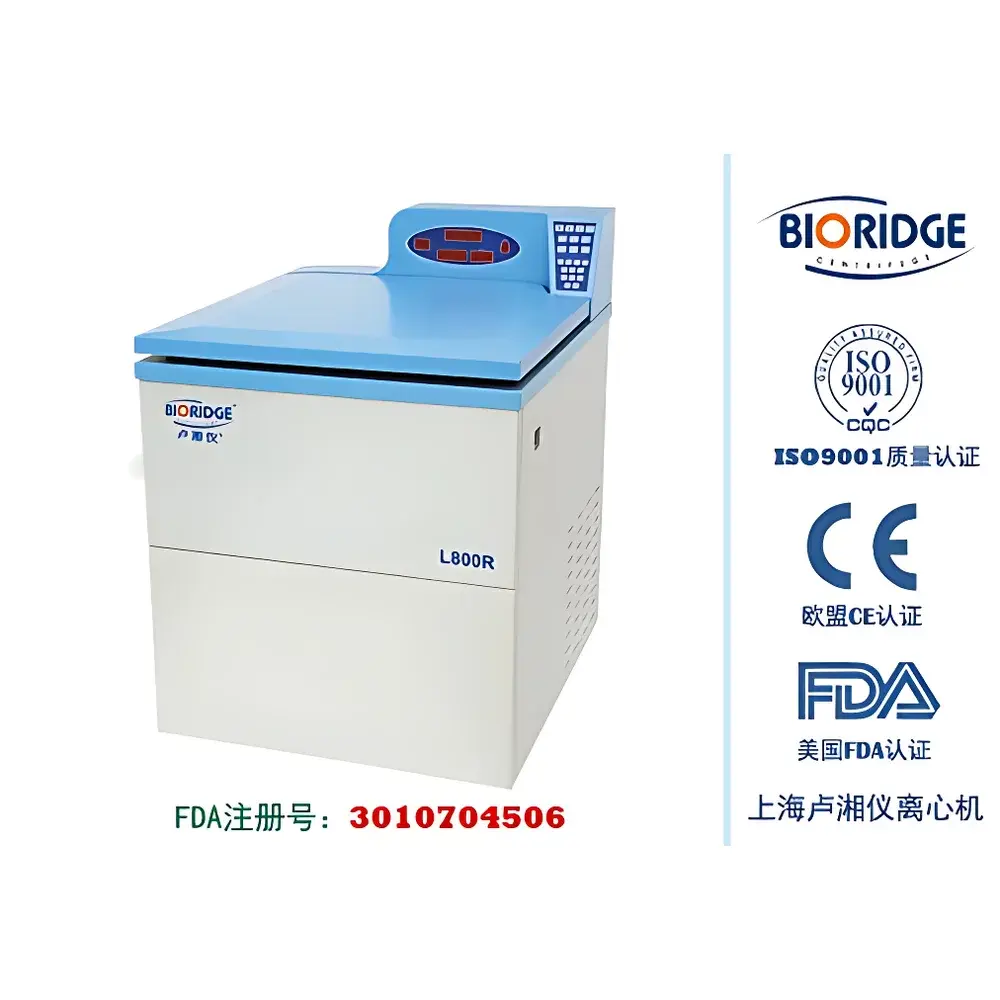
LuXiangYi L800R Ultra-High-Capacity Refrigerated Floor-Standing Centrifuge
| Brand | LuXiangYi / BIORIDGE |
|---|---|
| Origin | Shanghai, China |
| Model | L800R |
| Instrument Type | Floor-standing centrifuge |
| Centrifuge Category | Low-speed refrigerated centrifuge (max. 8,000 rpm) |
| Max. Capacity | 2400 mL × 6 |
| Max. Speed | 8,000 rpm |
| Max. RCF | 11,260 × g |
| Temperature Range | −20 °C to +40 °C |
| Temp. Accuracy | ±1 °C |
| Dimension (L×W×H) | 900 × 1000 × 1300 mm |
| Weight | 500 kg |
| Noise Level | <70 dB(A) |
| Power Supply | AC 380 V, 50 Hz, 40 A |
| Timer Range | 1 min – 99 h 59 min |
| Speed Accuracy | ±50 rpm |
| Refrigerant | R404a (non-ozone-depleting) |
| Compressor | High-performance imported unit |
| Rotor Configurations | Angle rotor (500/400 mL × 6, 8,000 rpm), Horizontal rotors (2000 mL × 6 & 2400 mL × 6, both at 4,500 rpm) |
Overview
The LuXiangYi L800R is an ultra-high-capacity refrigerated floor-standing centrifuge engineered for high-throughput separation of biological suspensions, blood components, and large-volume cell cultures in centralized clinical laboratories, biopharmaceutical manufacturing facilities, and plasma fractionation centers. It operates on the principle of sedimentation under controlled gravitational force (RCF), utilizing precise angular or horizontal rotor configurations to separate particles based on density, size, and shape. With a maximum capacity of 2400 mL × 6 per run—supporting up to twelve 400 mL triple- or quadruple-bag blood collections or twenty-four 200 mL triple bags—the L800R meets the rigorous demands of blood banking, vaccine production, and therapeutic protein purification where batch integrity, thermal stability, and reproducible pelleting are critical.
Key Features
- High-torque brushless frequency-controlled motor ensures stable rotational performance, low acoustic emission (<70 dB[A]), and speed accuracy within ±50 rpm across the full operating range (0–8,000 rpm).
- Advanced refrigeration system featuring an imported high-efficiency compressor and environmentally compliant R404a refrigerant maintains precise temperature control from −20 °C to +40 °C (±1 °C accuracy), enabling cold-sensitive sample preservation during extended runs.
- Intuitive touch-panel interface with large LCD display supports real-time dual-unit monitoring (rpm / RCF), programmable ramp/deceleration profiles (10 preset curves), and automatic parameter storage for repeatable protocols.
- Comprehensive safety architecture includes electronic lid lock, imbalance detection, overspeed cutoff, overtemperature protection, and fault-triggered audible/visual alarms—fully compliant with IEC 61010-2-020 safety standards for laboratory centrifuges.
- Modular rotor system accommodates three primary configurations: (1) angle rotor (500/400 mL × 6, 8,000 rpm, 11,260 × g); (2) standard horizontal rotor (2000 mL × 6, 4,500 rpm, 7,920 × g); and (3) ultra-capacity horizontal rotor (2400 mL × 6, 4,500 rpm, 7,920 × g), with optional adapters for 50 mL, 100 mL, and 250 mL tubes.
Sample Compatibility & Compliance
The L800R is validated for processing whole blood, platelet-rich plasma (PRP), leukocyte concentrates, viral harvests, and large-volume microbial lysates. Its rotor geometry and acceleration profiles are optimized for pelleting subcellular organelles—including mitochondria, lysosomes, and microsomes—as well as intact viruses and extracellular vesicles. The instrument complies with ISO 13485:2016 requirements for medical device manufacturing environments and supports GLP/GMP documentation workflows through timestamped parameter logging and non-volatile memory retention. While not FDA 510(k)-cleared as a Class II medical device, its operational parameters align with ASTM F2621-21 guidelines for centrifugal separation validation in biologics processing.
Software & Data Management
The embedded firmware provides audit-ready data handling without external PC dependency: all run logs—including start/stop time, setpoints (speed, temperature, duration), actual RCF, and error codes—are stored internally with time/date stamps. Optional RS-232 or Ethernet connectivity enables integration into LIMS environments for automated data export. Though no proprietary desktop software is bundled, the unit’s ASCII-formatted log output is compatible with common CSV parsers and statistical analysis platforms (e.g., JMP, Python pandas). All user-modifiable settings are password-protected to ensure protocol integrity in regulated settings.
Applications
- Blood banking: High-yield separation of red blood cells, white blood cells, and platelets from multi-bag systems under controlled hypothermic conditions.
- Biopharmaceutical upstream processing: Clarification of CHO or HEK293 cell culture harvests prior to depth filtration or chromatography.
- Vaccine development: Pelleting of inactivated virus particles or virus-like particles (VLPs) from large-scale bioreactor runs.
- Plasma derivatives manufacturing: Fractionation of cryoprecipitate, fibrinogen, and Factor VIII concentrates from thawed plasma pools.
- Academic core facilities: Scalable preparation of mitochondrial isolates, synaptosomal fractions, or exosome-enriched supernatants from tissue homogenates.
FAQ
What is the maximum certified load per rotor bucket in the 2400 mL horizontal configuration?
Each bucket accommodates one 400 mL blood bag or equivalent volume of liquid; total rotor load must not exceed 2400 mL × 6 with balanced mass distribution.
Does the L800R support 21 CFR Part 11-compliant electronic records?
No native e-signature or role-based access control is built-in; however, raw log exports meet ALCOA+ principles when paired with validated third-party LIMS or ELN systems.
Can the angle rotor be used for continuous operation at 8,000 rpm with full 500 mL tubes?
Yes—rated for continuous use at rated speed and capacity when tubes are filled to nominal volume and properly balanced.
Is R404a refrigerant still permissible under current EU F-Gas regulations?
R404a is restricted under EC No. 517/2014 but remains permitted for existing equipment servicing until 2030; users in EEA markets should consult local regulatory guidance for long-term compliance planning.
What maintenance intervals are recommended for the compressor and drive system?
Compressor oil and filter replacement every 24 months; motor bearing inspection and lubrication every 36 months—both performed by authorized service technicians using OEM-specified parts.



