
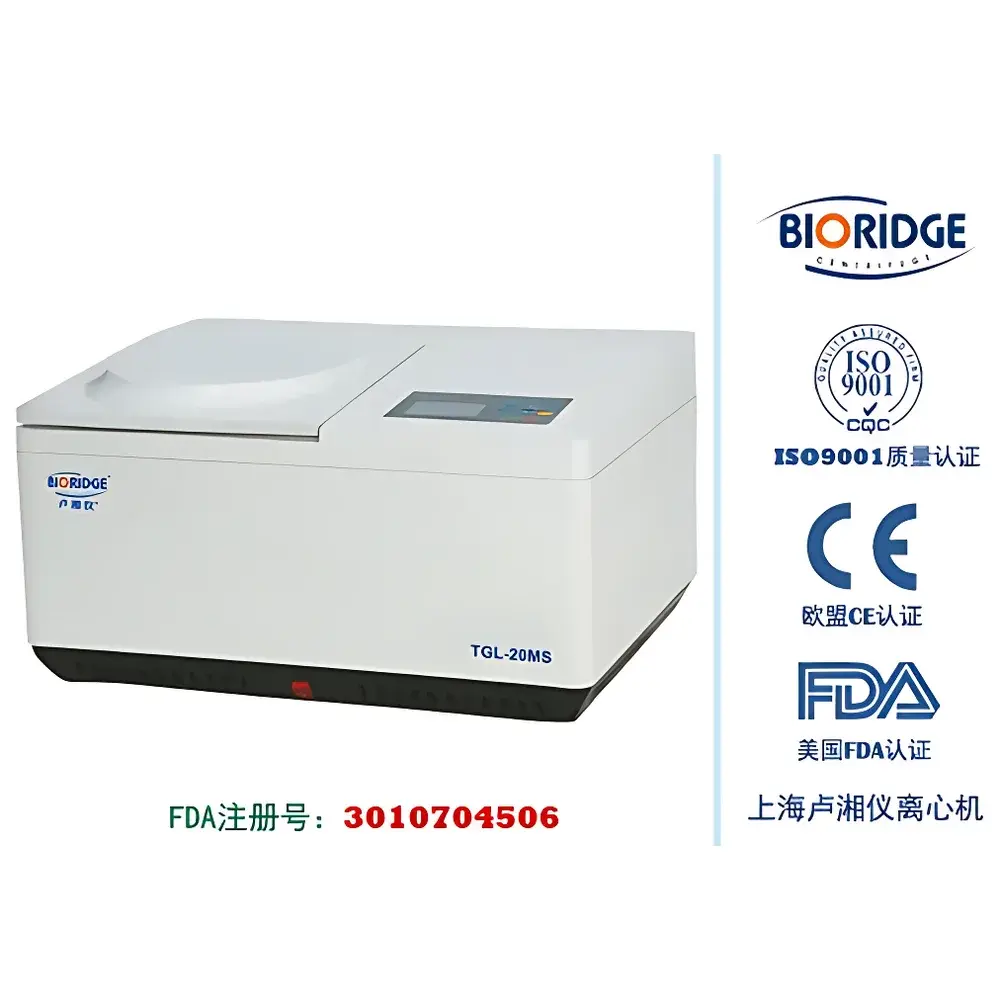
LuXiangYi TGL-20MS Benchtop High-Speed Refrigerated Centrifuge
| Brand | LuXiangYi / BIORIDGE |
|---|---|
| Origin | Shanghai, China |
| Model | TGL-20MS |
| Instrument Type | Benchtop Centrifuge |
| Category | High-Speed Refrigerated Centrifuge (10,000–30,000 rpm) |
| Max. Speed | 20,000 rpm |
| Max. RCF | 27,800 × g |
| Max. Capacity | 4 × 100 mL |
| Temperature Range | −20 °C to +40 °C |
| Temp. Accuracy | ±1 °C |
| Noise Level | <65 dB(A) |
| Dimensions (L×W×H) | 600 × 470 × 330 mm |
| Net Weight | 50 kg |
| Power Supply | AC 220 V, 50 Hz, 15 A |
| Refrigerant | R134a (eco-friendly) |
| Motor | High-torque AC frequency-controlled motor |
| Control Interface | Large LCD touchscreen with programmable protocols |
| Acceleration/Deceleration Profiles | 9 selectable ramp curves |
| Safety Features | Electronic door lock, overspeed protection, overtemperature cutoff, automatic fault diagnostics |
Overview
The LuXiangYi TGL-20MS Benchtop High-Speed Refrigerated Centrifuge is engineered for precise, reproducible separation of biological macromolecules—including nucleic acids, proteins, subcellular organelles, and viral particles—under controlled thermal conditions. Utilizing a high-torque AC frequency-controlled motor and advanced microprocessor-based control architecture, the TGL-20MS delivers stable rotational dynamics across its full operational range (up to 20,000 rpm / 27,800 × g), with minimal vibration and acoustic emission (<65 dB[A]). Its integrated refrigeration system—featuring an imported high-efficiency compressor and environmentally compliant R134a refrigerant—maintains sample integrity during extended runs by sustaining temperature setpoints from −20 °C to +40 °C with ±1 °C accuracy. Designed for compliance with routine laboratory workflow requirements, the unit supports both GMP-aligned process documentation and GLP-compliant operation through audit-ready parameter logging and user-accessible protocol storage.
Key Features
- Microprocessor-controlled operation with large backlit LCD touchscreen interface for intuitive programming and real-time monitoring of rpm, RCF, time, and temperature.
- Programmable acceleration and deceleration profiles: nine distinct ramp curves allow optimization of shear-sensitive separations (e.g., plasmid prep, exosome isolation).
- Electronic safety interlock system with auto-door locking, overspeed cutoff, overtemperature shutdown, and self-diagnostic error reporting.
- High-reproducibility rotor recognition via mechanical indexing; all rotors are balanced and certified to ISO 15189 and IEC 61010-2-020 standards.
- Energy-efficient thermal management: rapid cooldown (<15 min from ambient to −20 °C) and low standby power consumption.
- Comprehensive rotor compatibility—including fixed-angle, swing-out, and microplate carriers—enabling flexible adaptation to diverse sample formats (0.2 mL to 100 mL).
Sample Compatibility & Compliance
The TGL-20MS accommodates a broad spectrum of biospecimen types and container geometries, including 0.2–2.2 mL microtubes, 5–15 mL conical tubes, 50–100 mL centrifuge bottles, and standard 48-well microplates. All accessory rotors are validated for use with common labware materials (polypropylene, polycarbonate, polyethylene) and undergo batch-specific certification per ISO 20957-2 (centrifuge safety) and ISO 13485 (medical device quality systems). The instrument’s firmware architecture supports traceable operation under FDA 21 CFR Part 11 guidelines when paired with optional secure user authentication and electronic log export functionality. Temperature stability and run repeatability meet ASTM E2920-21 criteria for refrigerated centrifuge performance verification.
Software & Data Management
While the TGL-20MS operates autonomously via its embedded controller, it supports external data capture through RS-232 or optional USB-to-serial interface. Each run logs timestamped parameters—including setpoint values, actual measured rpm/RCF/temp, duration, and fault codes—in non-volatile memory (retains ≥1,000 cycles). Protocols can be saved, recalled, and duplicated directly on-device, with password-protected administrator access for critical settings modification. Exported CSV logs are compatible with LIMS integration and statistical process control (SPC) analysis tools. Optional PC-based configuration software enables centralized fleet management, firmware updates, and audit trail generation aligned with ISO/IEC 17025 documentation requirements.
Applications
- Clinical diagnostics: serum/plasma separation, PBMC isolation, pathogen pellet recovery.
- Molecular biology: plasmid DNA purification, RNA extraction, PCR cleanup, CRISPR ribonucleoprotein complex pelleting.
- Cell biology: mitochondrial and lysosomal fractionation, nuclear extraction, exosome enrichment (differential ultracentrifugation at ≤20,000 × g).
- Immunology: antibody purification, antigen-antibody complex sedimentation, ELISA plate spin-down.
- Biopharmaceutical QC: buffer exchange validation, aggregate removal from monoclonal antibody formulations, viral vector clarification.
FAQ
What is the maximum allowable imbalance tolerance for the TGL-20MS?
The instrument complies with ISO 15189 Annex C specifications: maximum load imbalance is ±0.5 g per tube position in symmetric configurations; rotor-specific tolerances are engraved on each rotor body and documented in the operator manual.
Can the TGL-20MS be operated without refrigeration?
Yes—the unit supports ambient-temperature operation (‘refrigeration off’ mode) for heat-labile samples or short-duration spins where thermal control is not required.
Is rotor NO.6 (100 mL × 4) compatible with all speed settings?
No—rotor NO.6 is rated for ≤12,000 rpm (13,000 × g); exceeding this limit triggers immediate overspeed shutdown and error code display.
How frequently should the refrigeration system be serviced?
Under normal usage (≤4 hrs/day, 5 days/week), annual preventive maintenance—including refrigerant pressure check, condenser cleaning, and seal integrity verification—is recommended per IEC 61000-4-11 guidelines.
Does the TGL-20MS support remote monitoring or network connectivity?
Standard configuration includes local control only; Ethernet or Wi-Fi modules are available as factory-installed options for integration into institutional IoT infrastructure and centralized equipment monitoring platforms.



