
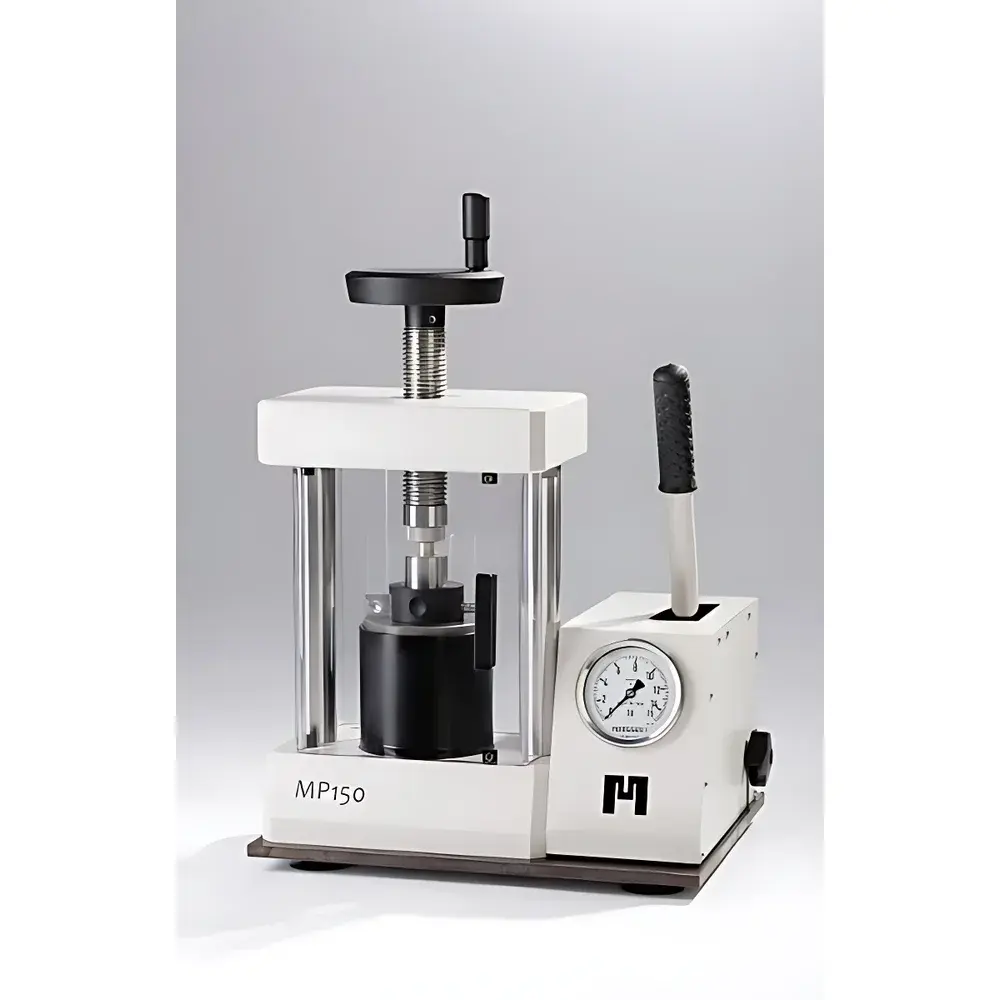
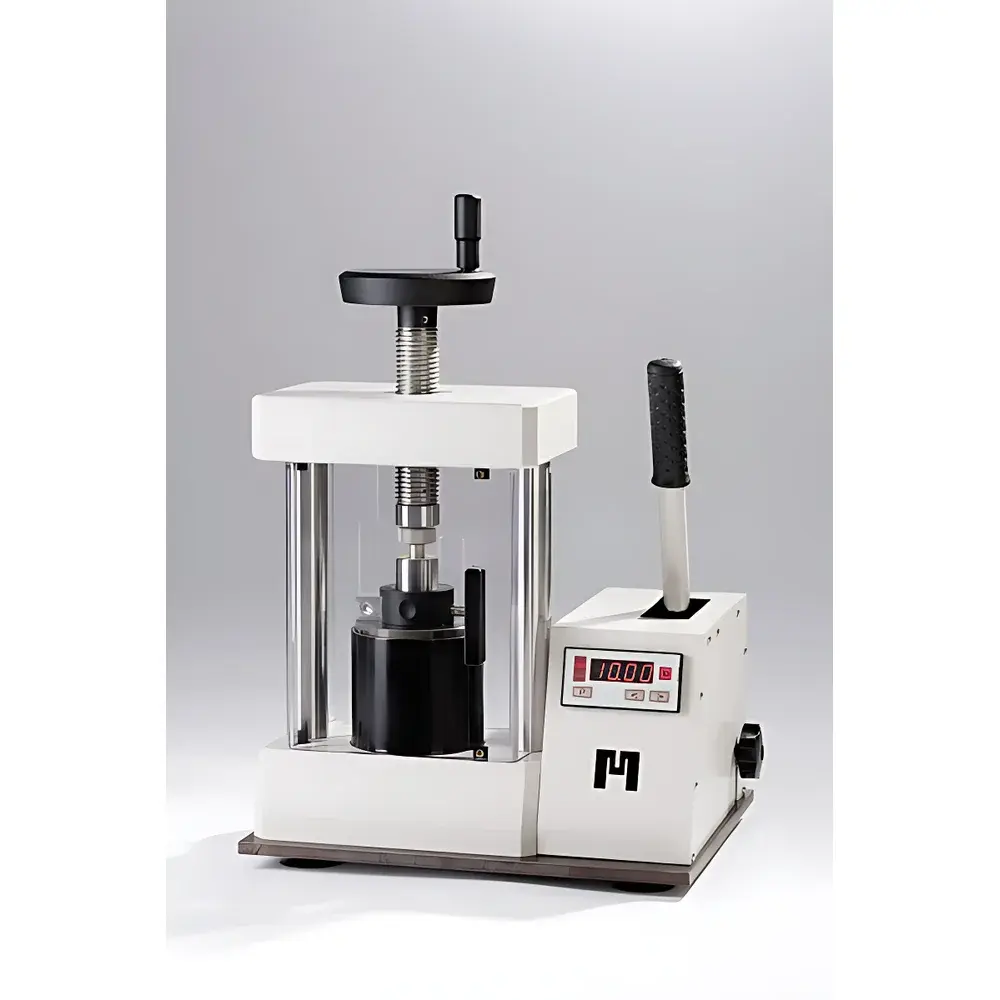
Maassen MP150 and MP150D Manual Pellet Press (15-Ton Maximum Force)
| Brand | Maassen |
|---|---|
| Origin | Germany |
| Model | MP150 / MP150D |
| Type | Manual Hydraulic Pellet Press |
| Maximum Force | 15 tons (147 kN) |
| Pressure Display | Analog (MP150, ±0.25 ton resolution) or Digital (MP150D, ±0.01 ton resolution) |
| Platen Opening Width | 150 mm |
| Minimum–Maximum Net Height | 10–115 mm |
| Column Diameter | 105 mm |
| Stroke | 25 mm |
| Handle Diameter | 35 mm |
| Handle Max Travel | 100 mm |
| Net Weight | 43 kg |
| Dimensions (W×D×H) | 400 × 360 × 300 mm |
| Construction | Stainless steel frame + high-grade aluminum components |
| Safety Features | Polycarbonate safety shield, mechanical stroke limiter, active pressure limiter, manual bleed valve |
| Mold Compatibility | 10–40 mm diameter dies (standard and low-load applications) |
| Compliance | Designed and manufactured in accordance with DIN EN ISO 9001 |
Overview
The Maassen MP150 and MP150D are precision-engineered manual hydraulic pellet presses developed and manufactured in Germany for reproducible, contamination-free sample compaction in analytical laboratories. These instruments operate on a dual-stage hydraulic principle: an initial rapid-fill stage minimizes operator effort during piston advancement under no-load conditions, followed by a fine-control compression stage enabling precise force application up to 15 metric tons (147 kN). Designed specifically for X-ray fluorescence (XRF), radiofrequency absorption (RFA), and Fourier-transform infrared (FT-IR) spectroscopy sample preparation, the MP150 series ensures uniform pellet density, minimal binder migration, and high inter-run repeatability—critical parameters for quantitative elemental and molecular analysis. The press architecture integrates structural rigidity with ergonomic operation, eliminating reliance on external power supplies while maintaining full compliance with laboratory safety and quality assurance requirements.
Key Features
- Two-stage hydraulic system: Enables rapid piston approach (fast-fill) followed by controlled, low-effort compaction—reducing operator fatigue and improving process consistency.
- Integrated mechanical stroke limiter: Prevents over-travel of the ram, protecting both die sets and internal hydraulic components from mechanical overload.
- Active pressure limiter: Independently adjustable on the MP150D model (±0.01 ton resolution); provides programmable upper-force cutoff to safeguard low-pressure molds (e.g., 8–13 mm diameter dies).
- Polycarbonate safety shield: Fully transparent, impact-resistant enclosure compliant with EN 13857 (safe distances for machinery) and integrated into the frame without compromising accessibility.
- Corrosion-resistant construction: Primary load-bearing elements fabricated from stainless steel; non-load-critical housings and levers machined from aerospace-grade anodized aluminum.
- Manual pressure release valve: Located on the right-hand side for intuitive, stepwise depressurization—enabling controlled piston retraction and safe die ejection.
- No-maintenance design: Sealed hydraulic circuit with mineral oil-based fluid; no scheduled servicing intervals required under normal laboratory use (per Maassen Technical Bulletin TB-MP-2023-01).
Sample Compatibility & Compliance
The MP150 and MP150D accommodate standard die sets ranging from 10 mm to 40 mm in diameter—including custom geometries for pressed pellets used in XRF fusion discs, FT-IR KBr tablets, and pharmaceutical tablet hardness qualification. Their 150 mm platen opening width supports both single-die and multi-cavity configurations. Both models meet mechanical safety requirements per EN 61000-6-2 (EMC immunity) and EN 61000-6-4 (EMC emission), despite being manually operated. For regulated environments, the MP150D’s digital pressure readout supports audit-ready documentation when paired with Maassen’s optional RS-232 data logger (Model DL-232-PR), enabling traceable force records aligned with GLP and 21 CFR Part 11 Annex 11 principles. The system is routinely validated for ASTM E1362 (XRF pellet preparation), ISO 1833-1 (textile fiber quantification via pressed standards), and pharmacopeial methods requiring compaction force documentation (e.g., Ph. Eur. 2.9.40).
Software & Data Management
While the MP150 operates without embedded firmware, the MP150D incorporates a microprocessor-controlled pressure transducer calibrated to NIST-traceable standards (certified annually per ISO/IEC 17025). Its 4-digit LED display updates at 10 Hz and retains last-set pressure limit values across power cycles. Optional connectivity includes RS-232 output for real-time force logging into LIMS or ELN platforms (e.g., LabVantage, Benchling), with timestamped CSV export supporting FDA 21 CFR Part 11-compliant electronic signatures when deployed with validated middleware. No proprietary software installation is required—raw serial data streams are ASCII-formatted and parseable via Python, MATLAB, or Excel Power Query.
Applications
- XRF sample preparation: High-density, binder-free pellets for geological, metallurgical, and environmental matrices (soils, slags, ores).
- FT-IR transmission spectroscopy: Uniform 13 mm KBr pellets with ≤±2% thickness variation across batches (validated per ASTM E1421).
- Pharmaceutical QA/QC: Compaction force profiling during excipient compatibility studies and generic drug product development.
- Materials science: Cold-pressing ceramic precursors, battery electrode slurries, and polymer composites prior to sintering or rheological characterization.
- Academic research: Teaching labs requiring robust, intuitive instrumentation for hands-on instruction in powder metallurgy and solid-state chemistry fundamentals.
FAQ
What is the difference between MP150 and MP150D?
The MP150 uses an analog 80 mm pressure gauge with 0.25-ton graduation; the MP150D replaces this with a digital display offering 0.01-ton resolution and programmable pressure limiting.
Can I use the MP150D for sub-10 mm dies?
Yes—its adjustable pressure limiter allows safe operation down to 0.1-ton minimum setpoints, making it suitable for micro-dies (e.g., 8 mm) commonly used in micro-XRF calibration standards.
Is hydraulic fluid replacement required?
No—Maassen specifies lifetime sealing of the hydraulic circuit under ISO 8573-1 Class 4 air quality conditions; fluid inspection is recommended only after 10,000 compression cycles or visible leakage.
Does the polycarbonate shield interfere with die loading?
No—the hinged front panel opens fully (180°) and locks magnetically in the open position, permitting unobstructed access to the platen and column assembly.
How is force accuracy verified?
Maassen provides factory calibration certificates traceable to PTB (Physikalisch-Technische Bundesanstalt); users may perform in-house verification using certified load cells (e.g., HBM U10M) mounted between die and platen per ISO 376 procedures.



