
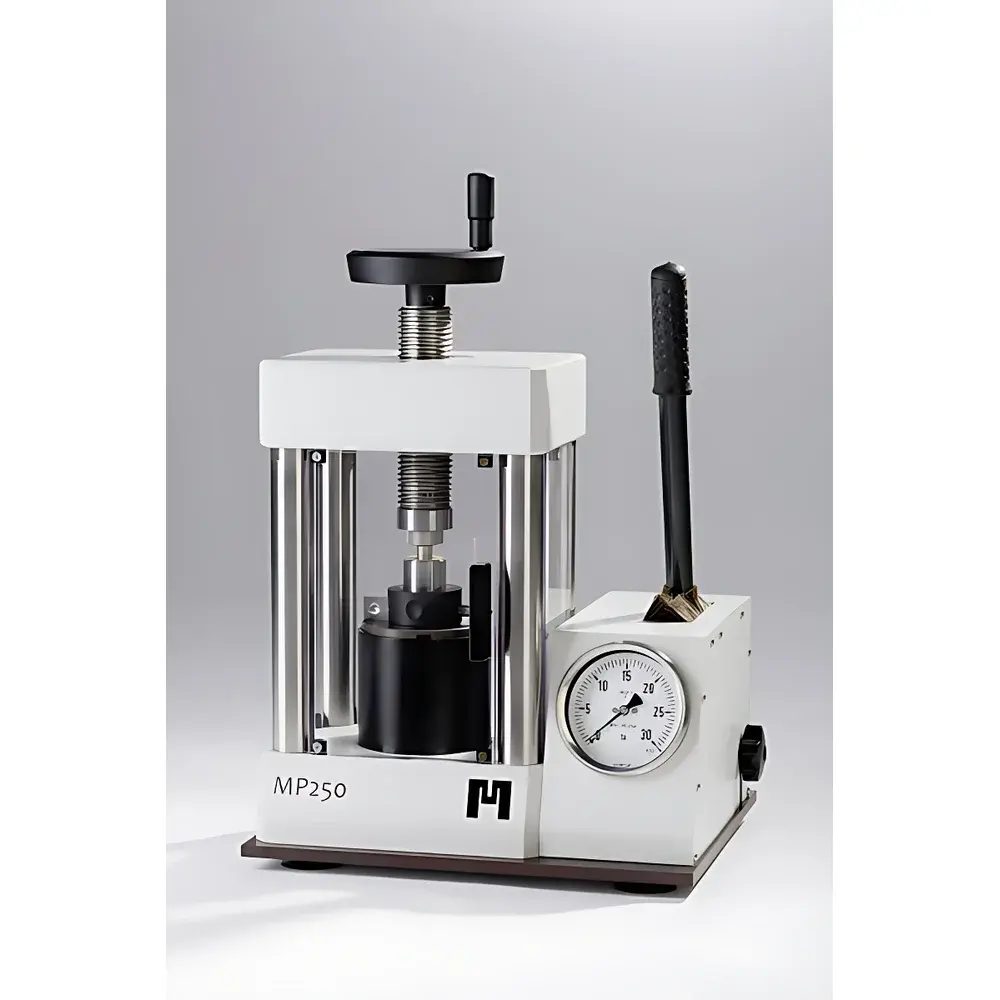
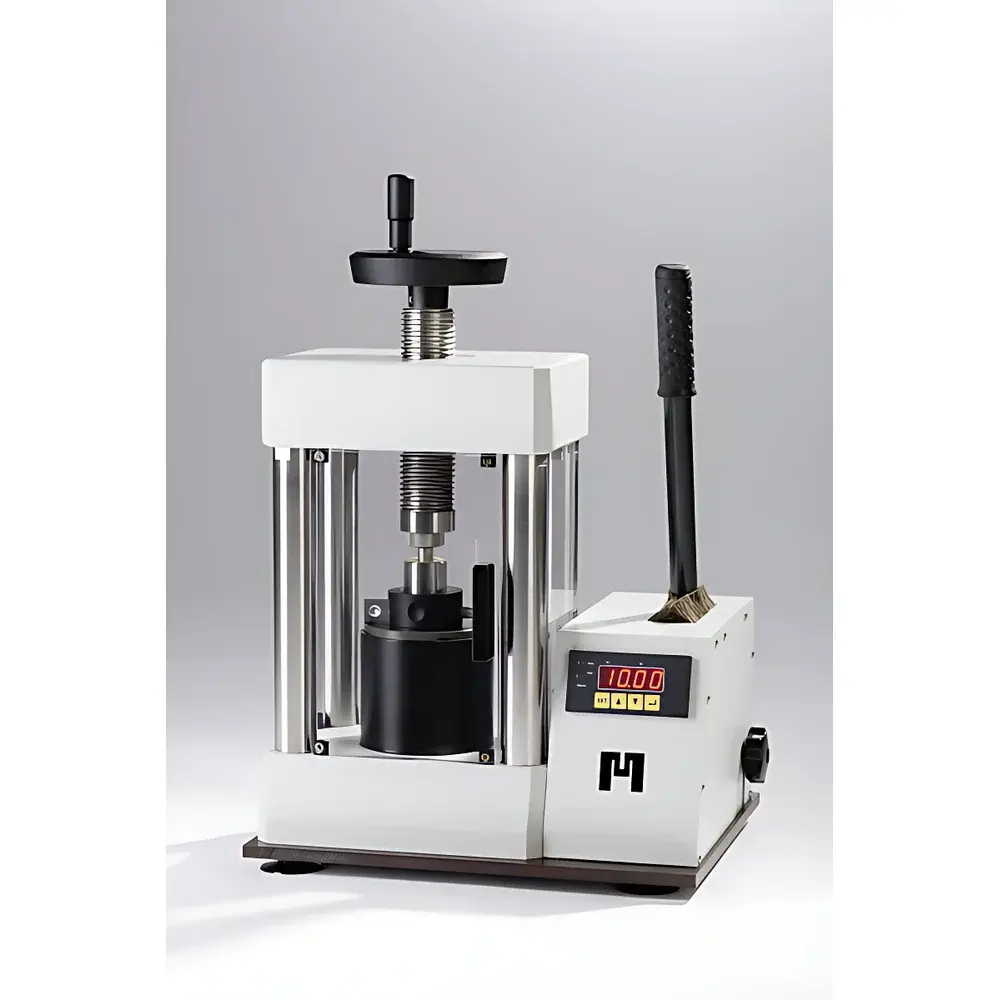
Maassen MP250 and MP250D Manual Pellet Press (30-Ton Maximum Force)
| Brand | Maassen |
|---|---|
| Origin | Germany |
| Model | MP250 / MP250D |
| Type | Manual Pellet Press |
| Maximum Force | 30 tons (294 kN) |
| Force Display | Analog (MP250, 0.5-ton increments) or Digital (MP250D, 0.01-ton resolution) |
| Column Spacing | 150 mm |
| Minimum/Maximum Net Height | 10 mm / 115 mm |
| Platen Diameter | 105 mm |
| Platen Stroke | 25 mm |
| Handle Diameter | 45 mm |
| Handle Stroke | 105 mm |
| Net Weight | 49.5 kg (MP250), 49 kg (MP250D) |
| Dimensions (W×D×H) | 400 × 360 × 300 mm |
| Construction | Stainless steel frame and high-grade aluminum components |
| Safety Features | Mechanical stroke limiter, active pressure limiter, polycarbonate safety guard |
| Compliance | Designed for ISO/IEC 17025-compliant sample preparation environments |
Overview
The Maassen MP250 and MP250D are precision-engineered manual hydraulic pellet presses developed in Germany for reproducible, high-force sample compaction in analytical laboratories. These instruments operate on a dual-stage hydraulic principle: an initial rapid-fill stage minimizes idle time, followed by a controlled high-pressure compaction phase delivering up to 30 tons (294 kN) of calibrated force. The MP250 employs an analog pressure gauge with 0.5-ton graduations and a 100-mm-diameter dial face; the MP250D integrates a four-digit digital display with 0.01-ton (10 kgf) resolution and programmable pressure limiting—enabling safe, repeatable operation across diverse mold geometries. Both models feature a rigid four-column architecture with 150 mm column spacing, accommodating molds up to 40 mm in diameter while maintaining structural stability under full load. The system is fully self-contained, requires no external power supply (except for the MP250D’s optional 12 V DC display module), and incorporates a polycarbonate safety shield compliant with EN 61496-1 for operator protection during operation.
Key Features
- Two-stage hydraulic pump mechanism: Fast initial ram advancement followed by precise high-force compression—reducing operator fatigue and improving cycle consistency.
- Mechanically limited platen stroke prevents over-compression and protects both die sets and internal components from mechanical overload.
- Active pressure limiter (standard on MP250D, optional on MP250): Programmable upper force threshold ensures compliance with low-tolerance applications such as fragile IR pellets or thin-film XRF standards.
- Robust construction using stainless steel structural elements and aerospace-grade aluminum alloy components—optimized for long-term dimensional stability and corrosion resistance in humid or chemically exposed lab environments.
- Ergonomic handwheel (45 mm diameter, 105 mm stroke) with integrated slow-release valve allows controlled decompression and precise positioning of the platen within ±0.1 mm repeatability.
- Interchangeable die compatibility: Supports standard diameters from 13 mm to 40 mm—including common XRF (32 mm, 40 mm), FT-IR (13 mm, 25 mm), and RFA-specific configurations—without adapter kits.
Sample Compatibility & Compliance
The MP250 series is validated for use in certified reference material (CRM) preparation, geological matrix standardization, pharmaceutical tablet validation, and environmental powder homogenization workflows. It meets mechanical design requirements aligned with ISO 17025:2017 Clause 6.4 (Equipment) and supports GLP/GMP traceability when paired with documented calibration records. While not an electronic data capture device per se, the MP250D’s digital readout enables manual entry into LIMS or ELN systems with timestamped pressure logs. The absence of firmware or network connectivity eliminates cybersecurity concerns associated with FDA 21 CFR Part 11 compliance—making it suitable for regulated QC labs where audit-ready documentation relies on procedural control rather than software validation.
Software & Data Management
Neither the MP250 nor MP250D includes embedded software or proprietary drivers. The MP250D’s digital display provides local real-time force readout only; no data export, USB interface, or PC connectivity is implemented. This design philosophy prioritizes mechanical reliability, regulatory transparency, and ease of third-party integration: users record pressure values manually alongside sample IDs and batch numbers in paper-based or validated electronic lab notebooks. For laboratories requiring automated data capture, Maassen recommends coupling the press with external load-cell interfaces compatible with LabVIEW™ or MATLAB® via analog voltage output (available upon request for OEM integration).
Applications
- X-ray fluorescence (XRF) and radiofrequency analysis (RFA): Preparation of homogeneous pressed pellets from powdered ores, soils, ceramics, and metallurgical slags at consistent density and surface flatness.
- Fourier-transform infrared (FT-IR) spectroscopy: Fabrication of KBr or polyethylene dispersion pellets with minimal scattering artifacts and optimal transmission characteristics.
- Quality control in cement, coal, and mineral processing: Reproducible compaction of heterogeneous feedstock for elemental assay standardization.
- Academic research in materials science: Controlled densification of ceramic precursors, battery electrode slurries, and polymer composites prior to sintering or mechanical testing.
- Environmental monitoring labs: Standardized pellet formation for EPA Method 6010D and ISO 12846 compliance in heavy metal quantification workflows.
FAQ
What is the maximum recommended operating pressure for routine use?
The rated maximum force is 30 tons (294 kN); however, sustained operation above 25 tons is discouraged unless validated for specific die geometry and material compressibility.
Can the MP250D be calibrated in-house?
Yes—calibration is performed using NIST-traceable deadweight test kits applied directly to the platen; Maassen provides detailed procedures in the technical manual (Document No. MA-TP-MP250-Rev.4).
Is the polycarbonate guard certified to any impact standard?
The guard conforms to EN 166:2002 Category B (low-energy impact resistance) and is rated for static loads up to 500 N without deformation.
Do these presses require periodic hydraulic fluid replacement?
No—the sealed, maintenance-free hydraulic system uses ISO VG 32 mineral oil pre-filled at factory; no servicing interval is specified under normal laboratory conditions.
Are custom die holders available for non-standard mold dimensions?
Maassen offers CNC-machined adapter plates for 8 mm, 50 mm, and segmented multi-cavity dies; lead time is typically 4–6 weeks from order confirmation.



