
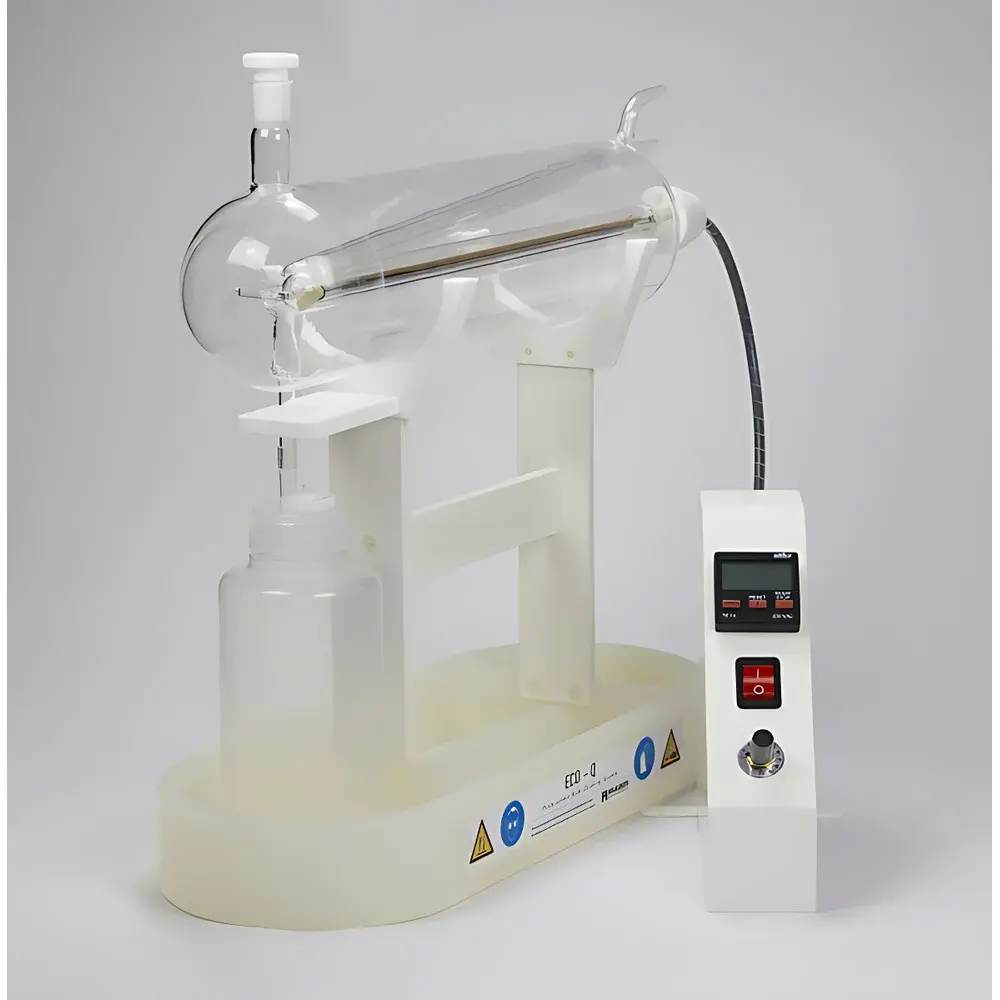
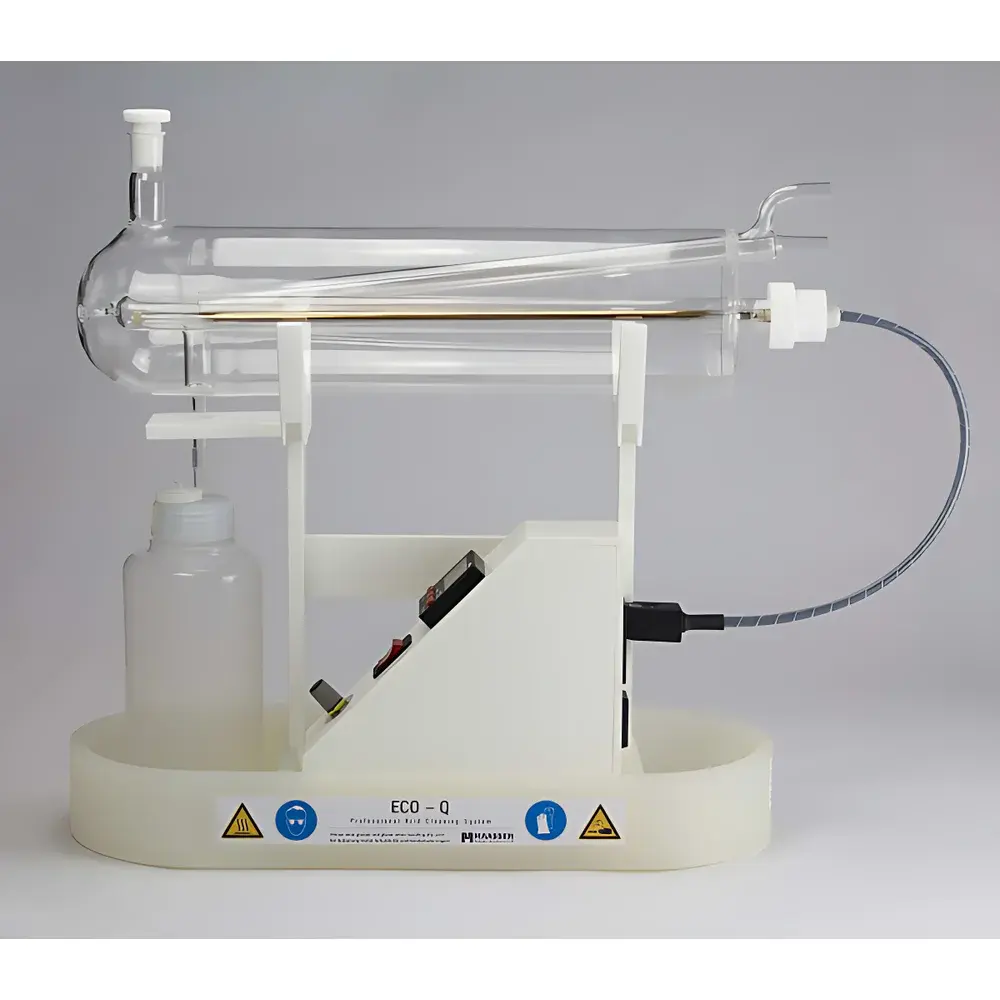
MAASSEN Quartz ECO Sub-Boiling Acid Distillation System
| Brand | MAASSEN |
|---|---|
| Origin | Germany |
| Model | Quartz ECO |
| Instrument Type | Sub-boiling Distiller |
| Compatible Acids | HCl, HNO₃, H₂SO₄, H₂O (excludes HF) |
| Construction Materials | High-purity fused quartz (heater tube, chamber, condenser), PFA collection bottle (1 L), PTFE/PP support frame, PTFE filters |
| Heating Method | Infrared (IR) radiant heating |
| Cooling | Quartz condenser with ambient air convection |
| Power Control | Continuously adjustable, non-boiling thermal regulation |
| Compliance | Metal-free architecture compliant with trace-metal analysis requirements for ISO/IEC 17025 laboratories |
Overview
The MAASSEN Quartz ECO Sub-Boiling Acid Distillation System is a precision-engineered, fully quartz-based purification apparatus designed for the production of ultra-trace-metal-free acids and ultrapure water in analytical chemistry laboratories. Operating on the principle of sub-boiling distillation—where liquid phase vaporization occurs at temperatures significantly below the atmospheric boiling point—the system avoids nucleate boiling, turbulence, and aerosol carryover that compromise purity in conventional distillation. Infrared radiation heats only the liquid surface layer, generating vapor through gentle thermal excitation; this vapor migrates upward into a high-purity fused quartz condenser, where it undergoes controlled condensation without contact with metallic or polymer surfaces. The resulting distillate exhibits exceptionally low background levels of Al, Cr, Cu, Fe, Ni, Pb, and other transition metals—critical for applications demanding detection limits in the low-atto- to zepto-mole range.
Key Features
- Fused quartz construction throughout all wetted and vapor-path components—including IR heater tube, reaction chamber, condenser, and vapor conduit—eliminates metal leaching and ensures chemical inertness toward aggressive mineral acids.
- Adjustable IR power control enables precise thermal management: operators can tune heating intensity to maintain quiescent liquid surface conditions, optimizing distillate purity over throughput rate.
- PFA (perfluoroalkoxy alkane) 1-L collection bottle provides certified low-metal extractables and compatibility with HCl, HNO₃, H₂SO₄, and deionized water.
- PTFE particulate filters integrated into both the PTFE cap and PFA bottle lid ensure pressure equilibration while preventing airborne contamination ingress during operation.
- Non-metallic support frame fabricated from chemically resistant PTFE and polypropylene serves as a spill containment tray and isolates all electrical controls from corrosive environments.
- Sealed silicone-encapsulated power adjustment knob prevents accidental contact with conductive surfaces and enhances long-term operational safety in humid or acid-laden atmospheres.
Sample Compatibility & Compliance
The Quartz ECO system is validated for sub-boiling purification of hydrochloric acid (HCl), nitric acid (HNO₃), sulfuric acid (H₂SO₄), and high-resistivity water (≥18.2 MΩ·cm). It is explicitly not rated for hydrofluoric acid (HF) due to quartz’s susceptibility to etching under HF exposure. All materials meet ASTM D1193 Type I water specifications and are compatible with USP , ISO 3696 Class 1, and CLSI EP21-A guidelines for reagent-grade purity. The metal-free architecture supports GLP and GMP workflows requiring documented contamination control, and its design aligns with ISO/IEC 17025 clause 5.5.2 (equipment suitability for intended use) when deployed in accredited trace-element laboratories.
Software & Data Management
The Quartz ECO is a manually operated, analog-controlled system with no embedded firmware or digital interface. Its operational integrity relies on operator training, procedural documentation, and routine verification via ICP-MS or ICP-OES blank analysis. Laboratories integrating the system into regulated environments may implement electronic lab notebook (ELN) entries for batch logs—including date, acid lot number, volume processed, collection time, and post-distillation elemental screening results—to satisfy FDA 21 CFR Part 11 audit trail requirements. Calibration and performance qualification (PQ) protocols are typically executed quarterly using certified reference materials (CRMs) such as NIST SRM 3100 series or Inorganic Ventures QC standards.
Applications
This system is routinely deployed in laboratories performing trace-element analysis by graphite furnace atomic absorption spectroscopy (GFAAS), inductively coupled plasma optical emission spectrometry (ICP-OES), and inductively coupled plasma mass spectrometry (ICP-MS). It supports preparation of calibration standards, instrument rinse solutions, and sample diluents where matrix-induced polyatomic interferences or memory effects must be minimized. Environmental testing labs use it for EPA Methods 200.8 and 6020B compliance; geochemical and nuclear research facilities rely on it for REE and actinide separations; and semiconductor metrology labs apply it to prepare cleaning reagents meeting SEMI C1–C12 purity tiers.
FAQ
Can the Quartz ECO purify hydrofluoric acid (HF)?
No. Quartz is chemically attacked by HF at room temperature and elevated temperatures; HF distillation requires fluoropolymer-lined or platinum-based systems.
What is the typical distillation rate for HNO₃ at optimal purity settings?
Under standard operating conditions (20–25°C ambient, 30–40% IR power), the system yields approximately 15–25 mL/hour of high-purity HNO₃—prioritizing purity over speed per ISO 15195 guidance.
How often should the quartz components be inspected for surface degradation?
Visual inspection is recommended after every 500 hours of cumulative operation; microscopic pitting or haze indicates replacement need—especially for the condenser tube.
Is third-party certification available for the distilled acid output?
MAASSEN does not provide certificate of analysis (CoA); users must perform in-house verification using ICP-MS or sector-field ICP-MS against CRM blanks per ISO/IEC 17025 method validation requirements.
Can previously contaminated acid be re-distilled?
Yes—provided the contamination is non-volatile (e.g., particulate metals or oxides); volatile organics or low-boiling impurities may co-distill and require pre-filtration or alternative pretreatment.



