
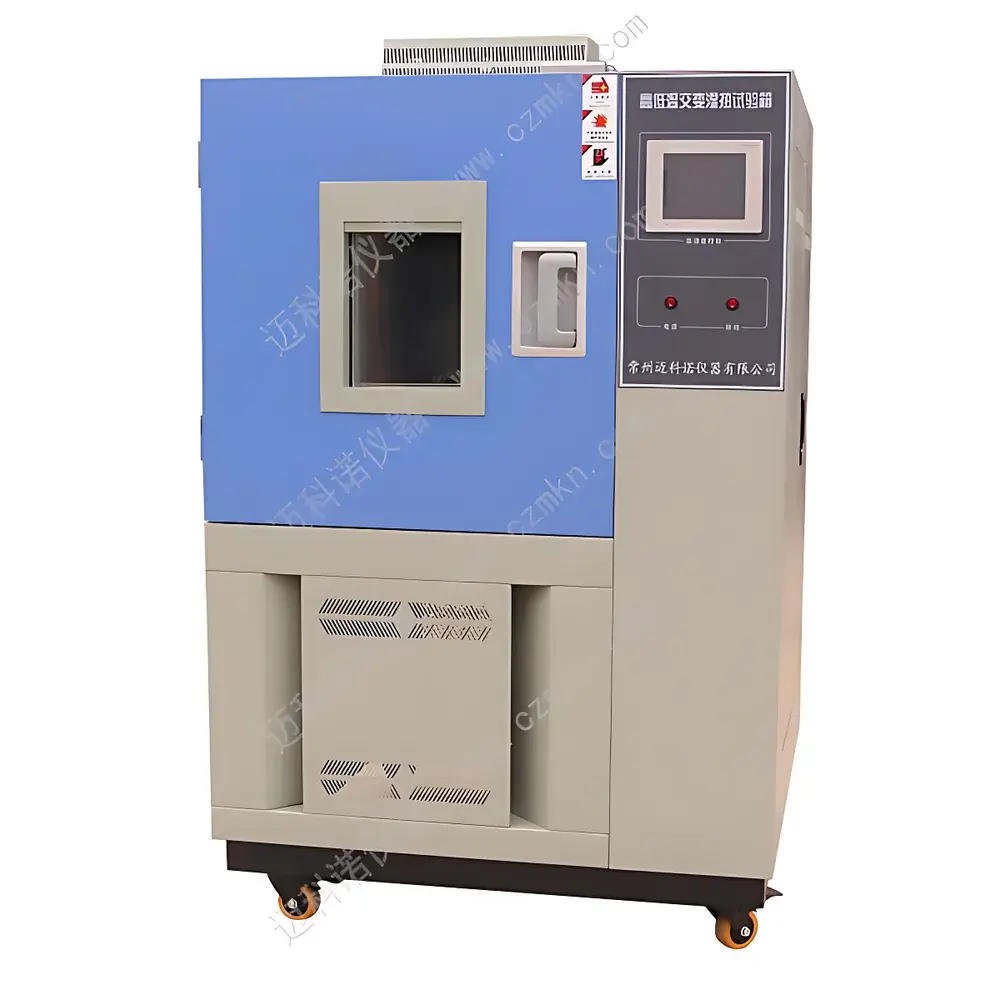
Macono GDWJ-025 High-Low Temperature Alternating Environmental Test Chamber
| Origin | Zhejiang, China |
|---|---|
| Manufacturer Type | Authorized Distributor |
| Domestic Origin | China-made |
| Model | GDWJ-025 |
| Quotation | Available upon Request |
| Temperature Range | –20/–40/–60 °C to 100 °C (configurable low-temp start point) |
| Temperature Uniformity | ≤ ±2 °C |
| Temperature Fluctuation | ≤ ±0.5 °C |
| Heating Rate | ≥ 2–3 °C/min |
| Cooling Rate | ≤ 1 °C/min |
| Internal Chamber Dimensions | 500 × 650 × 700 mm (W × H × D) |
| Insulation | Superfine Glass Fiber + Rigid Polyurethane Foam |
| Heating System | Nickel-Chromium Alloy Heaters with Stainless Steel Finned Radiators |
| Cooling System | Multi-Stage Diaphragm-Type Evaporator (Finned, Segmented) |
| Air Circulation | Single-Circuit, Extended-Shaft Low-Noise Stainless Steel Centrifugal Blower |
| Refrigeration Method | Single-Stage or Cascade (Dual-Stage) Refrigeration (Air-Cooled or Water-Cooled Options) |
| Compressor | Hermetic “Tecumseh” (France) Refrigeration Compressor |
| Controller | Fuji Electric or Honeywell PID Digital Temperature Controller |
| Sensor | PT100 Platinum Resistance Thermometer |
| Safety Protections | Leakage Current Protection, Over-Temperature Cut-Off, Fast-Acting Fuse, Compressor High-Pressure Protection |
Overview
The Macono GDWJ-025 High-Low Temperature Alternating Environmental Test Chamber is an engineered solution for accelerated environmental stress testing under precisely controlled thermal cycling conditions. Designed in accordance with the fundamental principles of thermodynamic equilibrium and forced-air convection heat transfer, this chamber enables rigorous evaluation of product reliability and material integrity across repeated transitions between extreme low and high temperatures. Its operational architecture supports both steady-state thermal exposure and programmable alternating cycles—critical for simulating real-world service environments encountered by electronic components, automotive subsystems, aerospace hardware, and military-grade equipment. The chamber complies with internationally recognized test standards including IEC 60068-2-1 (Cold), IEC 60068-2-2 (Dry Heat), MIL-STD-810H Method 502.7 (Low Temperature), Method 501.7 (High Temperature), and GJB 150.3A–2009 / GJB 150.4A–2009. It also meets the technical requirements specified in GB/T 10589–2008 (Low-Temperature Test Chambers) and GB/T 10586–2006 (General Technical Conditions for Environmental Test Equipment), ensuring metrological traceability and regulatory acceptability in GLP-compliant laboratories and ISO/IEC 17025-accredited testing facilities.
Key Features
- BTC (Balance Temperature Control) regulation algorithm ensures stable thermal equilibrium without overshoot, delivering high repeatability in temperature setpoint maintenance across dynamic cycling profiles.
- Double-wall construction: Inner chamber fabricated from SUS304 stainless steel; outer shell options include brushed-finish SUS304 or powder-coated Baosteel carbon steel—optimized for corrosion resistance and structural rigidity.
- Intelligent refrigeration routing: Automatically selects active cooling circuit(s) based on target temperature, minimizing energy consumption and extending compressor service life.
- High-efficiency insulation system combining superfine glass fiber and rigid polyurethane foam (≥80 mm thickness), achieving thermal loss <0.8 K/h at 100 °C and maintaining internal stability during ambient fluctuations.
- PT100 Class A platinum resistance sensors (IEC 60751) mounted at multiple spatial locations enable real-time monitoring of temperature uniformity and gradient distribution.
- Integrated safety architecture includes dual independent over-temperature cut-offs, compressor discharge pressure monitoring, ground-fault circuit interruption, and fast-blow fusing—fully compliant with IEC 61000-4-5 surge immunity and EN 61000-3-2 harmonic emission limits.
Sample Compatibility & Compliance
The GDWJ-025 accommodates a broad range of sample geometries and mass loads within its 227.5 L working volume (500 × 650 × 700 mm). Standard configurations include two adjustable stainless steel sample racks, a 250 × 300 mm double-glazed observation window with internal anti-fog heating, and a 25 mm diameter cable/port access hole sealed with silicone gasket. The chamber’s thermal performance has been validated per ISO 16750-4 (Road Vehicles – Environmental Conditions) and USCAR-2 (Automotive Electronics Reliability Standards), supporting qualification testing for ECUs, sensors, battery modules, and PCB assemblies. All control firmware and data logging functions are designed to support audit-ready documentation per FDA 21 CFR Part 11 (electronic records/signatures) when paired with optional validation packages and calibration-certified sensors.
Software & Data Management
While the base configuration features a standalone Fuji/Honeywell digital PID controller with local setpoint programming and real-time display, optional PC-based software (e.g., Macono TestSuite™ v3.2) provides extended functionality—including multi-step ramp-soak-cycle sequencing, automated report generation (PDF/CSV), trend graphing with timestamped alarms, and remote monitoring via Ethernet or RS485 Modbus RTU. Data integrity safeguards include write-protected memory buffers, cyclic redundancy check (CRC) validation for all logged entries, and configurable audit trails recording operator ID, parameter changes, and alarm events. Calibration certificates for temperature sensors and verification reports for chamber uniformity are supplied with each unit, traceable to NIM (National Institute of Metrology, China) or UKAS-accredited reference standards.
Applications
This test chamber serves as a core platform for environmental qualification across multiple sectors:
- Electronics manufacturing: Thermal cycling validation per JEDEC JESD22-A104D for solder joint fatigue assessment and component burn-in screening.
- Automotive Tier-1 suppliers: Climate stress testing of infotainment systems, ADAS sensors, and powertrain control units per ISO 16750-4 and VW 80101.
- Aerospace OEMs: Pre-flight environmental screening of avionics enclosures and composite structural coupons per DO-160G Section 4 (Temperature).
- Academic research: Controlled-stress studies on polymer crystallinity, battery electrolyte phase behavior, and metal fatigue under thermal hysteresis.
- Quality assurance labs: Routine compliance verification against GB/T 2423.1–2022 (Cold Test) and GB/T 2423.2–2022 (Dry Heat Test) for domestic market certification.
FAQ
What temperature ranges are supported by the GDWJ-025, and how is the low-end limit selected?
The GDWJ-025 offers three factory-configurable low-temperature thresholds: –20 °C (suffix “A”), –40 °C (suffix “B”), or –60 °C (suffix “C”). Selection is determined at time of order and corresponds to compressor staging, refrigerant charge, and evaporator surface area optimization.
Does the chamber support programmable thermal cycling profiles?
Yes—when equipped with the optional Macono TestSuite™ software, users can define up to 99 segments per cycle, including ramp rates, dwell times, and loop repetitions. Local controller supports basic two-step cycling (e.g., –40 °C for 2 h → +85 °C for 2 h) without PC connectivity.
Is third-party calibration and IQ/OQ/PQ documentation available?
Calibration certificates (NIST-traceable) are included. Full validation packages—including Installation Qualification (IQ), Operational Qualification (OQ), and Performance Qualification (PQ) protocols aligned with ASTM E2500 and EU Annex 15—are available as add-on services.
Can the chamber be integrated into a centralized lab monitoring network?
Standard RS485 Modbus RTU interface enables integration with SCADA or LIMS platforms. Optional Ethernet/IP or OPC UA gateways support seamless interoperability with enterprise-level infrastructure.
What is the expected mean time between failures (MTBF) for the refrigeration system?
Based on field data from >1,200 installed units, the Tecumseh hermetic compressor assembly demonstrates an MTBF of ≥18,000 operating hours under continuous duty at rated load, assuming scheduled maintenance every 12 months.
Related Products



