
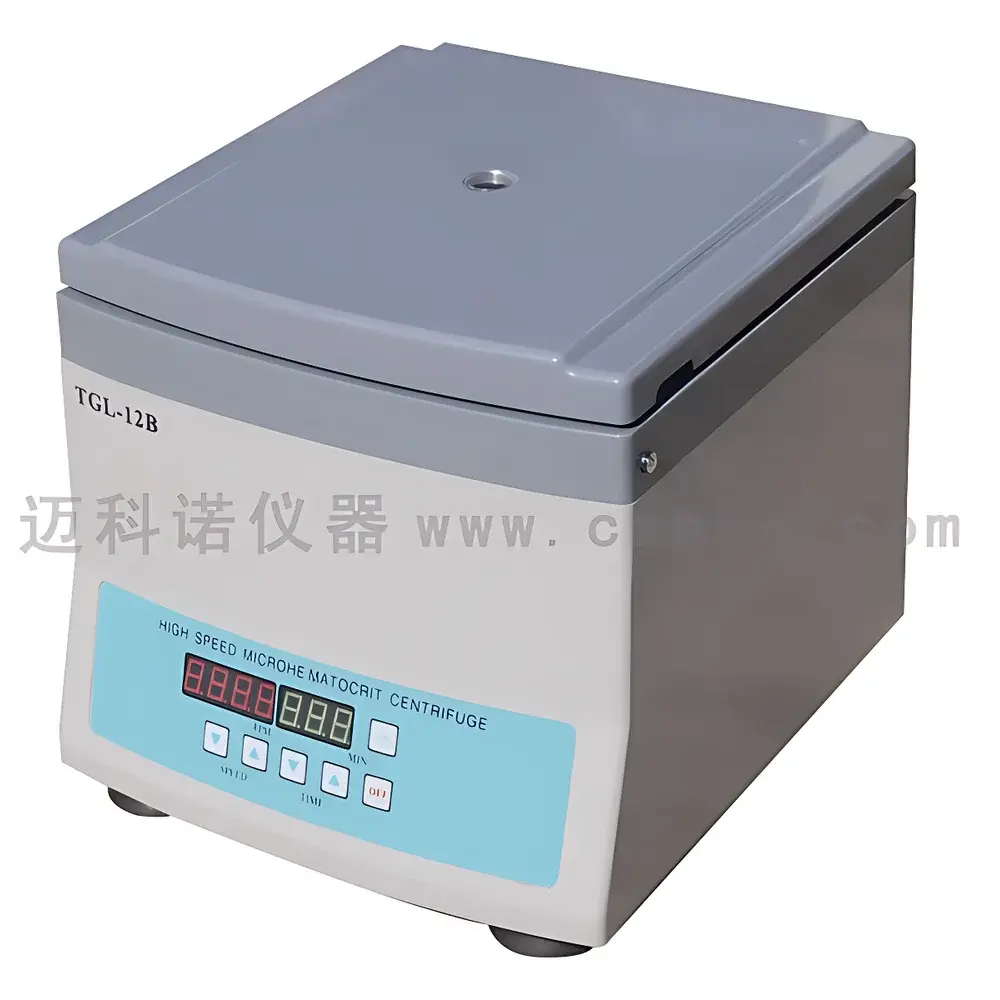
Macono TGL-12B Microhematocrit Centrifuge
| Origin | Zhejiang, China |
|---|---|
| Manufacturer Type | Distributor |
| Country of Origin | China |
| Model | TGL-12B |
| Maximum Capacity | 24 × capillary tubes (Φ1.5 mm × 75 mm) |
| Maximum Speed | 12,000 rpm (touchscreen-adjustable, stepless speed control) |
| Relative Centrifugal Force (RCF) | 13,500 × g |
| Power Input | 230 VA |
| Power Output | 100 W |
| Acceleration Time | <60 s |
| Deceleration Time | <120 s |
| Timer Range | 0–30 min (non-continuous operation only) |
| Dimensions (L×W×H) | 280 × 310 × 265 mm |
| Net Weight | 10 kg |
| Voltage Compatibility | 110 V / 220 V, 60 Hz |
Overview
The Macono TGL-12B Microhematocrit Centrifuge is a compact, benchtop centrifugal instrument engineered for rapid, precise separation of whole blood into cellular and plasma fractions using capillary tube geometry. It operates on the principle of sedimentation under controlled relative centrifugal force (RCF), enabling accurate hematocrit determination in clinical diagnostics, point-of-care testing, and small-volume hematology research. Designed specifically for microvolume samples—such as earlobe or finger-prick blood—the device eliminates the need for large venous draws while maintaining high reproducibility in packed cell volume (PCV) measurement. Its robust brushless motor, precision-balanced rotor assembly, and thermally stable housing ensure consistent performance across repeated runs, supporting GLP-aligned workflows in resource-constrained or field-deployable laboratory environments.
Key Features
- Touchscreen interface with intuitive, stepless speed control (0–12,000 rpm) for fine-tuned optimization of separation protocols.
- Fixed-angle rotor accommodating 24 capillary tubes (1.5 mm ID × 75 mm length), pre-balanced for vibration-free operation at maximum RCF (13,500 × g).
- Fast acceleration (<60 s to full speed) and controlled deceleration (<120 s) minimize thermal buildup and preserve sample integrity.
- Programmable timer (0–30 minutes) with automatic shut-off; non-continuous duty cycle design prevents motor overheating during extended use.
- Compact footprint (280 × 310 × 265 mm) and lightweight construction (10 kg) facilitate integration into biosafety cabinets, mobile labs, or decentralized clinical stations.
- Compliance-ready architecture: meets IEC 61010-1 safety standards for laboratory electrical equipment; compatible with ISO 15189 pre-analytical requirements for hematocrit testing.
Sample Compatibility & Compliance
The TGL-12B accepts standard heparinized or EDTA-coated glass or plastic capillary tubes used in manual hematocrit assays per CLSI H26-A3 guidelines. It supports both native whole blood and anticoagulated specimens without modification. The rotor geometry ensures uniform radial orientation and minimal meniscus distortion during spin, critical for optical reading accuracy in subsequent hematocrit readers. While not certified for infectious agent containment, its sealed rotor chamber and smooth stainless-steel surfaces allow effective decontamination using 70% ethanol or hospital-grade disinfectants compliant with CDC/WHO recommendations. The unit does not require refrigeration or vacuum assistance, making it suitable for ambient-temperature operation in low-infrastructure settings.
Software & Data Management
As a standalone mechanical instrument, the TGL-12B does not incorporate embedded software or digital data logging. All operational parameters—including speed, time, and run status—are displayed via LED indicators and confirmed through tactile feedback on the touchscreen panel. This analog-digital hybrid interface eliminates cybersecurity vulnerabilities associated with networked instruments and aligns with FDA 21 CFR Part 11 principles for audit-trail simplicity in regulated environments where manual logbook entry remains the primary record-keeping method. Users may integrate the centrifuge into broader LIMS workflows by documenting run conditions alongside downstream hematocrit measurements obtained via calibrated reflectance photometers or digital readers.
Applications
- Routine hematocrit determination in outpatient clinics, rural health centers, and veterinary practices.
- Capillary blood processing prior to microvolume CBC analysis, glucose testing, or serology screening.
- Preparation of platelet-rich plasma (PRP) fractions from small-volume donor samples in regenerative medicine labs.
- Quality control verification of anticoagulant efficacy in blood collection tube validation studies.
- Educational use in biomedical training programs for teaching sedimentation kinetics and centrifugation fundamentals.
FAQ
What capillary tube dimensions are supported?
The rotor is calibrated exclusively for 1.5 mm internal diameter × 75 mm length capillary tubes—standard format for microhematocrit assays.
Is continuous operation permitted?
No. The device is rated for intermittent use only; maximum run duration is 30 minutes, followed by a mandatory cooldown period before subsequent cycles.
Does the centrifuge meet international electrical safety standards?
Yes. It complies with IEC 61010-1:2010 for laboratory electrical equipment, including protection against electric shock, mechanical hazards, and abnormal temperature rise.
Can the speed be verified externally?
While no built-in tachometer calibration port exists, users may validate rotational speed using a non-contact optical tachometer traceable to NIST standards during routine maintenance checks.
What maintenance is required?
Routine cleaning of the rotor chamber and lid seal with lint-free cloth and 70% isopropyl alcohol; annual inspection of rotor integrity and bearing function recommended by qualified service personnel.



