
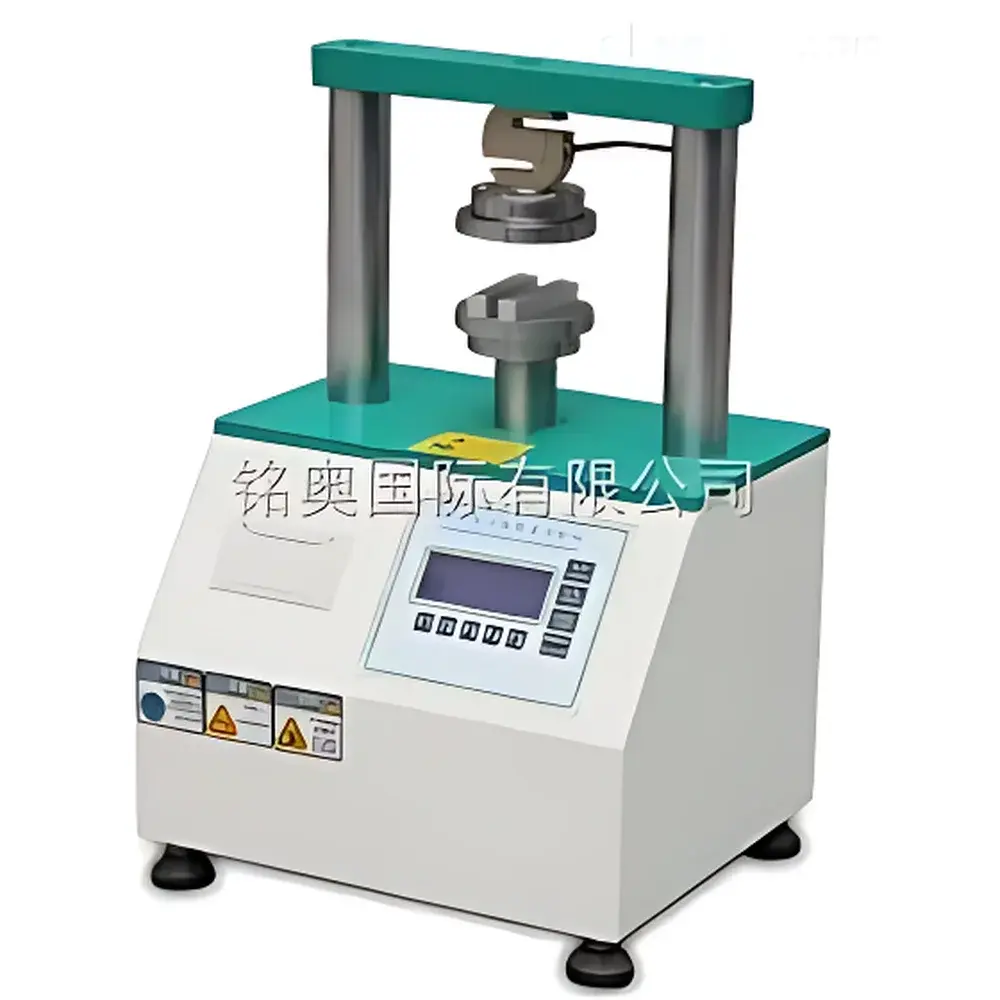
MAEC-18 Pork Water-Holding Capacity (WHC) Analyzer
| Origin | Jiangsu, China |
|---|---|
| Manufacturer Type | Authorized Distributor |
| Origin Category | Domestic (PRC) |
| Model | MAEC-18 |
| Price Range | USD 140–7,200 |
| Measurement Range | 0–1000 N (0–100 kgf) |
| Resolution | 0.1 N (0.01 kgf) |
| Accuracy | ±1% FS |
| Test Speed | 1–100 mm/min |
| Return Speed | 1–100 mm/min |
| Parallelism of Compression Plates | <0.05 mm |
| Compression Duration | 1–3600 s |
| Deformation Range | 1–70 mm |
| Max. Plate Separation | ≥70 mm |
| Dimensions (L×W×H) | 290 × 303 × 392 mm |
| Net Weight | ~30 kg |
| Power Supply | AC 110–240 V, 50 Hz |
Overview
The MAEC-18 Pork Water-Holding Capacity (WHC) Analyzer is a precision-controlled mechanical compression instrument engineered for quantitative assessment of water retention in porcine skeletal muscle tissue. WHC is a critical physicochemical parameter directly linked to post-mortem pH decline, myofibrillar protein denaturation, and sarcomere integrity—factors governing drip loss, cooking yield, texture stability, and overall processing efficiency in fresh and processed pork products. Unlike indirect biochemical assays or subjective sensory evaluation, the MAEC-18 implements standardized mechanical compression per widely adopted protocols—including the Chinese National Standard GB/T 9695.19–2008 (Meat and Meat Products – Determination of Water-Holding Capacity) and aligned methodologies referenced in ISO 2917:2021 (Meat and meat products – Determination of water-holding capacity by compression method). The device applies calibrated uniaxial force to a cylindrical meat sample confined between parallel stainless-steel plates, measuring mass loss before and after controlled compression to compute WHC as a percentage: WHC (%) = [(Initial Mass − Post-Compression Mass) / Initial Mass] × 100. This gravimetric-compressive approach ensures high reproducibility across laboratories and aligns with routine quality assurance workflows in commercial abattoirs, chilled meat distribution centers, and R&D facilities.
Key Features
- High-accuracy load cell with factory-calibrated accuracy ≤ ±0.5% FS—exceeding the ±1% tolerance specified in ISO 2917 and ASTM E4 for force transducers used in food material testing.
- Precision-ground ball-screw actuation system ensuring consistent linear displacement control and minimal hysteresis during loading/unloading cycles.
- Corrosion-resistant 316 stainless-steel compression platens with surface flatness certified to <0.05 mm parallelism—critical for uniform stress distribution and avoidance of localized shear artifacts.
- Integrated 7-inch capacitive touchscreen interface supporting multilingual operation (English default), programmable test profiles (target force, dwell time, deformation limit), and real-time force/displacement curve visualization.
- Automated test termination logic: configurable to halt upon reaching preset compression duration, target deformation (1–70 mm), or maximum applied load (up to 1000 N), eliminating operator-dependent timing variability.
- Onboard statistical engine computing mean, SD, CV%, and min/max values across batched samples; direct thermal printout via integrated micro-printer compliant with GLP documentation requirements.
Sample Compatibility & Compliance
The MAEC-18 accommodates standard cylindrical pork samples (typically 10 mm diameter × 10 mm height, per GB/T 9695.19), though custom fixtures support alternative geometries (e.g., 15 mm diameter cores for loin or ham cuts). Sample preparation follows AOAC Official Method 985.21–based chilling and equilibration guidelines: samples are excised within 45 min post-mortem, trimmed of visible fat/connective tissue, and conditioned at 4 °C for 24 h prior to testing. Instrument compliance extends to regulatory frameworks requiring traceable, auditable physical testing—including FDA Food Safety Modernization Act (FSMA) preventive controls verification, HACCP critical limit monitoring, and ISO/IEC 17025-accredited laboratory validation. All calibration certificates include NIST-traceable references and uncertainty budgets per ILAC-G8:2019.
Software & Data Management
Firmware v3.2 supports CSV export via USB port for downstream analysis in Excel, JMP, or Python-based statistical pipelines. Audit trails record operator ID, timestamp, test parameters, raw force/displacement arrays, and final WHC result—retained for ≥18 months with write-protection enabled. Optional PC software (MAEC-Link Pro) provides GMP-aligned electronic signatures, 21 CFR Part 11-compliant user access tiers (Admin/Operator/Reviewer), and automated report generation conforming to internal SOP templates. Raw data files include embedded metadata: ambient temperature/humidity, sample ID, anatomical origin (e.g., M. longissimus dorsi), and pH24h reference if paired with external pH meter integration.
Applications
- Quality grading of fresh pork carcasses in slaughterhouse QA labs—correlating WHC with ultimate pH and instrumental color (L*, a*, b*).
- Evaluation of pre-slaughter handling stressors (transport duration, lairage temperature) on post-mortem water migration kinetics.
- Validation of marination efficacy and salt/phosphate synergism in value-added product development.
- Stability testing of frozen-thawed pork under varying cryoprotectant formulations.
- Academic research on genetic markers (e.g., RN- gene variants) affecting myofibrillar water binding capacity.
- Contract testing services for third-party certification bodies verifying claims of “low-drip” or “high-yield” pork under retailer specifications.
FAQ
What standards does the MAEC-18 comply with for WHC determination?
It conforms to GB/T 9695.19–2008, ISO 2917:2021, and harmonized sections of AOAC 985.21. Calibration adheres to ISO/IEC 17025:2017 and ASTM E4.
Can the instrument be validated for GLP or GMP environments?
Yes—full IQ/OQ documentation packages are available; firmware supports 21 CFR Part 11 audit trails, electronic signatures, and role-based access control.
Is sample thickness compensation required for accurate WHC calculation?
No—the method relies on absolute mass loss, not dimensional normalization; however, consistent sample geometry (diameter/height ratio ≥1:1) is essential to minimize edge effects.
How often must the load cell be recalibrated?
Annually under normal use; more frequently if subjected to overload events (>110% FS) or environmental extremes (T > 40 °C or RH > 85%).
Does the system support multi-sample sequential testing without manual intervention?
Yes—batch mode allows up to 99 samples with auto-reset between runs; plate cooling intervals can be programmed to maintain thermal consistency.





