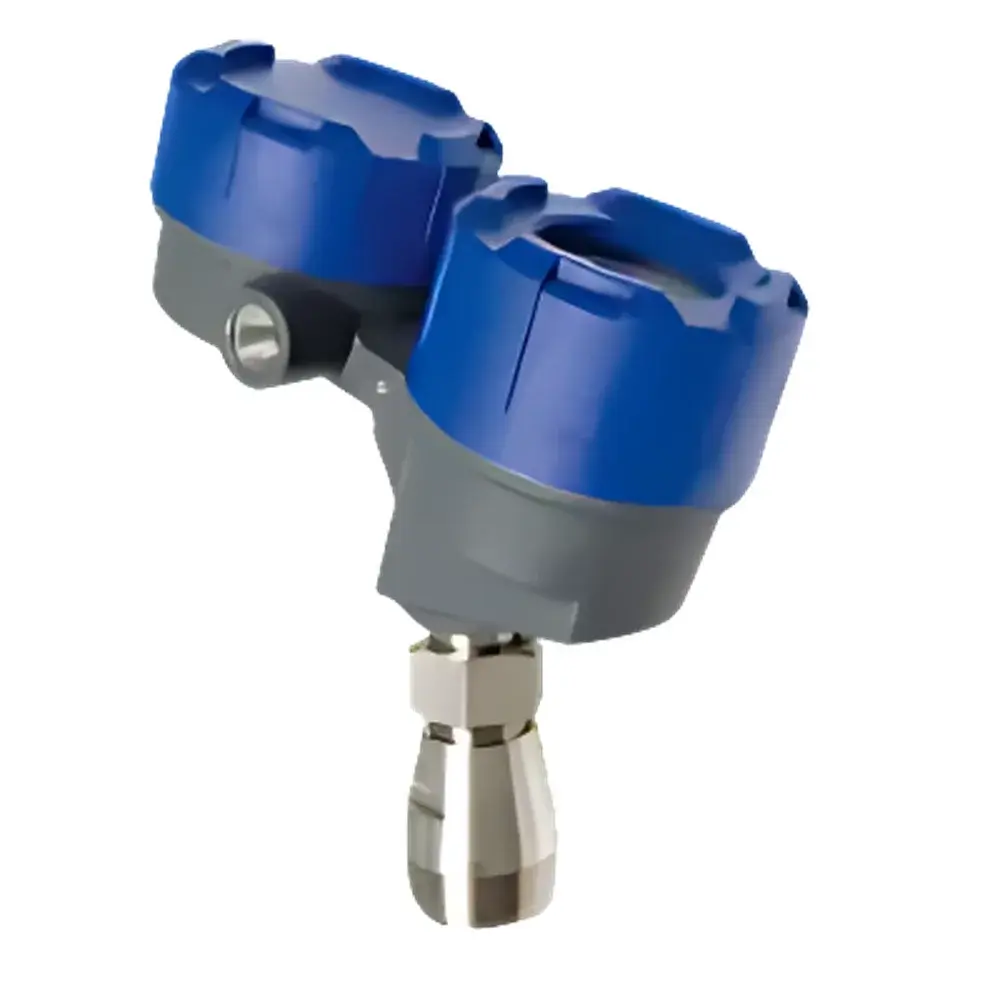
MAGNETROL Pulsar® R80 Radar Level Transmitter
| Brand | MAGNETROL |
|---|---|
| Model | Pulsar® R80 |
| Measurement Principle | Frequency-Modulated Continuous Wave (FMCW) Radar |
| Operating Frequency | 80 GHz |
| Beam Angle | <3° |
| Maximum Process Pressure | 70 bar (1000 psi) |
| Maximum Process Temperature | 200 °C (400 °F) |
| Output Signal | 4–20 mA HART |
| Enclosure Rating | IP66/IP67, NEMA 4X |
| Antenna Options | Stainless steel horn antennas with optional PTFE or ceramic coating |
| Display | Optional integrated LCD graphic display |
| Communication | HART 7, Foundation Fieldbus (optional) |
| Diagnostics | Advanced onboard diagnostics with echo curve analysis, false echo suppression, and predictive health monitoring |
| Certifications | ATEX, IECEx, FM, CSA, SIL2 per IEC 61508 |
Overview
The MAGNETROL Pulsar® R80 is a high-frequency, non-contact radar level transmitter engineered for precision continuous level measurement in demanding industrial process environments. Utilizing Frequency-Modulated Continuous Wave (FMCW) radar technology at 80 GHz, the R80 delivers exceptional signal focus and resolution—enabling reliable detection even in vessels with internal obstructions, turbulent surfaces, or low-dielectric media such as hydrocarbons, solvents, and aqueous slurries. Unlike pulse-based radar instruments, FMCW operation provides inherently higher signal-to-noise ratio and superior immunity to vapor, foam, dust, and condensation. The device operates on a standard 4–20 mA loop-powered architecture, eliminating the need for auxiliary power in most installations while supporting HART 7 digital communication for configuration, diagnostics, and real-time data exchange. Designed for integration into safety-critical and regulatory-compliant systems, the R80 meets SIL2 requirements per IEC 61508 and carries global hazardous area certifications including ATEX, IECEx, FM, and CSA.
Key Features
- 80 GHz FMCW radar engine: Delivers a narrow beam angle (<3°) and high spatial resolution—minimizing interference from tank walls, agitators, heating coils, or stilling wells.
- Robust process compatibility: Rated for continuous operation up to 70 bar (1000 psi) and 200 °C (400 °F), making it suitable for high-pressure reactors, steam-jacketed tanks, and hot oil storage.
- Sealed quick-disconnect antenna interface: Enables field replacement of the transmitter without breaking vessel integrity—maintaining pressure containment and reducing maintenance downtime.
- Corrosion-resistant antenna options: Standard 316L stainless steel horns with optional PTFE or ceramic coatings for aggressive chemical service (e.g., sulfuric acid, caustic soda, chlorinated solvents).
- Intelligent echo processing: Built-in false echo suppression algorithm automatically identifies and filters spurious reflections from weld seams, ladders, or feed nozzles—ensuring stable measurement under dynamic process conditions.
- Guided commissioning workflow: On-device setup wizard walks users through parameterization, reference level calibration, and echo curve optimization—reducing configuration time and minimizing human error.
Sample Compatibility & Compliance
The Pulsar® R80 is validated for liquid and slurry-level applications across a wide dielectric constant range (εr ≥ 1.4), including hydrocarbon fuels, crude oil, refined products, water-based emulsions, polymers, molten sulfur, and viscous bitumen. It performs reliably in vacuum, inert gas blanketing, and saturated vapor environments where guided wave radar (GWR) or ultrasonic technologies may exhibit drift or signal loss. Regulatory compliance includes full traceability to ISO 9001 manufacturing controls, CE marking per PED 2014/68/EU, and electromagnetic compatibility per EN 61326-1. For pharmaceutical and food-grade applications, the instrument supports validation documentation packages aligned with FDA 21 CFR Part 11 and GAMP 5 guidelines—particularly when deployed with HART-enabled DCS/SCADA systems requiring audit-trail-capable configuration management.
Software & Data Management
Configuration and diagnostics are supported via MAGNETROL’s proprietary Insight™ PC software (Windows-compatible) and the optional integrated graphical LCD display. Insight™ enables full access to raw echo curves, signal strength histograms, diagnostic logs, and historical trend export in CSV format. All configuration changes—including damping settings, fail-safe modes, and linearization tables—are timestamped and user-logged, satisfying GLP/GMP data integrity requirements. When integrated with HART-enabled asset management systems (e.g., Emerson DeltaV AMS, Honeywell PHD), the R80 provides automated alerts for signal degradation, coating buildup detection, or temperature/pressure excursions—facilitating predictive maintenance scheduling and reducing unplanned shutdowns.
Applications
- Level monitoring in API refining units: Crude distillation columns, hydrotreater feed drums, amine regenerators.
- Chemical process vessels: Batch reactors, neutralization tanks, polymerization kettles operating under nitrogen purge.
- Power generation: Condensate storage, deaerator tanks, and closed-loop lubrication reservoirs.
- Water & wastewater: Sludge thickeners, digesters, and chemical dosing tanks exposed to hydrogen sulfide or chlorine vapors.
- Food & beverage: Hot syrup tanks, edible oil storage, and CIP solution vessels requiring sanitary-grade surface finish compatibility.
FAQ
Does the Pulsar® R80 require recalibration after installation?
No—factory pre-calibrated with NIST-traceable reference standards; only field verification (not recalibration) is recommended during commissioning.
Can it measure level in a pressurized vessel with internal agitation?
Yes—the 80 GHz beam focus and adaptive signal processing maintain stability even with surface turbulence and mechanical vibration.
Is the device compatible with existing HART-based control systems?
Yes—it fully complies with HART 7 specification and supports all universal, common, and device-specific commands.
What documentation is provided for functional safety validation?
MAGNETROL supplies a complete SIL2 certification dossier including FMEDA reports, proof test procedures, and safe failure fraction (SFF) calculations per IEC 61508.
How does the false echo suppression feature differ from conventional filtering?
It employs real-time spectral analysis of the entire echo profile—not just amplitude thresholds—allowing discrimination between true level returns and geometric artifacts based on frequency-domain signature.