
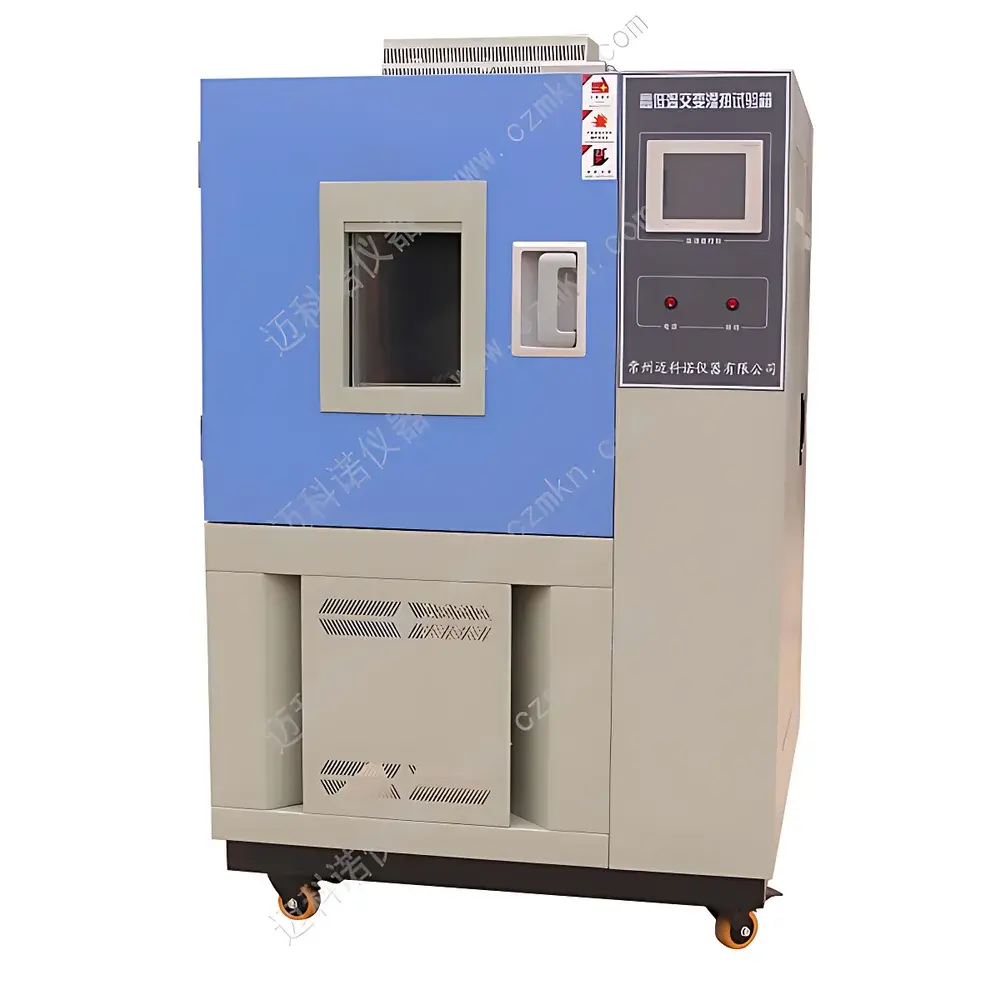
Micono GDS-100 High-Low Temperature and Humidity Environmental Test Chamber
| Origin | Zhejiang, China |
|---|---|
| Manufacturer Type | Authorized Distributor |
| Origin Category | Domestic (China) |
| Model | GDS-100 |
| Pricing | Available Upon Request |
| Temperature Range | −40 °C to +100 °C |
| Temperature Uniformity | ≤ ±2 °C |
| Temperature Fluctuation | ≤ ±0.5 °C |
| Heating Rate | ≥ 2–3 °C/min |
| Cooling Rate | ≤ 1 °C/min |
| Internal Dimensions (W×D×H) | 1000 × 1000 × 1000 mm |
| Insulation | Ultra-fine Glass Fiber + Rigid Polyurethane Foam |
| Heating System | Nickel-Chromium Alloy Heaters with Stainless Steel Finned Radiators |
| Cooling System | Multi-stage Membrane-type Evaporator (Finned, Segmented) |
| Air Circulation | Single-loop, Extended-shaft, Low-noise Stainless Steel Centrifugal Fan |
| Refrigeration Method | Single-stage or Cascade (Dual-stage) Refrigeration (Air-cooled or Water-cooled) |
| Compressor | Hermetic “Tecumseh” (France) Refrigeration Compressor |
| Controller | Fuji Electric (Japan) or Honeywell Programmable PID Controller |
| Sensor | PT100 Platinum Resistance Thermometer |
| Safety Protections | Leakage Current Protection, Over-temperature Protection, Fast-blow Fuse, Compressor High-pressure Protection |
| Standard Accessories | Dual-pane Stainless Steel Observation Window (250 × 300 mm), Ø25 mm Test Port, Two Adjustable Sample Racks, Interior LED Illumination |
| Power Supply | 380 V ±10%, 50 Hz, 3-phase 4-wire |
Overview
The Micono GDS-100 High-Low Temperature and Humidity Environmental Test Chamber is an engineered solution for accelerated environmental stress testing of industrial components and materials under controlled thermal and hygrometric conditions. Designed in accordance with fundamental principles of thermodynamic equilibrium and psychrometric control, the chamber employs a balanced heating–cooling–humidification system to precisely maintain setpoint temperature and relative humidity (RH) across its full operational range. Its core architecture supports both steady-state and cyclic test profiles—including temperature-only, humidity-only, and combined temperature–humidity cycling—making it suitable for qualification testing per IEC 60068-2 series, MIL-STD-810, and equivalent national standards. The GDS-100 serves as a critical tool in reliability engineering workflows, enabling validation of product robustness during design verification, production lot sampling, and failure mode analysis.
Key Features
- Stainless steel inner chamber (SUS304) with corrosion-resistant construction and seamless welding for long-term integrity under repeated thermal cycling.
- High-efficiency insulation combining ultra-fine glass fiber and rigid polyurethane foam, minimizing thermal bridging and energy consumption.
- Intelligent cascade refrigeration option (dual-stage) for stable operation at low-temperature extremes (−40 °C to −60 °C), ensuring consistent cooling performance without compressor overload.
- Shallow-tray humidification system based on surface evaporation, delivering rapid RH response and uniform moisture distribution while minimizing condensate carryover.
- PT100 platinum resistance sensors mounted at multiple spatial locations within the working chamber, supporting real-time monitoring and closed-loop feedback control.
- Integrated safety architecture including independent over-temperature cut-off, refrigerant high-pressure shutdown, leakage current interruption, and fast-blow fuse protection.
- Human-centered interface: optional wide-screen LCD touch controller with programmable profile storage, data logging, and alarm history traceability compliant with GLP audit requirements.
Sample Compatibility & Compliance
The GDS-100 accommodates samples up to 1000 mm × 1000 mm × 1000 mm in volume, supporting standard test specimens used in electronics packaging, automotive ECUs, aerospace avionics housings, and polymer-based structural components. It meets the technical specifications defined in GB/T 10586–2014 (Environmental Testing Chambers – General Technical Conditions), GB/T 10592–2008 (High/Low Temperature Test Chambers – Technical Requirements), and GB/T 2423.1–2023 (Environmental Testing – Part 2: Tests – Test A: Cold), GB/T 2423.2–2023 (Test B: Dry Heat), GB/T 2423.3–2016 (Test Ca: Damp Heat, Steady State), and GB/T 2423.4–2017 (Test Db: Damp Heat, Cyclic). While not certified to ISO/IEC 17025, its metrological traceability path supports internal calibration against NIST-traceable references and is routinely validated per ASTM E2293–22 (Standard Practice for Calibration of Environmental Chambers).
Software & Data Management
The standard Fuji or Honeywell controller provides local setpoint programming, real-time trend display, and event-triggered alarms. Optional PC-based software enables remote monitoring via Ethernet or RS485, synchronized time-stamped data export (CSV/Excel), and configurable report generation aligned with FDA 21 CFR Part 11 requirements—including electronic signature support, user access levels, and immutable audit trails. All logged parameters—including chamber temperature, RH, setpoint deviation, compressor status, and safety interlock states—are timestamped with millisecond resolution and retained for ≥90 days onboard memory. Data integrity is preserved through cyclic redundancy check (CRC) validation and automatic backup upon power loss.
Applications
- Electronics: Thermal cycling of PCBAs, connectors, and semiconductor packages to assess solder joint fatigue and intermetallic growth.
- Automotive: Validation of infotainment modules, battery management systems (BMS), and sensor housings under combined thermal–humidity stress per ISO 16750-4.
- Aerospace: Pre-flight environmental screening of avionics enclosures and composite material laminates per DO-160 Section 4 and 5.
- Academic Research: Controlled aging studies of polymers, adhesives, and coatings under accelerated hygrothermal exposure.
- Quality Assurance: In-process verification of incoming raw materials (e.g., elastomers, sealants) prior to final assembly.
FAQ
What temperature and humidity ranges does the GDS-100 support?
The standard configuration operates from −40 °C to +100 °C with RH control from 20% to 98% RH at temperatures ≥+10 °C. Low-temperature variants (GDS-100B/C) extend the lower limit to −60 °C using cascade refrigeration.
Is the chamber compatible with automated test sequencing and integration into lab-wide MES systems?
Yes—via Modbus RTU or TCP/IP protocol, the controller supports external SCADA integration, PLC handshaking, and scheduled start/stop commands. Optional software includes OPC UA server functionality.
How is calibration verification performed for regulatory audits?
Users may perform in-situ verification using calibrated reference probes placed at designated sensor locations. Calibration certificates (traceable to CNAS-accredited labs) are available upon request; internal SOPs align with ISO/IEC 17025 clause 6.5.
Can the GDS-100 be customized for non-standard sample loading configurations or specialized sensor ports?
Yes—Micono offers mechanical and electrical customization including additional test ports, reinforced floor plates, inert gas purge interfaces, and bespoke rack geometries. Engineering consultation is provided at no cost during specification review.
What is the expected mean time between failures (MTBF) for critical subsystems?
Based on field data from >1,200 installed units, the refrigeration system demonstrates MTBF ≥12,000 hours; the Fuji controller ≥60,000 hours; and the stainless steel chamber structure ≥20 years under normal laboratory use conditions.



