
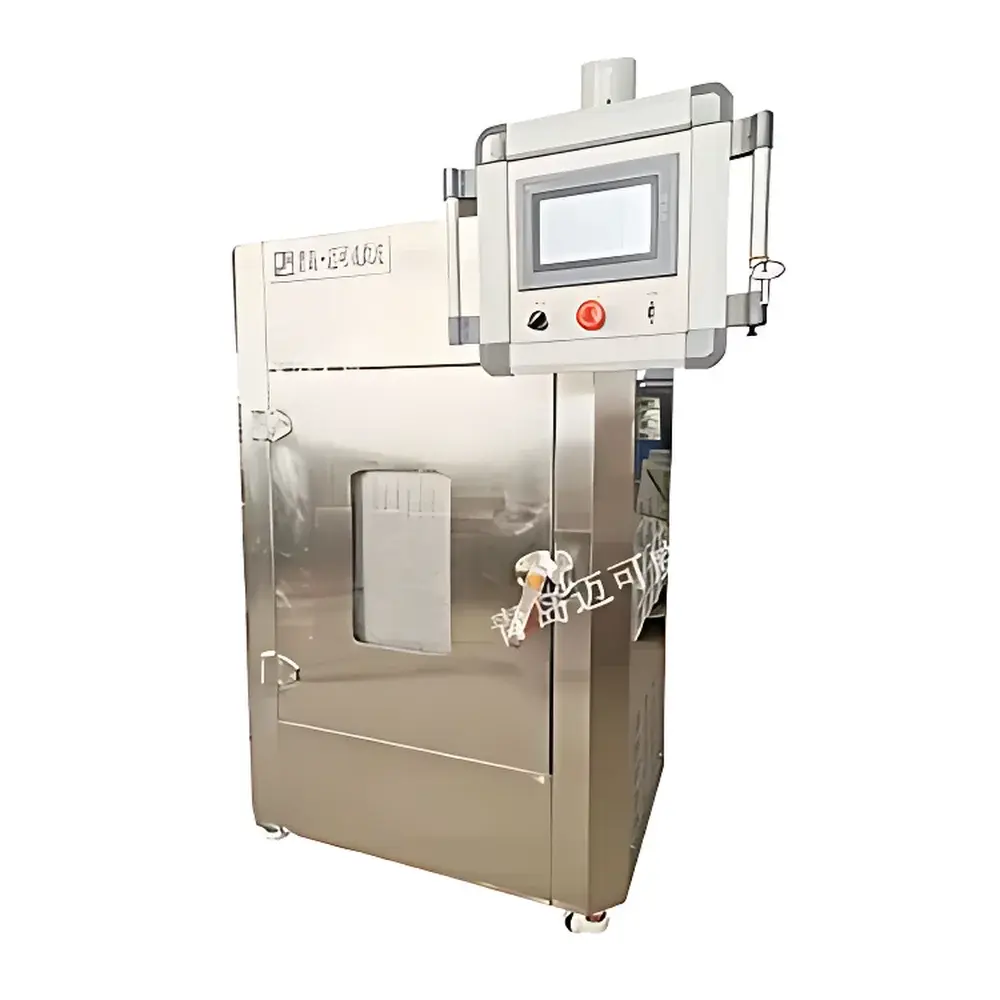
MakeWave HXG-T225 Large-Volume Microwave-Assisted Drying Oven
| Brand | MakeWave |
|---|---|
| Origin | Shandong, China |
| Manufacturer Type | Direct Manufacturer |
| Product Category | Domestic |
| Model | HXG-T225 |
| Instrument Type | High-Temperature Microwave Drying Oven |
| Temperature Range | 0–1200 °C (thermocouple) / 0–500 °C (infrared pyrometer) |
| Temperature Uniformity | ±1 °C |
| External Dimensions | 1500 × 750 × 1640 mm |
| Internal Volume | 225 L |
| Chamber Material | AISI 304 Stainless Steel |
| Heating Method | 2450 MHz Microwave + Auxiliary Convection |
| Microwave Power Output | 0–4800 W (infinitely adjustable) |
| Electrical Input Power | 1000 W |
| Microwave Leakage | <5 mW/cm² (GB 10436-2008 compliant) |
| Airflow System | Adjustable axial-flow forced convection |
| Control System | PLC-based with color touchscreen interface |
| Tray Configuration | 1–4 removable perforated stainless steel shelves |
| Safety Features | Interlocked door switch, overtemperature cutoff, pressure-relief venting, explosion-resistant chamber design, EMI-shielded RF cavity |
Overview
The MakeWave HXG-T225 is an industrial-grade, large-volume microwave-assisted drying oven engineered for high-throughput, energy-efficient thermal processing of biological, environmental, pharmaceutical, and materials science samples. Unlike conventional resistive-heating ovens that rely on conductive/convective surface heating, the HXG-T225 employs 2450 MHz microwave energy to induce volumetric dielectric heating—directly exciting polar molecules (e.g., water, ethanol, solvents) throughout the sample matrix. This enables rapid, uniform internal moisture migration and evaporation, significantly reducing drying time while preserving thermally labile components. Integrated forced-air convection ensures homogeneous temperature distribution across the 225 L stainless steel cavity and prevents localized condensation or vapor re-deposition. The system operates across a wide thermal range—from ambient up to 1200 °C (via K-type thermocouple) or up to 500 °C (via non-contact infrared pyrometer)—making it suitable for both low-temperature lyophilization support and high-temperature ashing protocols.
Key Features
- Volumetric Microwave Heating: 0–4800 W infinitely adjustable magnetron output at 2450 MHz, delivering precise energy dosing without thermal lag or overshoot.
- Dual-Mode Temperature Monitoring: Redundant sensing architecture combining embedded K-type thermocouples (0–1200 °C) and calibrated infrared pyrometers (0–500 °C) for cross-validated process control.
- Corrosion-Resistant Cavity: Fully welded AISI 304 stainless steel interior and exterior, including gasketed door seal and pressure-balanced venting for controlled atmosphere operation.
- Modular Sample Handling: Four-tier removable perforated stainless steel trays (standard configuration), configurable for batch parallelism or spatial segmentation to accommodate heterogeneous sample geometries.
- Intelligent Process Control: PLC-based automation with color touchscreen HMI; supports multi-segment recipes, real-time temperature/humidity curve logging, USB data export (CSV), and alarm-triggered event capture.
- Continuous-Operation Design: Industrial-grade power supply, cooling fan redundancy, and thermal management architecture validated for unattended 24-hour operation under GLP-compliant laboratory conditions.
Sample Compatibility & Compliance
The HXG-T225 accommodates diverse sample types—including soil cores, plant tissues, polymer granules, ceramic precursors, and biological sludge—without requiring pre-grinding or size reduction in most cases. Its sealed, micro-positive-pressure cavity minimizes oxidation during drying and supports inert gas purging (N₂, Ar) for oxygen-sensitive applications. The system complies with GB 10436-2008 for microwave radiation safety (<5 mW/cm² leakage), meets IEC 61000-6-3/6-4 for electromagnetic compatibility, and incorporates mechanical interlocks and Class I electrical protection per IEC 61010-1. While not certified to UL or CE for North American/EU market placement without regional adaptation, its architecture aligns with foundational requirements for FDA 21 CFR Part 11–ready data integrity when paired with validated software extensions.
Software & Data Management
The embedded PLC controller records timestamped temperature, humidity, microwave power level, and airflow rate at user-defined intervals (1–60 s). All operational parameters—including setpoints, ramp rates, hold durations, and alarm thresholds—are stored in non-volatile memory with versioned recipe management. Data export is supported via USB 2.0 port in comma-separated values (CSV) format, compatible with LIMS integration and statistical process analysis tools (e.g., JMP, Minitab). Audit trail functionality logs operator ID, parameter changes, and system events—enabling traceability required under ISO/IEC 17025 and GLP frameworks. Optional Ethernet module enables remote monitoring and centralized fleet management via Modbus TCP protocol.
Applications
- Rapid moisture content determination in agricultural feedstocks and soil samples per ASTM D4442 and ISO 11465.
- Pre-treatment of biomass prior to elemental analysis (CHNS/O), XRD, or SEM—reducing carbon loss vs. conventional ovens.
- Controlled dehydration of microbial cultures and biopharmaceutical intermediates where residual solvent profiles impact stability.
- Low-temperature drying of lithium-ion battery electrode slurries to preserve binder integrity and particle dispersion.
- High-temperature ashing of organic matrices (e.g., food, tissue) for subsequent heavy metal quantification by ICP-MS.
FAQ
Can the HXG-T225 be used for vacuum drying?
No—the chamber is designed for micro-positive-pressure or inert-gas-purged operation only. Vacuum compatibility requires structural reinforcement and specialized sealing not included in this configuration.
Is the microwave generator serviceable on-site?
Yes—magnetron, waveguide, and circulator assemblies are modular and accessible via front-panel service doors. Spare parts and technical documentation are provided with OEM support channels.
What is the typical drying time reduction versus conventional ovens?
Empirical testing shows 30–90% time reduction depending on sample mass, initial moisture content, and target final water activity—attributable to direct molecular excitation rather than thermal conduction gradients.
Does the system support regulatory-compliant electronic signatures?
The base PLC interface does not include 21 CFR Part 11–compliant e-signature logic; however, third-party SCADA integration packages can be deployed to meet this requirement in validated environments.
How is temperature uniformity verified across the 225 L volume?
Uniformity is characterized using 9-point thermocouple mapping per ISO 17025 Annex B, performed at three load conditions (empty, 50% loaded, full load) and reported in the factory calibration certificate supplied with each unit.



