
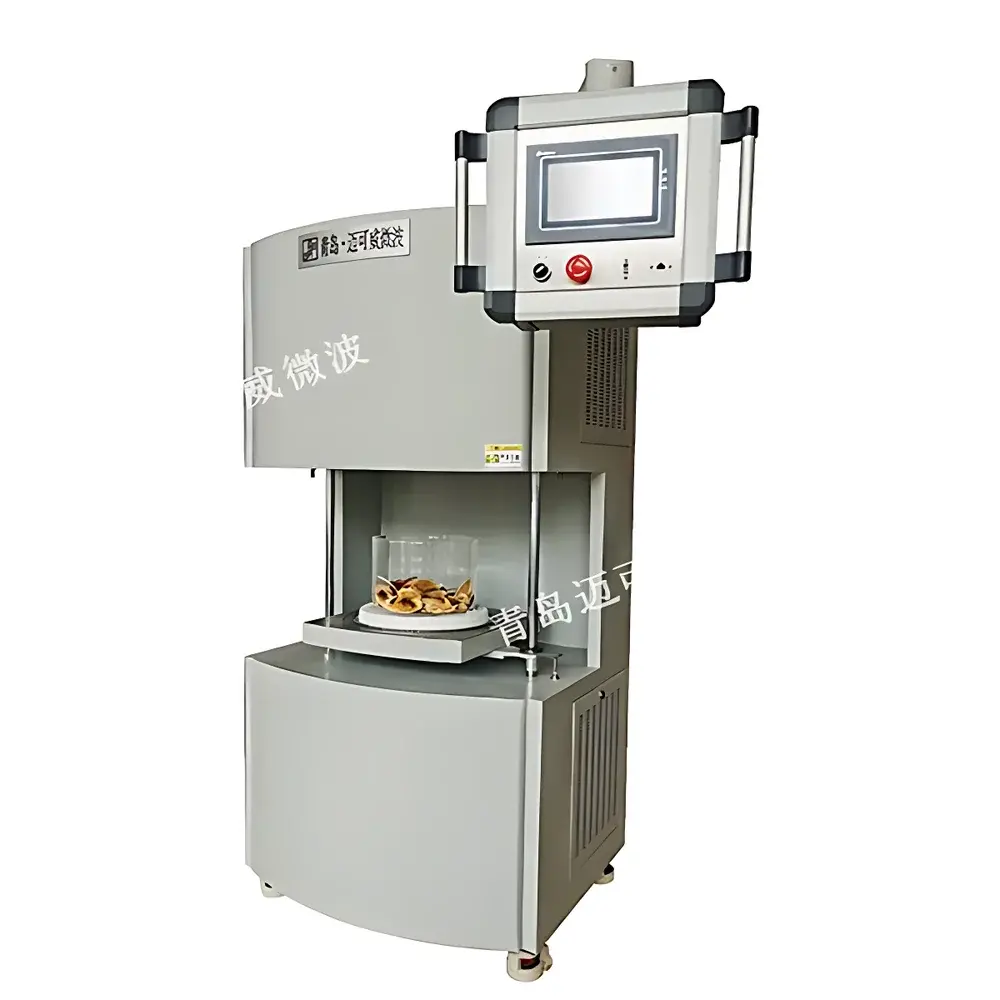
MakeWave HXH-S15/S20A High-Capacity Microwave-Assisted Drying, Carbonization & Ashing Integrated System
| Brand | MakeWave |
|---|---|
| Origin | Shandong, China |
| Manufacturer Type | Direct Manufacturer |
| Equipment Category | Domestic |
| Model | HXH-S15 / HXH-S20A |
| Instrument Type | High-Temperature Microwave Ashing Oven |
| Temperature Range | 0–1200 °C |
| Temperature Uniformity | ±1 °C |
| External Dimensions | 1400 × 750 × 1800 mm (HXH-S15) / 910 × 750 × 1950 mm (HXH-S20A) |
| Chamber Capacity | 15 L / 20 L quartz crucible |
| Chamber Material | Seamless stainless steel welding construction |
| Heating Method | Dual-mode — microwave energy (0–4.8 kW, 2450 MHz) + optional auxiliary electric heating (up to 1000 °C, 4 kW) |
| Atmosphere Control | Adjustable inlet for air or inert gas |
| Temperature Sensing | Type K thermocouple, 0–1200 °C |
| Automation | PLC-based intelligent control with color touchscreen interface |
| Data Management | Multi-step programmable protocols, recipe storage, USB data export |
| Optional Modules | Integrated thermogravimetric monitoring (0–20 kg load cell), real-time mass loss tracking |
Overview
The MakeWave HXH-S15/S20A is a high-capacity, integrated laboratory system engineered for sequential or simultaneous drying, carbonization, and ashing of biological, environmental, and industrial samples under controlled thermal and atmospheric conditions. Unlike conventional muffle furnaces or standalone microwave ovens, this instrument employs a hybrid thermal activation strategy—combining resonant 2450 MHz microwave energy with supplemental resistive heating—to achieve rapid, uniform, and reproducible thermal decomposition. The system operates across a full temperature range of 0–1200 °C with ±1 °C stability, enabling precise execution of standardized ashing procedures per ASTM D3174, ISO 1171, USP , and EPA Method 3050B. Its seamless stainless steel cavity—designed as a micro-positively sealed, multi-layer insulated chamber—ensures consistent field distribution, minimizes thermal leakage, and supports operation under variable gas atmospheres (air, N₂, O₂-deficient, or custom blends), critical for residue characterization in regulatory-compliant sample preparation workflows.
Key Features
- Dual-mode thermal processing: Independent or synergistic operation of 4.8 kW microwave source and 4 kW high-temperature electric heater enables optimized kinetics for both volatile removal (drying/carbonization) and oxidative mineralization (ashing).
- High-throughput chamber design: 15 L (HXH-S15) or 20 L (HXH-S20A) quartz crucibles support batch processing of up to 500 g of wet biomass or 200 g of dried sludge—increasing throughput by 50% over predecessor models.
- Ergonomic automated loading: Motorized vertical lift tray lowers to operator waist height for safe sample placement and retrieval, eliminating manual handling at elevated temperatures and reducing occupational exposure risk.
- Real-time thermogravimetric monitoring (optional): Integrated precision load cell (0–20 kg, ±0.1% FS) provides continuous mass-loss profiling during thermal treatment—enabling endpoint detection, kinetic modeling, and validation of complete organic matrix removal.
- Active cooling architecture: Three-zone forced-air cooling system—comprising top, side, and base ducted airflow—reduces post-ash cooldown time by ≥80%, accelerating turnaround between runs and minimizing thermal stress on crucibles.
- Regulatory-ready control platform: PLC-based controller with color touchscreen interface supports audit-trail-enabled operation, user-level access control, protocol versioning, and timestamped data export (CSV/Excel) compliant with GLP and FDA 21 CFR Part 11 requirements.
Sample Compatibility & Compliance
The HXH-S15/S20A accommodates heterogeneous solid matrices including plant tissues, food products, wastewater sludge, soil sediments, polymer composites, and pharmaceutical excipients. Its micro-positive pressure cavity and configurable gas inlets allow adaptation to oxygen-limited carbonization (e.g., biochar production per ISO 17225-2) or oxidative ashing (e.g., total ash quantification per AOAC 942.05). All thermal profiles are traceable and repeatable under ISO/IEC 17025-accredited laboratory conditions. Chamber materials meet EN 61000-6-3 EMC standards, and electrical safety complies with IEC 61010-1 for laboratory equipment.
Software & Data Management
The embedded control software enables creation, storage, and recall of multi-segment thermal programs—including ramp rates, dwell times, power modulation, and atmosphere switching logic. Each run logs temperature, microwave power, chamber pressure, mass change (if TGA option installed), and elapsed time. Data files are exportable via USB port with metadata headers (operator ID, date/time stamp, protocol name, version number). Optional software modules support statistical process control (SPC) charting, deviation alerts, and integration with LIMS via Modbus TCP or OPC UA protocols.
Applications
- Environmental laboratories: Rapid ash content determination in soils, sediments, and fly ash per EPA SW-846 Method 3050B and ASTM D5630.
- Food & agriculture testing: Total mineral residue analysis in cereals, dairy powders, and animal feed per AOAC 942.05 and ISO 5984.
- Pharmaceutical QC: Residual catalyst or inorganic impurity quantification in APIs and excipients per USP and ICH Q5D.
- Materials science: Controlled pyrolysis of polymers, carbon nanomaterial synthesis, and ceramic precursor calcination.
- Academic research: Kinetic studies of thermal degradation pathways using synchronized temperature–mass–power datasets.
FAQ
What distinguishes microwave-assisted ashing from conventional furnace-based methods?
Microwave energy couples directly with polar molecules and ionic species, enabling volumetric heating and significantly reduced thermal lag. This results in faster ramp rates, lower energy consumption per gram of sample, and improved repeatability in residue yield—particularly for moisture-rich or thermally insulating matrices.
Can the system operate under inert or reducing atmospheres?
Yes. Gas inlet ports support regulated flow of nitrogen, argon, or forming gas (N₂/H₂), while exhaust configuration can be set to negative pressure (for volatile containment) or micro-positive pressure (to prevent ambient air ingress during carbonization).
Is thermogravimetric capability standard or optional?
The 0–20 kg load cell and real-time mass monitoring module are factory-installed options. When selected, they integrate fully with the PLC control loop and data logging system.
How is temperature calibrated and verified?
Each unit ships with NIST-traceable calibration certificate for the Type K thermocouple. Users may perform routine verification using external reference thermometers per ISO/IEC 17025 internal calibration procedures.
What maintenance is required for long-term reliability?
Routine inspection of waveguide integrity, door seal condition, and crucible surface integrity is recommended quarterly. The microwave magnetron carries a 2-year warranty; all stainless steel structural components are designed for ≥10 years of continuous lab use under proper operating conditions.



