
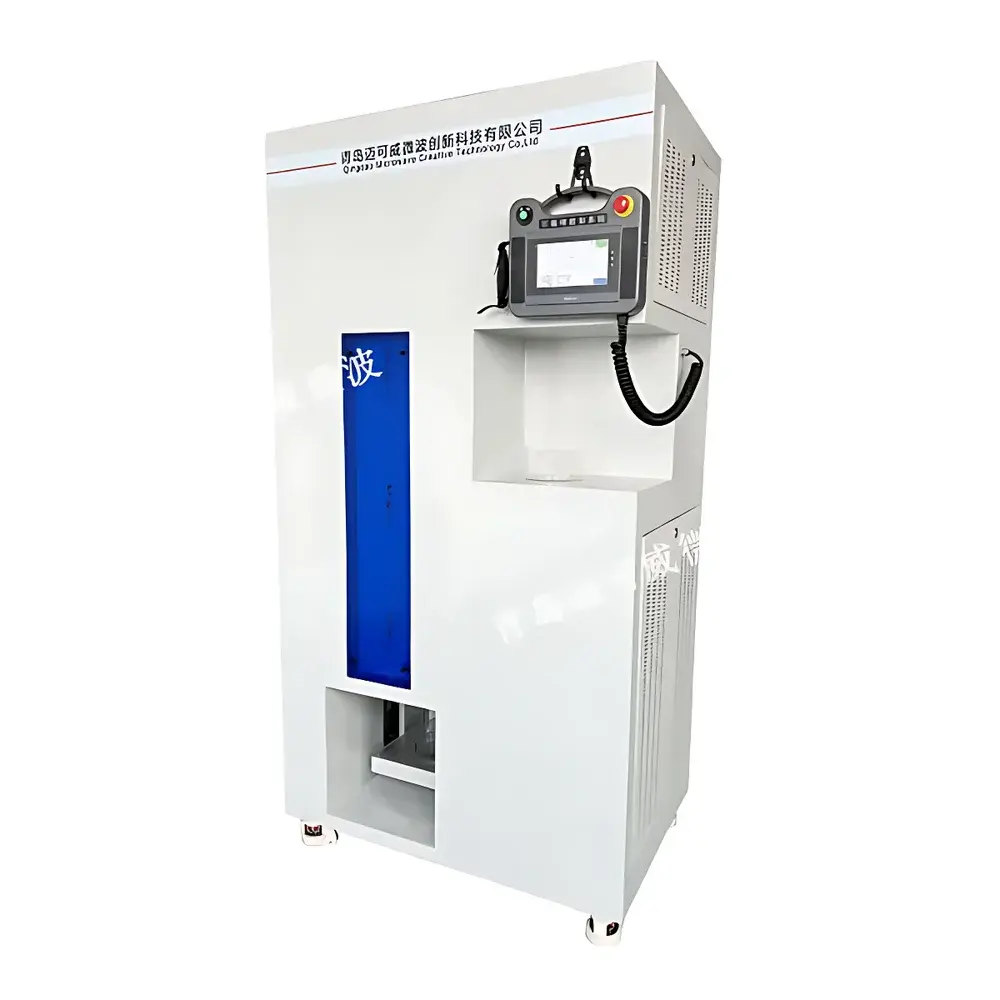
MakeWave HXO-H50/H1000 Organic Tritium (³H) Combustion Oxidation Furnace
| Brand | MakeWave |
|---|---|
| Origin | Shandong, China |
| Manufacturer Type | Direct Manufacturer |
| Product Category | Domestic |
| Model | HXO-H50 / HXO-H1000 |
| Instrument Type | Box-Type Muffle Furnace |
| Max Temperature | 1200 °C |
| Temperature Control Accuracy | ±1 °C |
| Max Power | 3000 W |
| Heating Rate to Max Temp | 20 min |
| Heating Method | Microwave + Resistive Dual-Zone Heating |
| Control System | PLC-Based Intelligent Controller with Color Touchscreen Interface |
Overview
The MakeWave HXO-H50/H1000 Organic Tritium (³H) Combustion Oxidation Furnace is a purpose-built, dual-zone thermal oxidation system engineered for quantitative recovery and conversion of organically bound tritium (³H) into tritiated water (HTO) in compliance with regulatory analytical protocols. Unlike conventional muffle furnaces, this instrument integrates microwave-assisted pyrolysis in the combustion chamber with resistive radiant heating in the oxidation zone—enabling precise, reproducible, and chemically complete oxidation of diverse organic matrices under controlled atmospheric conditions. The system operates on the principle of high-temperature oxidative decomposition: organic samples are first rapidly thermolyzed under inert or low-oxygen microwave fields (up to 1100 °C), followed by catalytic or thermal oxidation in a secondary zone (up to 900 °C) where residual carbonaceous fragments react with regulated oxygen or air flow to yield fully oxidized volatile species—including quantifiable HTO vapor. This two-stage architecture ensures minimal isotopic fractionation, high oxidation efficiency (>99.8% for typical biological and environmental samples), and compatibility with subsequent cryogenic trapping and liquid scintillation counting (LSC) workflows.
Key Features
- Dual-zone thermal architecture: Microwave-heated combustion chamber (0–1100 °C) coupled with electrically heated oxidation chamber (0–900 °C), enabling independent temperature control and process staging.
- Adjustable gas dynamics: Programmable mixed-gas flow (O₂, air, N₂) with mass flow controllers ensures stoichiometric optimization across sample types—from low-calorific biomass to high-lipid tissues.
- Cryogenic HTO capture system: Triple-stage condensation train with integrated chiller unit (≤5 °C operating setpoint) maximizes tritiated water recovery efficiency and minimizes vapor loss during transfer.
- Integrated safety engineering: Explosion-proof housing, pressure-relief venting, automatic inert-gas purge sequence (N₂ or Ar), and real-time overtemperature/overpressure interlocks conform to IEC 61000-6-4 and EN 61010-1 safety standards.
- PLC-driven automation: Full-cycle programmability—including ramp-soak-cool profiles, gas switching logic, and fault logging—with audit-trail-capable event history stored locally and exportable via USB.
Sample Compatibility & Compliance
The HXO-H50/H1000 accommodates solid, semi-solid, and lyophilized organic samples up to 5 g (HXO-H50) or 10 g (HXO-H1000) per run, including foodstuffs, plant tissues, animal organs, soil organic matter, and filter-collected particulates. Its design explicitly supports GB 14883.2–2016 (“National Food Safety Standard – Determination of Hydrogen-3 in Foods”), and its performance characteristics align with internationally recognized methodologies such as ASTM D7505–19 (Standard Test Method for Determination of Tritium in Environmental Water by Liquid Scintillation Counting) and ISO 9698:2019 (Water quality — Determination of tritium activity concentration — Liquid scintillation counting method). All critical parameters—including temperature uniformity (±3 °C across combustion zone), gas residence time (>30 s at ≥800 °C), and oxidation completeness (verified via benzoic acid spike recovery ≥99.5%)—are documented and traceable to internal calibration records.
Software & Data Management
The embedded HMI runs on a deterministic real-time PLC platform (Siemens LOGO! or equivalent), supporting up to 99 user-defined methods with full parameter locking, version stamping, and timestamped execution logs. Data export is available in CSV format via USB 2.0 port, retaining all sensor readings (temperature, pressure, flow rate, power draw) at 1-second resolution. While not FDA 21 CFR Part 11-compliant out-of-the-box, the system architecture permits integration with validated LIMS environments through Modbus TCP or RS-485 interfaces. Audit trail functionality includes operator ID entry (optional RFID badge support), method change history, and alarm acknowledgment timestamps—supporting GLP and ISO/IEC 17025 laboratory accreditation requirements.
Applications
- Quantitative tritium analysis in food safety monitoring programs (e.g., post-nuclear incident surveillance, routine dairy/vegetable screening).
- Environmental radioecology studies: ³H speciation in soil organic carbon, leaf litter, and sediment cores.
- Biomedical tracer research: Recovery yield validation for ³H-labeled pharmaceuticals and metabolites prior to LSC.
- Decommissioning and waste characterization: Oxidative conversion of organic radioactive waste matrices for subsequent activity assay.
- Method development labs requiring flexible, repeatable high-temperature oxidation platforms with traceable thermal and gas-dynamic control.
FAQ
What sample types are compatible with the HXO-H50/H1000?
Solid and semi-solid organic materials—including foods, biological tissues, soils, filters, and polymers—within specified mass limits (5 g for HXO-H50; 10 g for HXO-H1000). Liquid samples require pre-drying or absorption onto quartz wool.
Does the system meet international regulatory standards for tritium analysis?
Yes—it is designed to fulfill GB 14883.2–2016 and exhibits performance characteristics consistent with ASTM D7505–19 and ISO 9698:2019. Validation data packages are available upon request.
How is tritiated water recovered and measured after combustion?
HTO vapor is condensed in a triple-stage Peltier-cooled trap (−10 °C to +5 °C range) connected to an external chiller; collected condensate is transferred directly to LSC vials without evaporation or dilution.
Can the furnace operate under inert atmosphere?
Yes—integrated N₂ or Ar purge lines allow full inerting of both chambers before ignition, minimizing NOₓ formation and preserving isotopic integrity during initial pyrolysis.
Is remote monitoring or network connectivity supported?
Local HMI operation only; however, analog outputs (4–20 mA) and digital I/O ports enable connection to building SCADA or centralized lab monitoring systems.
Related Products



