
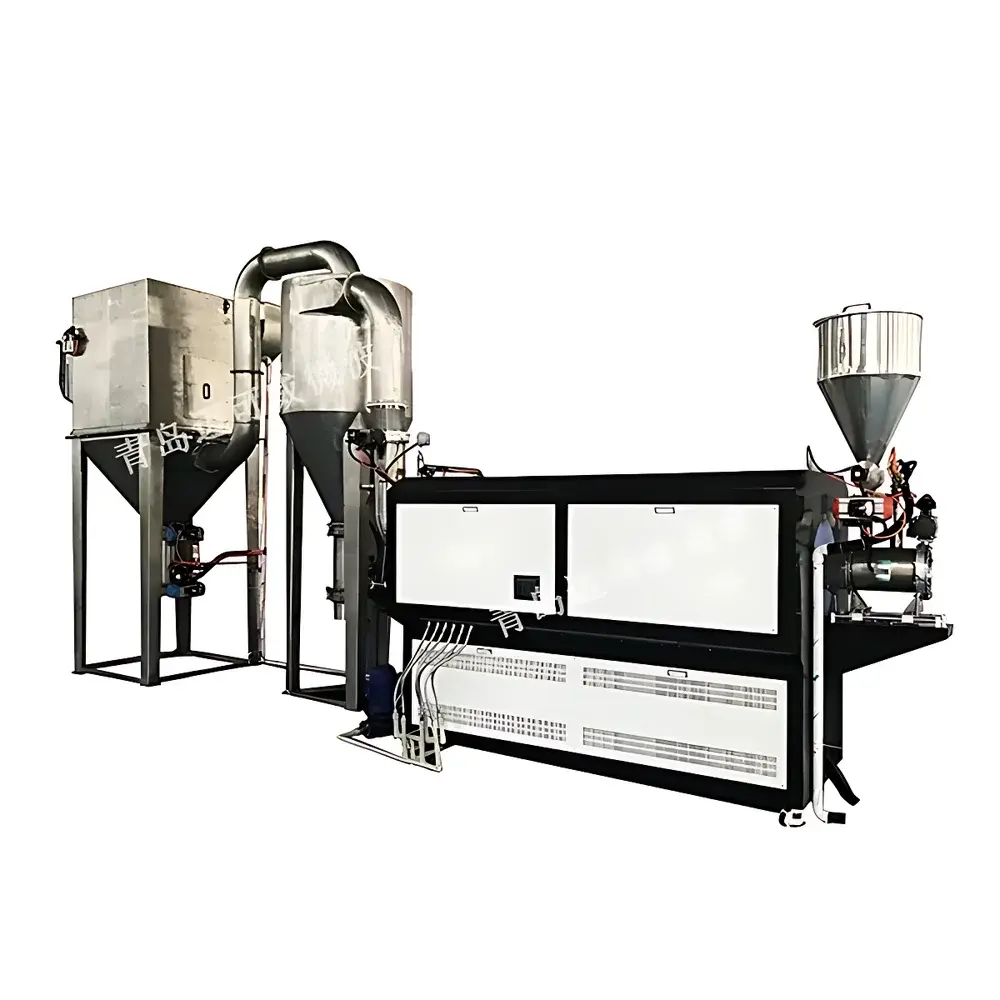
Makewave MCG-M60HBR Industrial Continuous Microwave Graphene Reduction System
| Brand | Makewave |
|---|---|
| Origin | Shandong, China |
| Manufacturer Type | Direct Manufacturer |
| Product Origin | Domestic (China) |
| Model | MCG-M60HBR |
| Pricing | Available Upon Request |
| Control System | PLC with Color Touchscreen HMI |
| Feed Form | Sealed Weighing Valve |
| Discharge Form | Dual-Density Collection System |
| Output Capacity | ≥10 Metric Tons/Year (Reduced Graphene Oxide) |
| External Dimensions | ~10 m (L) × 3 m (D) × 3.6 m (H) |
| Vacuum System | Integrated |
| Atmosphere Control | Multi-Gas Inlet Ports |
| Temperature Monitoring | Multi-Point RTD Sensors |
| Microwave Power | Adjustable |
| Safety Compliance | Microwave Leakage < GB 10436-2008 Limit |
Overview
The Makewave MCG-M60HBR is an industrial-scale, continuous-flow microwave reduction system engineered for the scalable and controlled thermal deoxygenation of graphene oxide (GO) into reduced graphene oxide (rGO). Unlike batch-mode laboratory reactors, this system implements a fully integrated process architecture grounded in dielectric heating principles—where microwave energy (typically 2.45 GHz) couples directly with polar functional groups (e.g., hydroxyl, epoxy, carboxyl) on GO sheets, enabling rapid, volumetric, and selective thermal reduction. The system is designed to meet the engineering requirements of pilot-to-production transition: it unifies material handling (feed, distribution), microwave exposure, inert or reactive atmosphere control, vacuum-assisted oxygen-free processing, and dual-density product recovery—all under centralized PLC supervision. Its modular subsystem integration supports reproducible rGO synthesis with consistent C/O ratio, sheet integrity, and electrical conductivity profiles across multi-ton annual output.
Key Features
- PLC-based automation with color touchscreen HMI for real-time monitoring and parameter logging—including microwave power level, chamber pressure, multi-point temperature profiles (RTD-sensed at ≥6 locations), gas flow rates, and feed mass accumulation.
- Multi-atmosphere capability via independent gas inlet ports; compatible with N₂, Ar, H₂/N₂ mixtures, or forming gases—enabling tailoring of reduction kinetics and surface chemistry.
- Continuous-feed architecture featuring a sealed, weight-calibrated dosing valve and vibratory distribution mechanism to ensure uniform GO layer formation on the conveyor belt prior to microwave exposure.
- Integrated high-efficiency vacuum system (≤10 Pa ultimate pressure) to evacuate residual oxygen and moisture prior to and during reduction—critical for minimizing re-oxidation and carbon defect formation.
- Dual-stage collection system separating rGO by bulk density and particle agglomeration state: primary cyclone for coarse fraction (>5 µm), secondary electrostatic precipitator for fine aerosols (<1 µm), both with corrosion-resistant internal coatings (e.g., ceramic-reinforced PFA).
- Observation windows with borosilicate quartz and RF-shielded viewports permit non-intrusive visual verification of material flow, charring behavior, and gas evolution without compromising containment integrity.
- RF leakage mitigation per GB 10436-2008: all waveguide joints, door seals, and aperture shielding are validated using calibrated field probes; measured leakage ≤1 mW/cm² at 5 cm distance.
Sample Compatibility & Compliance
The MCG-M60HBR accommodates aqueous or solvent-dispersed GO slurries (solid content 2–15 wt%), freeze-dried GO powders, and pre-compressed GO pellets (diameter ≤25 mm). All wetted surfaces—including conveyor, feed chute, and collection hoppers—are lined with chemically inert, microwave-transparent coatings resistant to acidic reduction byproducts (e.g., NOₓ, CO, formic acid vapors). The system conforms to China’s GB/T 19001–2016 (ISO 9001) quality management framework and includes audit-ready operational logs compliant with GLP-aligned data integrity practices. While not certified to FDA 21 CFR Part 11, its timestamped parameter history, user-access controls, and electronic signature support can be configured to align with GMP documentation workflows upon customer specification.
Software & Data Management
The embedded control software records time-stamped sequences of all critical process variables at 1 Hz resolution. Export formats include CSV and SQLite for integration with LIMS or MES platforms. Alarm thresholds (e.g., temperature deviation >±15°C, vacuum loss >50 Pa/s) trigger automatic power ramp-down and audible/visual alerts. Optional Ethernet/IP or Modbus TCP interfaces enable remote SCADA-level supervision and predictive maintenance analytics—such as magnetron aging trend analysis based on reflected power history and cooling water temperature differentials.
Applications
This system serves industrial R&D labs and production facilities engaged in conductive ink formulation, battery electrode manufacturing (anode/cathode additives), EMI shielding composites, and catalytic support synthesis. It enables direct correlation between microwave dwell time, peak temperature, and rGO properties—including XPS-measured oxygen content (target: 5–12 at.%), BET surface area (300–600 m²/g), and four-point probe resistivity (0.5–5 Ω·cm). Process scalability is validated through linear throughput correlation: doubling conveyor speed maintains equivalent specific energy input (kJ/g GO) when power and residence time are proportionally adjusted.
FAQ
What types of graphene oxide precursors are compatible with the MCG-M60HBR?
Aqueous GO dispersions, lyophilized GO powders, and mechanically compacted GO tablets (≤25 mm diameter) are supported. Slurry viscosity must remain below 500 cP for stable valve feeding.
Can the system operate under hydrogen-containing atmospheres?
Yes—multi-port gas manifold allows safe introduction of H₂/N₂ mixtures up to 10 vol% H₂, with integrated O₂ sensors and purge interlocks meeting IEC 60079-10-1 hazardous area classification guidelines.
Is remote operation supported out-of-the-box?
Standard configuration includes Ethernet connectivity and web-enabled HMI access; full remote start/stop, recipe upload, and alarm acknowledgment require optional cybersecurity hardening (TLS 1.2, role-based authentication).
How is temperature uniformity ensured across the reaction zone?
Multi-zone microwave applicator design combined with real-time IR pyrometry feedback (±2°C accuracy) and adaptive power modulation maintains ±10°C axial and radial uniformity over 2.5 m active length.
What maintenance intervals are recommended for magnetrons and waveguide components?
Magnetron service life exceeds 5,000 operating hours under rated load; quarterly inspection of ceramic window integrity and quarterly cleaning of waveguide interior with isopropyl alcohol are advised.
Related Products







