
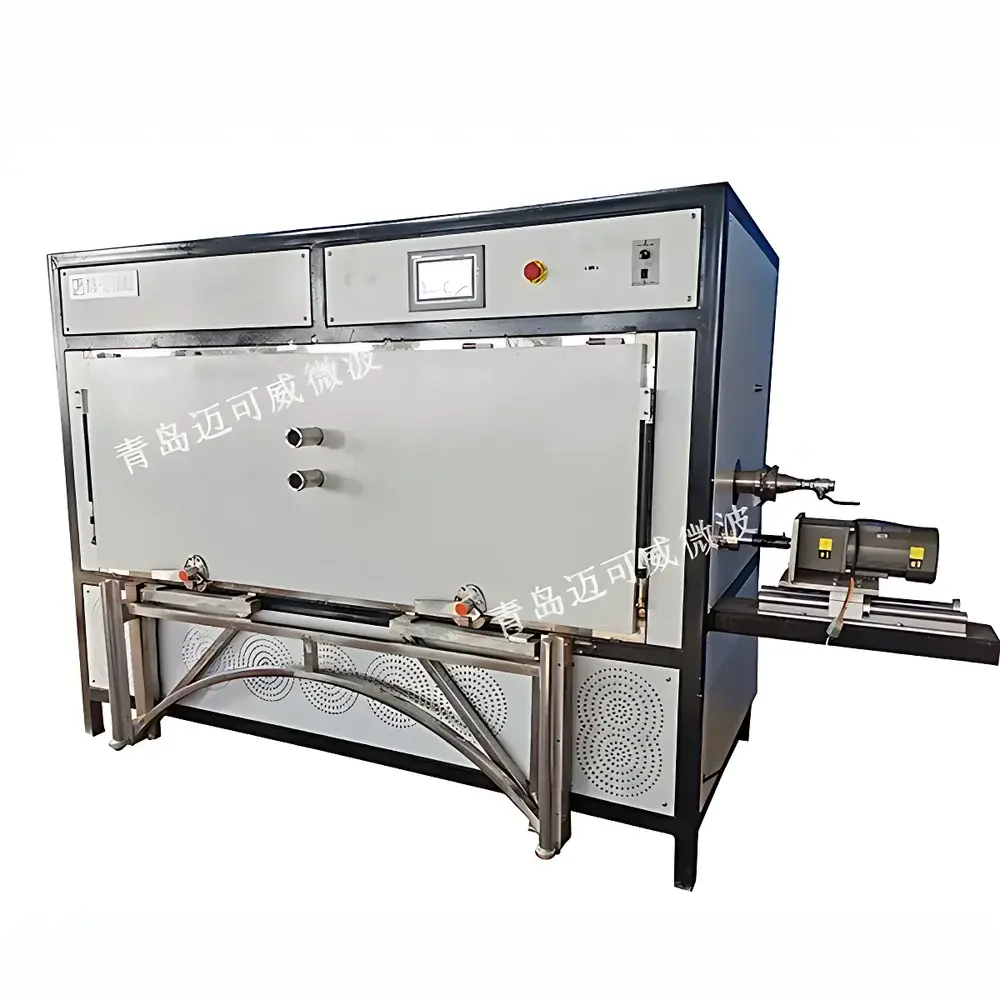
Makewave MGG-R24HA Large-Scale Microwave Rotary High-Temperature Kiln
| Brand | Makewave |
|---|---|
| Origin | Shandong, China |
| Manufacturer Type | Direct Manufacturer |
| Product Origin | Domestic (China) |
| Model | MGG-R24HA |
| Power Supply | 380 V / 50 Hz, 35 kVA |
| Microwave Output Power | Up to 24 kW (adjustable, water-cooled industrial magnetron) |
| Max Operating Temperature | 800 °C |
| Heating Zone Volume | 50 L (Φ250 mm × 1000 mm quartz tube) |
| Rotational Speed Range | 0.1–1 rpm |
| Gas Flow Capacity | up to 5 m³/h |
| Atmosphere Compatibility | Air, N₂, O₂, Ar, and other process gases |
| Temperature Measurement | Axial infrared pyrometry (0–800 °C) |
| Control System | PLC-based with HMI touchscreen, 10-segment programmable ramp-soak profiles |
| Microwave Leakage | <5 mW/cm² (compliant with GB 10436-2008) |
| Overall Dimensions (W×H×D) | ~2500 × 1000 × 1000 mm |
| Feedstock | ≤1000 mesh powder, max batch load: 10 kg |
| Sealing | Dynamic microwave-shielded rotary feedthroughs |
| Insulation | Low-loss ceramic fiber lining |
| Safety Compliance | CE-compatible design architecture, EMI shielding per IEC 61000-6-4 |
Overview
The Makewave MGG-R24HA is a large-scale, continuous-feed microwave rotary high-temperature kiln engineered for controlled thermal processing of fine particulate materials under reactive or inert atmospheres. Unlike conventional resistance-heated rotary kilns, this system leverages volumetric microwave energy coupling—primarily via dipole rotation and conduction loss mechanisms—to achieve rapid, uniform internal heating across bulk powder beds. The rotating quartz reaction tube (Φ250 mm × 1800 mm, with 1000 mm active heating zone) ensures consistent material exposure to the electromagnetic field while promoting mechanical mixing via integrated quartz paddles. Designed for R&D scalability and pilot-stage process validation, the MGG-R24HA bridges laboratory experimentation and pre-industrial deployment in fields requiring precise thermal history control—including graphene exfoliation, metal oxide reduction, catalyst regeneration, and thermal desorption of adsorbed contaminants.
Key Features
- 24 kW water-cooled industrial magnetron with analog power modulation, enabling stable output across full load range and extended duty cycles
- Multi-port radial microwave coupling into a stainless-steel cavity with carbon-steel powder-coated exterior—optimized for field homogeneity and EMI containment
- Quartz reaction tube with axial infrared pyrometry through center-bore optical access; real-time temperature feedback enables closed-loop power regulation
- Variable-speed gearmotor drive (0.1–1 rpm) with linear slide rails for full tube extraction—facilitating rapid loading, unloading, and chamber maintenance
- Dynamic gas-tight rotary feedthroughs with integrated RF shielding, supporting continuous atmosphere purging at up to 5 m³/h flow rate
- Low-loss ceramic fiber insulation system minimizing thermal inertia and external surface temperature rise during operation
- PLC-controlled HMI interface with 10-segment programmable thermal profiles, data logging (time-stamped temperature/power curves), and USB export capability
Sample Compatibility & Compliance
The MGG-R24HA accommodates free-flowing, microwave-absorbing powders with particle size ≤1000 mesh (D₉₀ < 15 µm), including carbon blacks, graphite flakes, transition metal oxides, and activated carbons. Non-absorbing or low-loss materials may require susceptor blending for effective coupling. All gas interfaces support ASTM E2653-compliant purge protocols, and the sealed reaction environment meets ISO 8573-1 Class 4 purity requirements when used with certified gas delivery systems. Microwave leakage remains below 5 mW/cm² at 5 cm distance (per GB 10436-2008 and aligned with ICNIRP 2020 occupational exposure limits). Structural design follows ASME BPVC Section VIII Div. 1 principles for pressure boundary integrity where applicable.
Software & Data Management
The embedded control firmware supports audit-trail-enabled operation per GLP/GMP-aligned practices: all parameter changes, program executions, and alarm events are timestamped and stored locally on the HMI’s non-volatile memory. Raw sensor data (temperature, power, rotation speed, gas flow if externally monitored) is logged at user-selectable intervals (1–60 s) and exportable as CSV files for post-processing in MATLAB, Python, or statistical analysis platforms. No cloud connectivity or remote access is implemented—ensuring data sovereignty and compliance with institutional IT security policies. Firmware updates are performed via authenticated USB media only.
Applications
- Controlled thermal expansion of natural graphite to produce low-density, high-surface-area graphene precursor flakes
- Reductive annealing of NiO, Co₃O₄, or Fe₂O₃ nanoparticles under H₂/N₂ mixtures for battery cathode precursor synthesis
- Thermal desorption of VOC-laden activated carbon or soil matrices in environmental remediation studies
- Kinetic investigation of solid-state decomposition pathways (e.g., MgCO₃ → MgO + CO₂) under dynamic gas environments
- Pre-sintering of ceramic green bodies prior to final HIP or SPS consolidation
- Continuous-flow pyrolysis screening for biomass-derived biochar optimization
FAQ
What types of atmospheres can be used with the MGG-R24HA?
Air, nitrogen, argon, oxygen, hydrogen, and custom gas mixtures are supported via standardized VCR or Swagelok fittings; flow rates up to 5 m³/h are accommodated with optional mass flow controllers.
Is the quartz tube replaceable, and what is its typical service life?
Yes—the tube is a consumable component designed for quick replacement; expected lifetime exceeds 300 h at 800 °C in inert atmospheres, depending on thermal cycling frequency and chemical exposure.
Can the system be integrated with external gas analyzers or mass spectrometers?
Yes—dedicated flange ports (KF40 or CF63) are available on the exhaust line for inline coupling to FTIR, GC-MS, or quadrupole mass spectrometers for real-time off-gas analysis.
Does the control system support 21 CFR Part 11 compliance?
While the base configuration does not include electronic signature or role-based access control, the architecture permits third-party validation packages for regulated pharmaceutical or medical device manufacturing environments.
What safety interlocks are implemented?
Hardware-level microwave suppression triggers upon door opening, overtemperature (>850 °C), cooling water flow failure, or excessive cavity reflection (>30% VSWR); all interlocks are hardwired to the magnetron power supply.



