
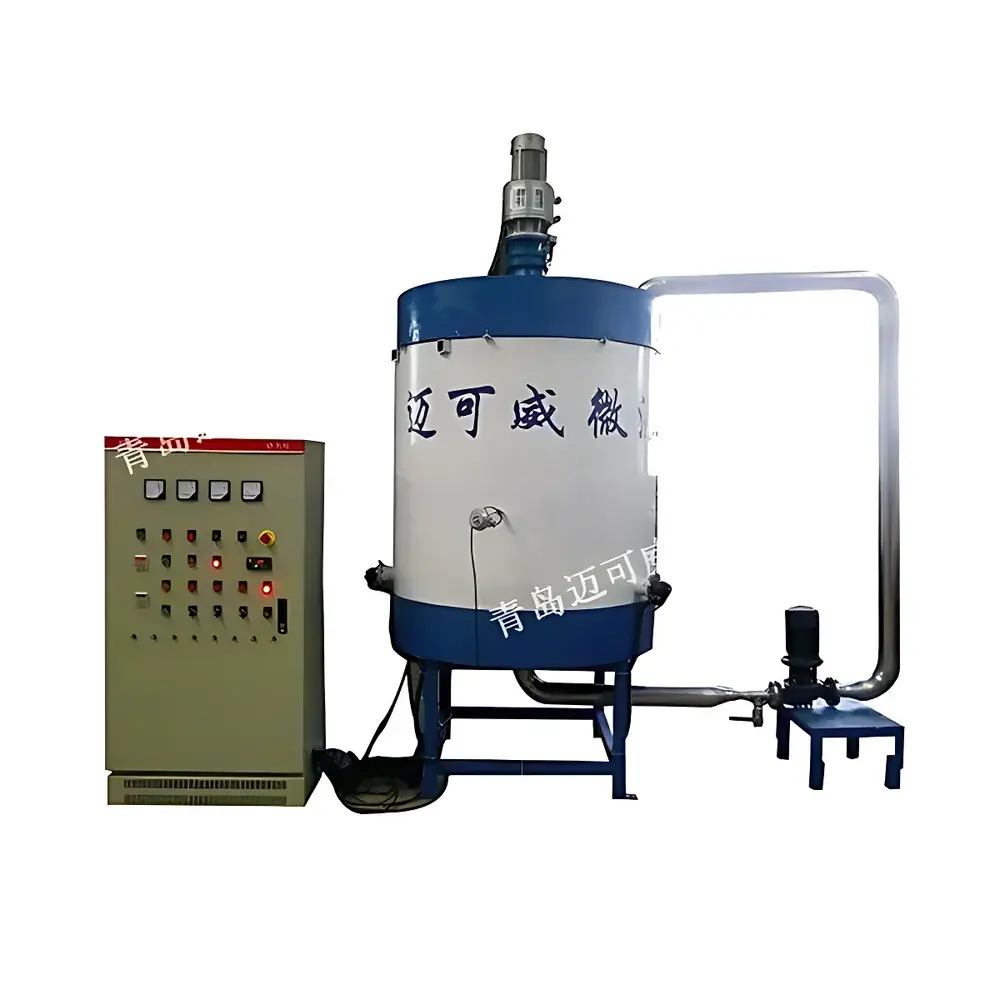
MakeWave MGX-J Series Stirred Microwave Chemical Reactor
| Brand | MakeWave |
|---|---|
| Origin | Shandong, China |
| Manufacturer Type | Direct Manufacturer |
| Country of Origin | China |
| Model | MGX-J Series |
| Price Range | USD 21,000 – 42,500 (FOB) |
| Usable Volume | Large-scale (1000 L) |
| Construction Material | 304 Stainless Steel |
| Operating Pressure | Low-pressure (≤0.6 MPa gauge) |
| Vacuum Capability | Atmospheric operation only (no vacuum rating) |
| Frequency | 2450 MHz |
| Microwave Power Output | 8–50 kW (adjustable, industrial-grade frequency-variable magnetron source) |
| Auxiliary Electric Heating Power | 30–100 kW |
| Temperature Range | Ambient to 250 °C |
| Control Interface | PLC-based HMI touchscreen terminal |
| Compliance | GB 5959.6–2008, ISO 9001 certified |
Overview
The MakeWave MGX-J Series Stirred Microwave Chemical Reactor is an industrial-scale, open-loop microwave-assisted synthesis platform engineered for continuous or batch catalytic chemical processing under controlled thermal and mechanical conditions. Unlike conventional jacketed reactors relying solely on conductive/convective heating, this system integrates high-power 2450 MHz microwave energy directly into the reaction medium via liquid-immersion multi-port broadband coupling — enabling rapid, volumetric, and selective dielectric heating of polar solvents and reactants. The reactor’s cylindrical 304 stainless steel vessel (1000 L usable volume) features integrated anchor-type agitator, dynamic recirculation loop, and real-time multipoint temperature monitoring. Designed for low-pressure operation (≤0.6 MPa), it supports exothermic/endothermic reactions requiring precise thermal management between ambient and 250 °C — with closed-loop power modulation synchronized to thermocouple feedback. Its architecture conforms to GB 5959.6–2008 for industrial microwave equipment safety and integrates seamlessly into existing pilot-plant or production-line infrastructure.
Key Features
- Industrial-grade variable-frequency microwave generator (8–50 kW output), optimized for stable long-duration operation with automatic load matching
- Simultaneous auxiliary electric heating (30–100 kW) for hybrid thermal control, enhancing ramp rate consistency and cold-start performance
- 304 stainless steel monolithic cavity and reactor vessel, fully welded per ASME BPVC Section VIII Div. 1 fabrication standards
- Multi-point Pt100 thermocouple array with ±1.5 °C accuracy across reaction zone; data logged at 1 Hz resolution
- Variable-speed anchor agitator (0–60 rpm) coupled with external corrosion-resistant circulation pump (flow rate up to 15 m³/h)
- PLC-based control system with 10.1″ resistive touchscreen HMI, supporting recipe storage, parameter trending, and event logging
- Integrated safety interlocks: microwave door shielding, pressure relief valve, overtemperature cutoff, and nitrogen purge interface
Sample Compatibility & Compliance
The MGX-J reactor accommodates liquid-phase, slurry-phase, and heterogeneous catalytic reactions involving organic solvents (e.g., DMF, ethylene glycol), aqueous electrolytes, and metal-organic precursors. Its stainless steel wetted parts ensure compatibility with mildly corrosive media; optional Hastelloy C-276 lining is available for aggressive halide-containing systems. The system meets GB 5959.6–2008 for electromagnetic leakage (<5 mW/cm² at 5 cm), complies with ISO 9001:2015 quality management requirements, and supports documentation traceability for GLP/GMP-aligned process validation. While not rated for vacuum service, its low-pressure design aligns with ASTM E2847 (standard guide for microwave-assisted chemical synthesis) and supports pressure-rated lid configurations upon customization.
Software & Data Management
Control firmware implements deterministic real-time scheduling for temperature, power, agitation speed, and feed timing — all configurable via intuitive graphical workflow editor. Process data (temperature profiles, power absorption curves, stirrer torque, inlet/outlet temperatures) are timestamped and stored locally on industrial SSD with 12-month retention. Optional OPC UA server enables integration with DCS/SCADA systems (e.g., Siemens PCS7, Emerson DeltaV). Audit trail functionality records user logins, parameter modifications, and alarm acknowledgments — satisfying FDA 21 CFR Part 11 requirements when deployed with electronic signature module and network time synchronization. Remote monitoring via secure HTTPS interface supports TLS 1.2+ encryption and role-based access control.
Applications
This reactor is validated for scalable microwave-accelerated synthesis including esterification, transesterification, nanoparticle precipitation (e.g., ZnO, TiO₂), polymer grafting, and Fischer–Tropsch model reactions. It serves R&D departments developing continuous-flow pharmaceutical intermediates, fine chemical manufacturers optimizing catalyst turnover frequency (TOF), and materials science labs scaling solvothermal MOF crystallization. Its ability to maintain uniform field distribution in large-volume vessels (>1 m³ variants available) makes it suitable for technology transfer from lab-scale (0.5 L) to pilot (1000 L) and pre-commercial (10 m³) stages — reducing scale-up risk associated with thermal gradients in conventional heating.
FAQ
What is the maximum allowable operating temperature and pressure?
The standard configuration supports continuous operation up to 250 °C at nominal pressure ≤0.6 MPa gauge. Higher pressure ratings require custom ASME-certified vessel design.
Is microwave leakage monitored during operation?
Yes — integrated RF sensors continuously measure cavity leakage; automatic power shutdown triggers if readings exceed 5 mW/cm² per GB 5959.6–2008.
Can the system be integrated into an existing plant automation network?
Absolutely — standard Modbus TCP and optional OPC UA interfaces enable bidirectional communication with PLCs, MES, and historian systems.
Does the controller support audit trail and electronic signatures for regulated environments?
Yes — with optional 21 CFR Part 11 compliance package, including digital certificate authentication, immutable log archiving, and e-signature workflows.
What cooling infrastructure is required for sustained operation?
A closed-loop chiller delivering ≤25 °C softened water at ≥15 L/min is recommended for >8-hour duty cycles to maintain magnetron junction temperature below 65 °C.



