
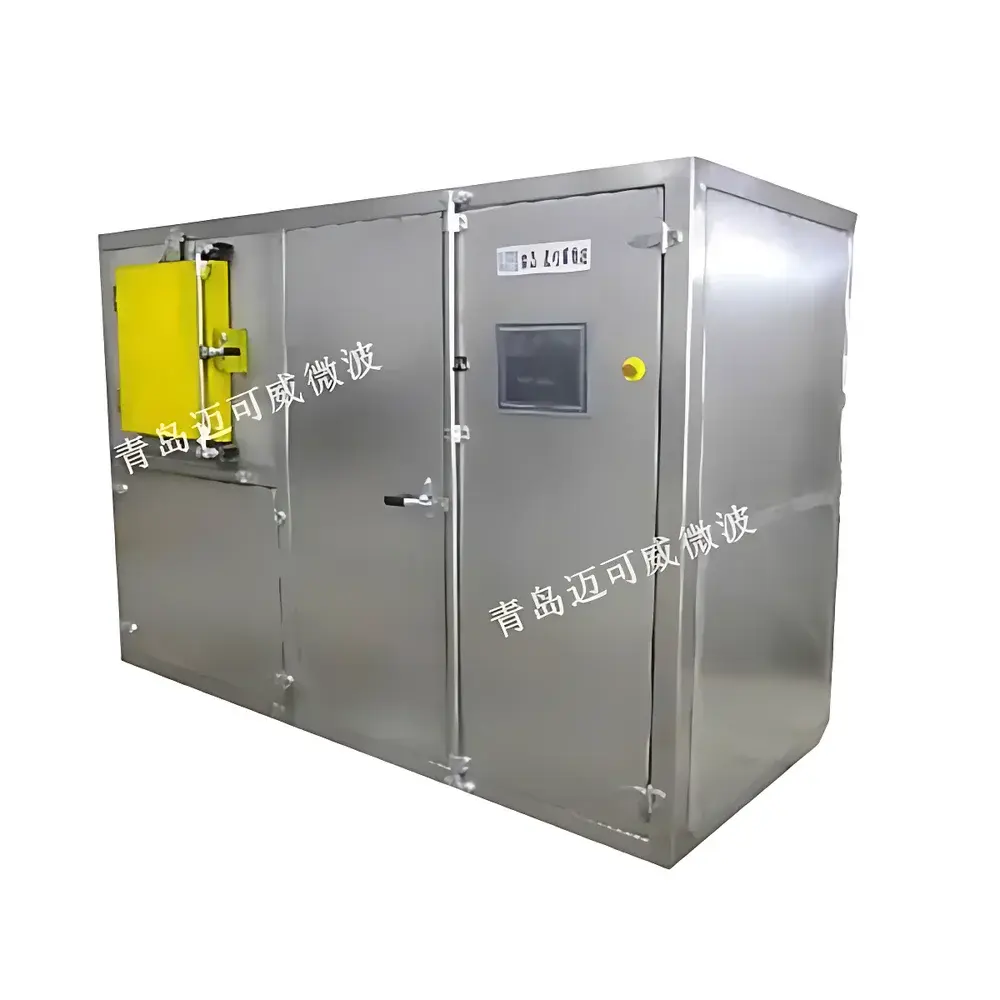
MakeWave MHX-16A Integrated Microwave Pyrolysis and Incineration System for Hazardous Solid Waste
| Brand | MakeWave |
|---|---|
| Origin | Shandong, China |
| Manufacturer Type | Direct Manufacturer |
| Country of Origin | China |
| Model | MHX-16A |
| Price Range | USD 70,000 – 140,000 (FOB) |
| Instrument Category | Hazardous Solid Waste Treatment System |
| Applicable Field | On-site, low-volume hazardous waste generators with logistical constraints (e.g., limited transport access, high batch frequency, space-sensitive facilities) |
| Treatment Principle | Microwave-assisted pyrolysis (anaerobic thermal decomposition) and controlled incineration (aerobic combustion) |
| Throughput | 2 kg/h (based on cotton textile reference matrix) |
| Regulatory Compliance | GB 18484–2001 (Pollution Control Standard for Hazardous Waste Incineration), GB 4706.21–2008, GB 5959.6–2008 |
| Microwave Power/Frequency | 0–16 kW adjustable / 2450 MHz |
| Cavity Construction | Fully welded stainless steel vacuum-rated chamber |
| Chamber Volume | Pyrolysis/Incineration chamber: 70 L |
| Discharge chamber | 100 L |
| Expansion/diffusion chamber | 30 L |
| Temperature Range | 0–1200 °C (Type K thermocouple) |
| Atmosphere Control | Dual independent gas supply paths (inert for pyrolysis |
| Exhaust Treatment | Integrated adsorption-catalytic decomposition system compliant with GB 18484–2001 emission limits |
| Residue Thermal Reduction Rate | <5% (measured per ASTM D2974 or equivalent gravimetric protocol) |
| Volume Reduction Ratio | 40:1 (cotton textile reference) |
| Control System | PLC-based HMI with color touchscreen |
| Safety Features | Interlocked access doors |
| Dimensions (W×D×H) | 2800 × 1300 × 2400 mm (excl. external exhaust treatment unit) |
Overview
The MakeWave MHX-16A Integrated Microwave Pyrolysis and Incineration System is an engineered solution for on-site thermal treatment of small-batch hazardous solid waste under stringent regulatory and operational constraints. Designed specifically for laboratories, healthcare facilities, nuclear support centers, pharmaceutical R&D units, and environmental testing institutions, the MHX-16A employs dual-mode microwave energy delivery to execute either anaerobic pyrolysis (carbonization) or aerobic incineration—each mode optimized for distinct waste compositions and emission control requirements. Unlike conventional resistive-heating furnaces, the MHX-16A utilizes 2450 MHz microwave radiation to induce volumetric heating within the waste matrix, enabling rapid, uniform thermal decomposition without reliance on conduction or convection. This principle yields faster ramp rates, lower energy input per mass unit, and precise thermal control across heterogeneous feedstocks. The system operates within a fully sealed, pressure-rated stainless steel cavity architecture capable of maintaining vacuum or micro-positive inert atmospheres—critical for suppressing dioxin/furan formation during halogenated waste processing.
Key Features
- Dual-process thermal treatment: Selectable carbonization (anaerobic, vacuum-assisted pyrolysis) or incineration (aerobic, air-supported combustion) modes via HMI interface.
- Modular chamber design: 70 L main reaction chamber (quartz-lined, microwave-transparent), 100 L automated discharge chamber, and 30 L expansion/diffusion volume—engineered for sequential thermal staging and residence time control.
- Integrated exhaust management: Multi-stage post-combustion treatment including catalytic oxidation, activated carbon adsorption, and alkaline scrubbing—validated against GB 18484–2001 emission thresholds for CO, NOx, SO2, particulates, and total hydrocarbons.
- Full automation: PLC-controlled sequence includes auto-loading, atmosphere purging, microwave power ramping, temperature hold, residue quenching, ash collection, and system cooldown—all initiated via single-touch operation.
- Industrial-grade safety architecture: Electromechanical door interlocks, real-time microwave leakage monitoring (<5 mW/cm²), surface temperature regulation (<50 °C), explosion-proof motorized actuators, and redundant overtemperature cutoffs.
- Remote operability: Ethernet-enabled PLC supports secure remote diagnostics, parameter adjustment, and historical log retrieval—compatible with institutional IT security policies and audit-ready data retention protocols.
Sample Compatibility & Compliance
The MHX-16A accommodates diverse hazardous solid matrices including contaminated PPE, spent filter media, laboratory absorbents, biological culture waste, pharmaceutical residues, and low-level radioactive simulants (non-fissile). It excludes metallic or highly conductive materials exceeding 5% by mass and unprocessed liquid-phase streams. All operational parameters adhere to national and internationally referenced frameworks: GB 18484–2001 defines permissible stack emissions and destruction efficiency requirements (≥99.9% DRE for organics); GB 5959.6–2008 governs microwave equipment electromagnetic safety and shielding integrity; GB 4706.21–2008 informs enclosure mechanical stability and user interface ergonomics. While not certified to ISO 14001 or EPA SW-846 methods out-of-box, the system’s modular exhaust train permits integration with third-party continuous emission monitoring systems (CEMS) required for GLP/GMP-aligned environmental compliance reporting.
Software & Data Management
The embedded Siemens S7-1200 PLC runs proprietary firmware supporting up to 32 preconfigured thermal profiles, each with up to 8 programmable segments (ramp rate, dwell time, atmosphere type, power setpoint). Real-time process visualization includes synchronized temperature/time curves, microwave power output history, chamber pressure trends, and exhaust gas sensor readouts (O2, CO, VOC). All data are timestamped, stored locally on industrial-grade SD card (16 GB), and exportable in CSV format for traceability. Audit trails record operator ID, session start/end times, parameter modifications, and alarm events—structured to satisfy FDA 21 CFR Part 11 electronic record requirements when deployed with validated user authentication and digital signature modules.
Applications
- Nuclear support labs: Treatment of ion-exchange resins, wipe tests, and glovebox liners contaminated with beta/gamma emitters—minimizing secondary waste volume and eliminating off-site shipment liabilities.
- Hospital central sterile supply departments: On-demand disposal of used surgical gowns, drapes, and sharps-contaminated absorbents without reliance on municipal medical waste haulers.
- Pharmaceutical QC labs: Destruction of failed batches, reference standard residues, and solvent-soaked wipes—ensuring no active pharmaceutical ingredient (API) leaching into landfill streams.
- Environmental field stations: Deployment at remote sampling sites where hazardous soil/sediment samples require stabilization prior to analytical submission.
- Defense R&D centers: Secure elimination of classified documentation, composite material scraps, and propellant-adjacent residues under controlled thermal conditions.
FAQ
What types of hazardous waste are incompatible with the MHX-16A?
Materials containing bulk metals (>5% mass), free liquids, explosives, perchlorates, or cyanide salts must not be processed due to risk of arcing, pressure surge, or toxic gas release.
Does the system meet U.S. EPA or EU IED requirements?
The MHX-16A complies with Chinese national standards (GB series) and incorporates engineering controls aligned with core principles of EPA Method 26A and EU Directive 2010/75/EU—however, site-specific permitting requires local authority validation and supplementary stack testing.
Can the unit operate continuously for 24 hours?
Yes—the thermal management system, reinforced cooling circuitry, and duty-cycle-optimized magnetron array enable uninterrupted operation, subject to scheduled maintenance every 500 operational hours.
Is operator training included with purchase?
Comprehensive on-site commissioning, SOP development support, and two-day hands-on operator certification are provided as standard; advanced maintenance training is available upon request.
How is residual ash handled post-cycle?
Ash is automatically transferred to a cooled, sealed 10 L stainless steel collection bin with lift-out capability—designed for direct transfer to UN-certified hazardous waste containers without manual exposure.



