
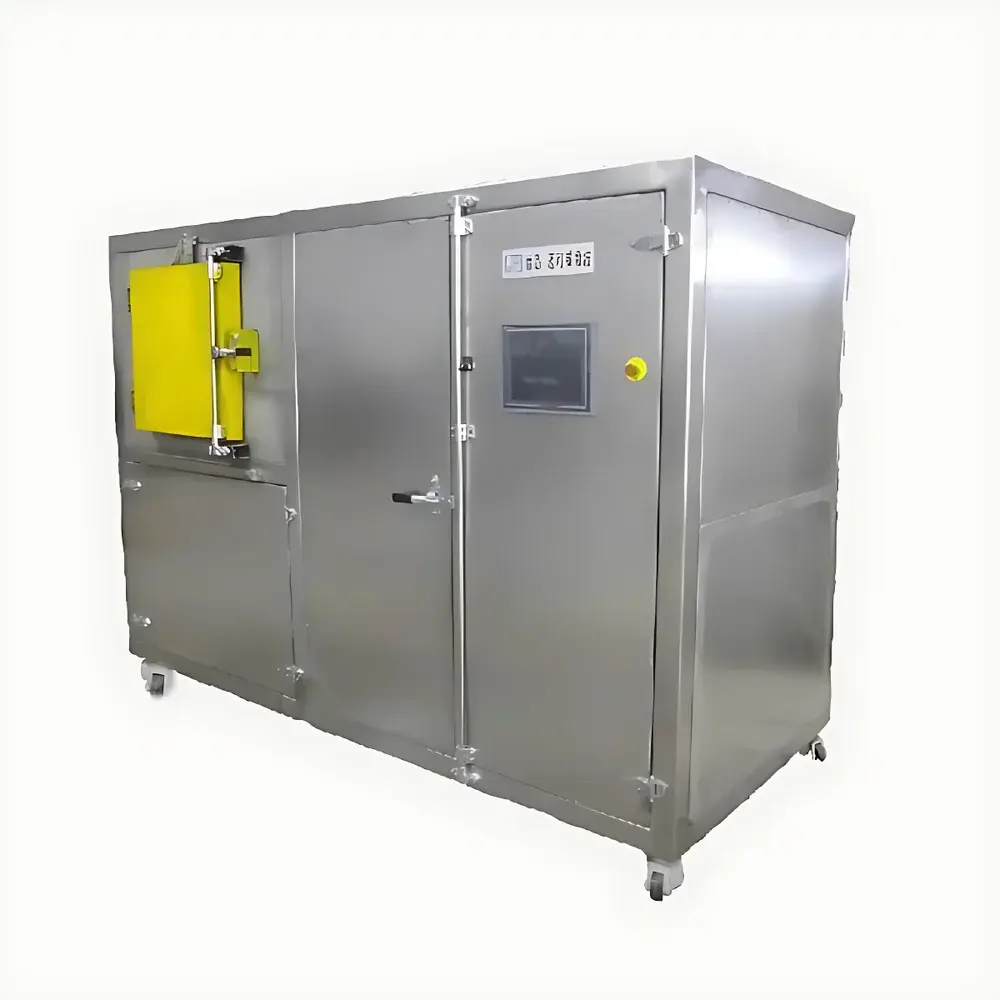
MakeWave MHX-16B Microwave Solid Waste Pyrolysis and Thermal Treatment System
| Brand | MakeWave |
|---|---|
| Origin | Shandong, China |
| Manufacturer Type | Direct Manufacturer |
| Country of Origin | China |
| Model | MHX-16B |
| Frequency | 2450 MHz |
| Time Control Range | 0–99 h |
| Sample Capacity | 1 vessel |
| Temperature Range | 0–900 °C |
| Temperature Control Accuracy | ±1 °C |
| Maximum Power Output | 16 kW (pyrolysis mode), 5 kW (thermal decomposition mode) |
| Chamber Volume | 66 L |
| Chamber Material | Fused quartz |
| Atmosphere Options | Vacuum or oxidizing (air-assisted) |
| Control System | PLC-based industrial automation with real-time monitoring of temperature, pressure, microwave power, and process sequencing |
| Exhaust Compliance | Meets GB 18484–2001 “Pollution Control Standard for Hazardous Waste Incineration” |
| Microwave Leakage | <5 mW/cm² (per GB 10436–2008) |
Overview
The MakeWave MHX-16B Microwave Solid Waste Pyrolysis and Thermal Treatment System is an engineered solution for controlled, on-site thermal processing of hazardous and non-hazardous solid waste streams in laboratories, R&D facilities, and small-to-medium industrial settings. Unlike conventional resistive furnaces, the MHX-16B employs 2450 MHz microwave energy to induce volumetric heating—enabling rapid, uniform temperature ramping and precise thermal management within a sealed quartz chamber. The system supports two distinct operational modes: oxidative ashing (air-assisted combustion at up to 900 °C) and anaerobic pyrolysis (vacuum or inert atmosphere, up to 900 °C), allowing users to select the optimal pathway based on feedstock composition and regulatory emission requirements. Its design targets batch processing of ≤10 kg per cycle, achieving >95% volume reduction (e.g., 40:1 ash-to-feed ratio for cellulose-based waste) and residual char/ash thermal reduction rates <5%—a key performance indicator for compliance with hazardous waste treatment validation protocols.
Key Features
- Sealed fused-quartz reaction chamber rated for vacuum (≤10 Pa) and oxidizing atmospheres, enabling reproducible process control under defined gas-phase conditions.
- Five-point pneumatically actuated anti-explosion door with position-sensing feedback and dual-seal integrity monitoring for simultaneous microwave containment and gas-tight operation.
- Integrated water-cooled architecture with built-in reservoir ensures rapid post-cycle cooling and sustained thermal stability during extended runs.
- PLC-driven automation platform with programmable logic sequences for temperature ramping, dwell time, atmosphere switching, pressure regulation, and exhaust flow modulation.
- Dual-mode thermal processing: ashing mode (oxygen-rich, air-assisted combustion); pyrolysis mode (oxygen-free, vacuum or nitrogen-purged thermochemical decomposition).
- Real-time microwave power modulation (0–100% continuous adjustment) synchronized with thermocouple feedback (Type K, ±1 °C accuracy) for high-fidelity thermal profiling.
- Exhaust gas conditioning system incorporating activated carbon adsorption and catalytic thermal oxidation to meet GB 18484–2001 emission limits for dioxins, NOx, SO2, and particulate matter.
Sample Compatibility & Compliance
The MHX-16B accommodates heterogeneous solid waste matrices including contaminated lab filters, spent catalysts, medical sharps packaging, electronic scrap residues, and organic-rich sludges. It is not intended for halogenated polymers without upstream dehalogenation pretreatment. The system complies with national safety standards for microwave equipment (GB 10436–2008), electromagnetic leakage limits (<5 mW/cm²), and hazardous waste treatment verification criteria per GB 18484–2001. While not certified to ISO/IEC 17025 or ASTM D5631 for method validation, its process repeatability (±2 °C inter-batch variance at 800 °C, n=10) supports internal QA/QC documentation required under GLP-aligned environmental testing workflows.
Software & Data Management
Process data—including temperature, pressure, microwave power, chamber atmosphere status, and elapsed time—is logged at 1-second intervals to non-volatile memory. Export formats include CSV and PDF reports compliant with basic audit-trail requirements. The HMI interface supports user-defined recipe storage (up to 50 profiles), password-protected parameter modification, and event-triggered alarms (e.g., door open during operation, overtemperature, vacuum loss). Optional Ethernet/IP integration enables SCADA-level connectivity for centralized facility monitoring, though native FDA 21 CFR Part 11 electronic signature or full ALCOA+ compliance requires third-party validation support.
Applications
- Rapid volume reduction and stabilization of low-volume hazardous waste prior to off-site disposal or landfill acceptance.
- Thermal pretreatment of waste samples prior to TCLP (Toxicity Characteristic Leaching Procedure) or SPLP (Synthetic Precipitation Leaching Procedure) testing per EPA Method 1311/1312.
- Controlled carbonization of biomass-derived feedstocks for activated carbon precursor synthesis.
- Residue analysis support in forensic and environmental chemistry labs requiring matrix destruction with minimal volatilization loss.
- Method development for alternative thermal treatment pathways under evolving circular economy regulations (e.g., EU Waste Framework Directive Annex IV exemptions).
FAQ
What types of solid waste are compatible with the MHX-16B?
The system is validated for organic-rich, non-halogenated, non-metallic waste streams such as paper, cotton, plastics (PE, PP, PET), and dried sludge. Halogenated or heavy-metal-laden materials require pre-screening and may necessitate supplemental scrubbing.
Does the MHX-16B support automated sample loading/unloading?
Yes—integrated pneumatic actuators enable fully automatic door actuation, crucible positioning, and ash collection into a sealed drawer with thermal insulation.
Can the system operate under inert gas (e.g., N₂ or Ar)?
Yes—the chamber is rated for vacuum and positive-pressure inert gas purging; gas inlet/outlet ports are fitted with mass flow controllers and pressure relief valves.
Is calibration traceable to national standards?
Temperature calibration uses NIST-traceable reference thermocouples; routine verification follows internal SOPs aligned with JJG 617–1996 (Chinese national metrology regulation for high-temperature furnaces).
What maintenance intervals are recommended?
Quartz chamber inspection every 200 operating hours; microwave waveguide cleaning every 500 hours; cooling water reservoir replacement every 3 months or per conductivity monitoring.
Related Products







