
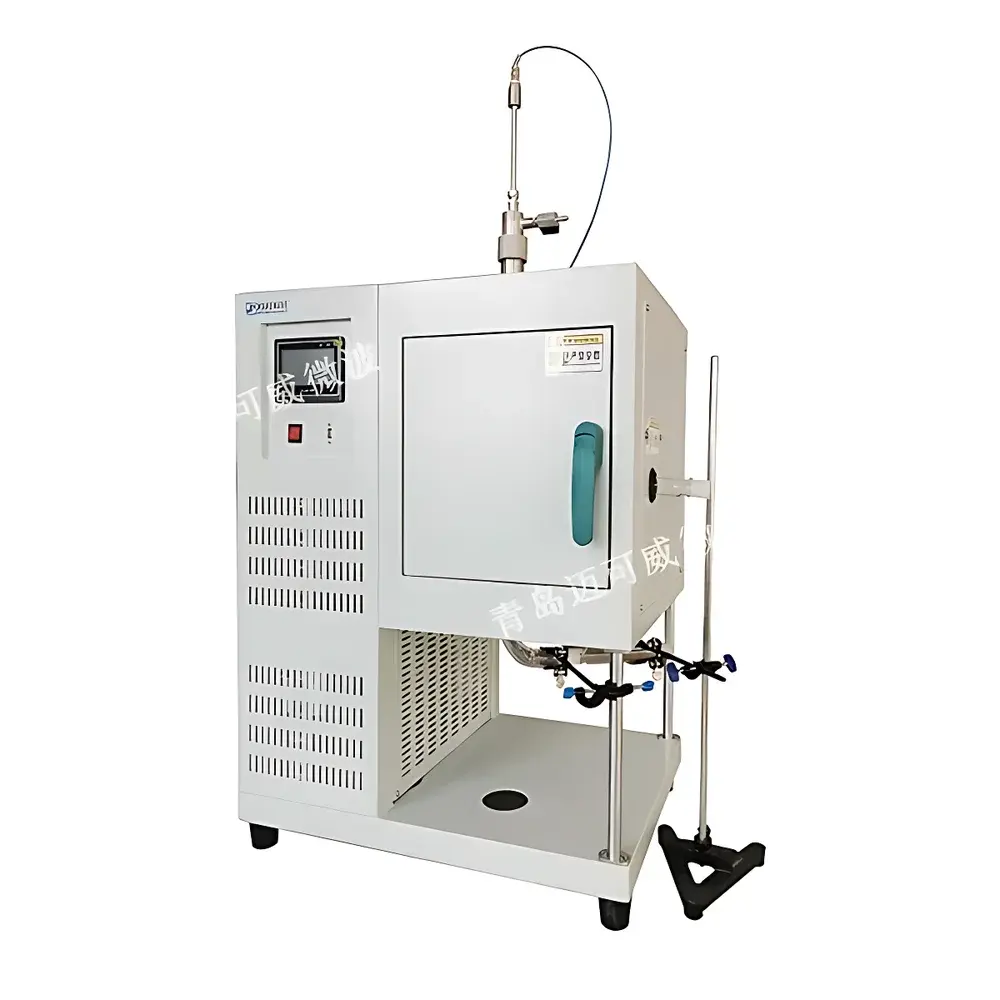
MakeWave MKG-M2TA Microwave High-Temperature Tube Furnace
| Brand | MakeWave |
|---|---|
| Origin | Shandong, China |
| Manufacturer Type | Direct Manufacturer |
| Product Category | Domestic |
| Model | MKG-M2TA |
| Price Range | USD 14,000–42,000 |
| Instrument Type | Tube Furnace |
| Maximum Temperature | 1200 °C |
| Temperature Control Accuracy | ±3 °C |
| Rated Microwave Power | 1600 W at 2450 MHz |
| Heating Time to Max Temp | ≤40 min |
| Heating Method | Continuous Non-Pulsed Microwave Energy |
| Internal Cavity Dimensions (Box Mode) | Approx. 670 × 1060 × 560 mm (W × H × D) |
| Microwave Cavity Volume | ~5 L |
| Power Supply | 220 V AC / 50 Hz |
| Total Power Consumption | 2600 W |
| Net Weight | 75 kg |
Overview
The MakeWave MKG-M2TA Microwave High-Temperature Tube Furnace is an engineered hybrid thermal platform integrating microwave volumetric heating with the controlled atmosphere capabilities of a horizontal tube furnace. Unlike conventional resistive-heated tube furnaces, this system employs 2450 MHz continuous-wave microwave energy to induce rapid, selective, and uniform internal heating in dielectric and susceptive materials—enabling faster thermal ramp rates, reduced thermal gradients, and improved energy efficiency. Its dual-mode architecture supports both open-box (crucible-based) high-temperature processing and sealed-tube gas-phase or solid–gas reaction environments. Designed for advanced materials synthesis, catalyst activation, ceramic sintering, and precursor decomposition studies, the MKG-M2TA operates up to 1200 °C under inert, reducing, oxidizing, or reactive atmospheres—including dynamic flow, static batch, and vacuum-compatible configurations. The system complies with ISO 9001 quality management standards and meets international microwave safety requirements (leakage <5 mW/cm², per IEC 61000-4-3 and GB 10436).
Key Features
- Dual-function design: seamlessly switches between box-mode (100 × 100 mm crucible compatibility) and top-insertion tube-mode (Φ40 mm quartz tube with F-shaped gas routing and sample support structure)
- Continuous non-pulsed microwave generation: 1600 W nominal output at 2450 MHz, enabling stable power modulation across full temperature range (0–1200 °C)
- Integrated high-efficiency insulation: multi-layer low-εr ceramic fiber composite lining (thermal conductivity ≈ 0.226 W/m·K), embedded within a 304 stainless steel monolithic cavity
- Precision temperature control: K-type thermocouple feedback loop with ±3 °C accuracy; real-time closed-loop regulation of both microwave power and thermal setpoint
- Atmosphere flexibility: dual-gas mass flow control (MFC) inputs with mixing capability; optional electrically heated gas lines (up to 200 °C) prevent condensation during volatile product handling
- PLC-based intelligent control system: 7-inch industrial touchscreen interface with programmable ramp-soak profiles, real-time curve visualization (time vs. temp vs. power), and CSV data export
- Comprehensive safety architecture: interlocked side-sliding door with λ/4 choke suppression, vacuum-rated sealing, and integrated exhaust ducting compatible with fume hoods
Sample Compatibility & Compliance
The MKG-M2TA accommodates heterogeneous samples including powders, pellets, fibers, thin films, and irregular bulk solids—particularly suited for microwave-responsive ceramics (e.g., SiC, TiO2, ZnO), metal oxides, MOFs, and carbon-based precursors. Its Φ40 mm quartz tube configuration enables precise control over gas residence time, partial pressure, and redox potential during thermal treatment. The system supports ASTM E1113 (microwave equipment safety), ISO/IEC 17025-aligned calibration traceability for temperature sensors, and GLP-compliant data logging (audit trail enabled via timestamped parameter storage). Optional upgrades include 2500 W high-power modules and vacuum integration (≤10−2 mbar) for low-oxygen sintering applications.
Software & Data Management
The embedded PLC controller records all operational parameters—including temperature, forward/reflected microwave power, gas flow rates, and elapsed time—at user-defined intervals (1–60 s resolution). Data is stored locally on internal flash memory and exportable via USB to standard spreadsheet formats. The interface supports up to 20 independent process programs, each with up to 10 ramp/soak segments. While not natively compliant with FDA 21 CFR Part 11, the system provides raw data integrity suitable for integration into validated LIMS or ELN platforms when deployed in regulated environments (e.g., pharmaceutical excipient thermal stability testing per USP ).
Applications
- Rapid synthesis of nanocrystalline oxides and phosphors via microwave-assisted solvothermal calcination
- Controlled pyrolysis of polymer-derived ceramics under Ar/H2 mixtures
- In situ activation of supported transition-metal catalysts (e.g., Ni/Al2O3, Pt/C) with real-time off-gas analysis
- Thermal aging studies of battery electrode materials (LiCoO2, NMC) under simulated ambient and inert conditions
- Low-thermal-budget densification of transparent conducting oxides (ITO, AZO) without substrate warping
- Decomposition kinetics modeling of metal–organic frameworks (MOFs) using variable heating rates (5–50 °C/min)
FAQ
Can the MKG-M2TA operate under vacuum?
Yes—vacuum compatibility is available as an optional upgrade, supporting pressures down to 10−2 mbar using a turbomolecular pump interface and vacuum-rated quartz tube end flanges.
Is the quartz tube included with the base configuration?
A standard Φ40 mm × 600 mm high-purity fused quartz tube with O-ring sealed end caps is supplied as standard equipment.
What types of thermocouples are supported?
The system uses grounded-sheath K-type thermocouples rated for continuous operation up to 1200 °C; Type S or B thermocouples may be integrated upon request for extended-range validation.
Does the system support remote monitoring or Ethernet connectivity?
Standard configuration includes USB and RS485 interfaces; optional Ethernet module (Modbus TCP/IP) enables integration into facility SCADA systems.
How is microwave leakage monitored during operation?
A calibrated microwave leakage detector (included with commissioning) verifies compliance before each experimental run; continuous monitoring is not built-in but can be added via third-party OEM sensor integration.



