
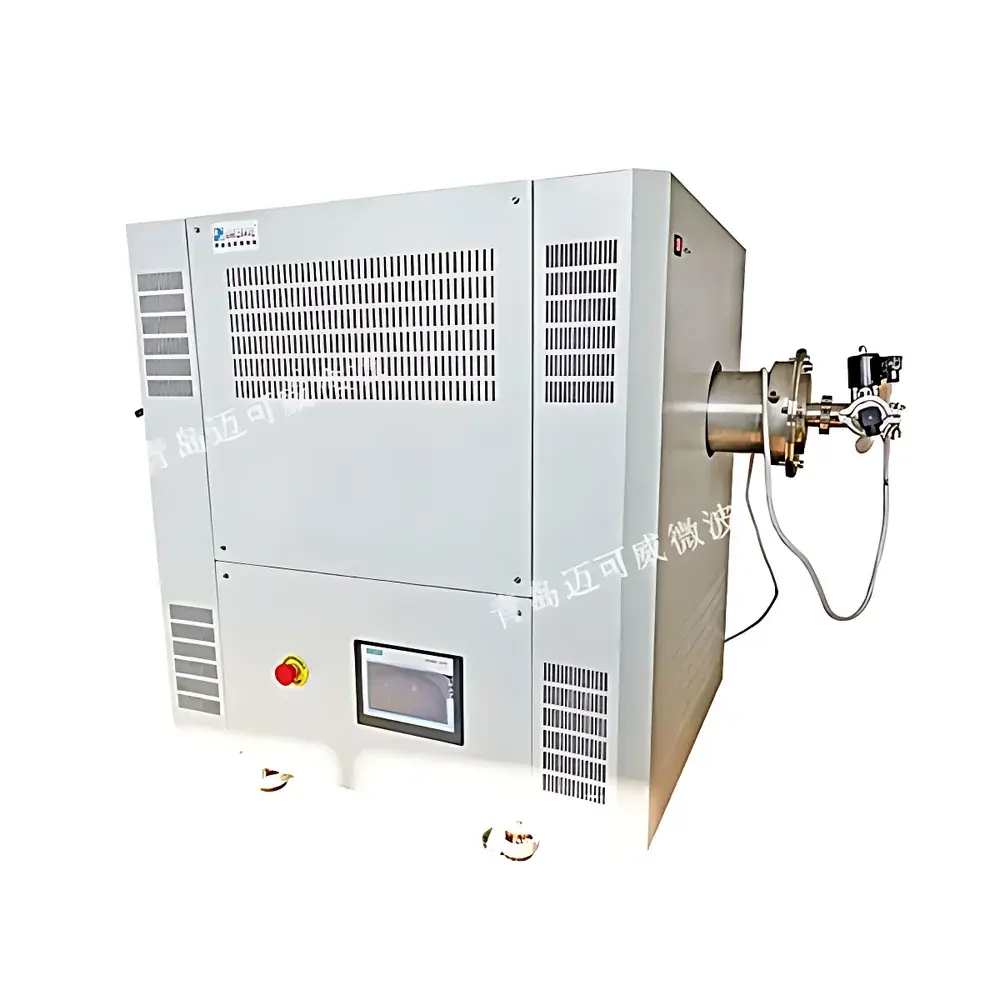
MakeWave MKG-T4HD Microwave High-Temperature Tube Furnace (1600 °C)
| Brand | MakeWave |
|---|---|
| Origin | Shandong, China |
| Manufacturer Type | Direct Manufacturer |
| Country of Origin | China |
| Model | MKG-T4HD |
| Temperature Range | 700–1500 °C (up to 1600 °C short-term) |
| Temperature Uniformity | ±1 °C |
| Chamber Dimensions | Φ100–Φ230 mm tube ID (adjustable), max. 1600 °C operational envelope |
| Inner Tube Material | High-purity alumina (standard), optional quartz or molybdenum disilicide |
| Heating Method | 2450 MHz continuous-wave microwave energy |
| Microwave Power | 3200 W (water-cooled magnetron, non-pulsed, infinitely variable) |
| External Dimensions | 1500 × 800 × 650 mm (W × H × D) |
| Weight | 90 kg |
| Power Supply | 380 V AC / 50 Hz |
| Cooling | Integrated recirculating water chiller for magnetron |
| Vacuum Capability | Up to –0.099 MPa (absolute) |
| Safety Compliance | Microwave leakage < 5 mW/cm² (IEC 61000-3-2 compliant) |
| Certification | ISO 9001 certified |
Overview
The MakeWave MKG-T4HD Microwave High-Temperature Tube Furnace is an engineered platform integrating resonant 2450 MHz microwave heating with a fully sealed, high-integrity tube furnace architecture. Unlike conventional resistance-heated tube furnaces, the MKG-T4HD delivers rapid, volumetric, and selective energy coupling directly into dielectric or semiconducting materials—enabling accelerated thermal processing while preserving atmospheric purity and minimizing thermal gradients. Its design adheres to core principles of microwave thermodynamics: electromagnetic field confinement within a TE10-mode cavity, impedance-matched waveguide coupling, and controlled power modulation to sustain stable high-temperature equilibria in inert, reducing, or vacuum environments. This system serves laboratories requiring precise, repeatable, and contamination-sensitive high-temperature treatments—from ceramic sintering and catalyst activation to advanced battery electrode annealing and solid-state synthesis—where conventional heating methods introduce excessive thermal inertia, wall-to-sample temperature offsets, or oxidation risks.
Key Features
- Continuous-wave 3200 W microwave source with water-cooled magnetron and analog power regulation (0–100% full scale), eliminating thermal cycling stress and enabling true steady-state operation at 1500 °C.
- Hermetically sealed 304 stainless steel cavity with multi-layer low-εr ceramic fiber insulation (thermal conductivity ≈ 0.226 W/m·K), optimized for minimal conductive loss and maximal microwave absorption efficiency above 1000 °C.
- Modular tube interface supporting interchangeable high-purity alumina tubes (Φ100–Φ230 mm ID), compatible with custom-length configurations and auxiliary gas manifolds for dynamic flow control.
- Non-contact infrared pyrometry calibrated for emissivity-compensated surface and bulk material temperature measurement—directly referenced to sample position rather than furnace wall.
- PLC-based control architecture with 7-inch industrial touchscreen HMI, supporting up to 20 independent multi-segment thermal programs with real-time overlay of temperature, power, and time curves.
- Dual-safety interlock system: hardware-level microwave cutoff upon door/tube flange disengagement, plus redundant pressure/vacuum monitoring with automatic venting protocol.
Sample Compatibility & Compliance
The MKG-T4HD accommodates diverse sample geometries—including powders, pellets, fibers, and thin films—within its cylindrical hot zone. Standard Φ100 mm alumina tubes meet ASTM C20 and ISO 13384 requirements for refractory integrity under thermal shock. Optional MoSi2-lined or quartz tubes extend compatibility to reducing atmospheres (H2, CO) or UV-transparent processes. The furnace conforms to IEC 61000-3-2 for conducted emissions and EN 55011 Class B limits for radiated interference. Vacuum operation (≤0.099 MPa absolute) satisfies ASTM E595 outgassing criteria for space-grade material conditioning. All electrical and mechanical interfaces comply with CE machinery directive 2006/42/EC and low-voltage directive 2014/35/EU.
Software & Data Management
Embedded firmware supports CSV export of timestamped temperature/power/pressure logs via USB 2.0 port. Optional Ethernet connectivity enables integration into LabVIEW™ or MATLAB® environments via Modbus TCP. Audit trails record operator ID, program execution history, parameter modifications, and alarm events—meeting GLP/GMP data integrity requirements per FDA 21 CFR Part 11 when paired with user-access-controlled accounts and electronic signatures. Calibration certificates for IR sensor and pressure transducer are traceable to NIST standards and supplied with each unit.
Applications
- Sintering of oxide ceramics (Al2O3, ZrO2) and non-oxides (SiC, Si3N4) with >98% theoretical density and grain size control below 500 nm.
- Thermal treatment of Li-ion cathode precursors (e.g., NMC, LFP) under Ar/H2 mixtures to suppress oxygen loss and improve cation ordering.
- Graphitization of carbon nanomaterials with reduced defect density versus resistive heating, verified by Raman ID/IG ratio analysis.
- In-situ annealing of thin-film photovoltaic absorbers (CIGS, CZTS) under sulfur-containing atmospheres to optimize phase purity and carrier lifetime.
- High-temperature catalytic testing (e.g., methane reforming, CO2 hydrogenation) with integrated mass spectrometry feedthrough ports.
FAQ
What is the maximum sustained operating temperature, and how is it validated?
The MKG-T4HD achieves 1500 °C continuously; 1600 °C is rated for ≤30 min exposures. Temperature stability is verified using dual-point calibration against a Pt/Pt–10%Rh thermocouple traceable to NIST SRM 1749.
Can the system operate under dynamic gas flow without compromising microwave coupling?
Yes—the inlet/outlet flanges integrate RF-tight waveguide breaks and laminar flow distributors. Gas velocity is limited to ≤50 cm/s at 1500 °C to prevent cavity detuning, as confirmed by VNA S-parameter sweeps pre- and post-flow initiation.
Is third-party validation available for microwave leakage during vacuum operation?
All units undergo factory testing with Narda NBM-550 broadband survey meters per IEEE Std 1528-2013. Full test reports—including worst-case vacuum + max-power scenarios—are provided with shipment.
How does the infrared temperature measurement compensate for varying emissivity across material types?
The pyrometer includes adjustable ε-input (0.1–0.99) and supports two-point emissivity mapping using reference blackbody sources at 800 °C and 1200 °C, ensuring accuracy within ±2 °C for known material classes.
What maintenance intervals are recommended for the water-cooling system?
The closed-loop chiller requires biannual inspection of coolant pH (target 7.0–7.5), conductivity (<50 µS/cm), and pump impeller integrity. Deionized water with 10% glycol antifreeze is specified to prevent scaling and freezing in ambient lab conditions.



