
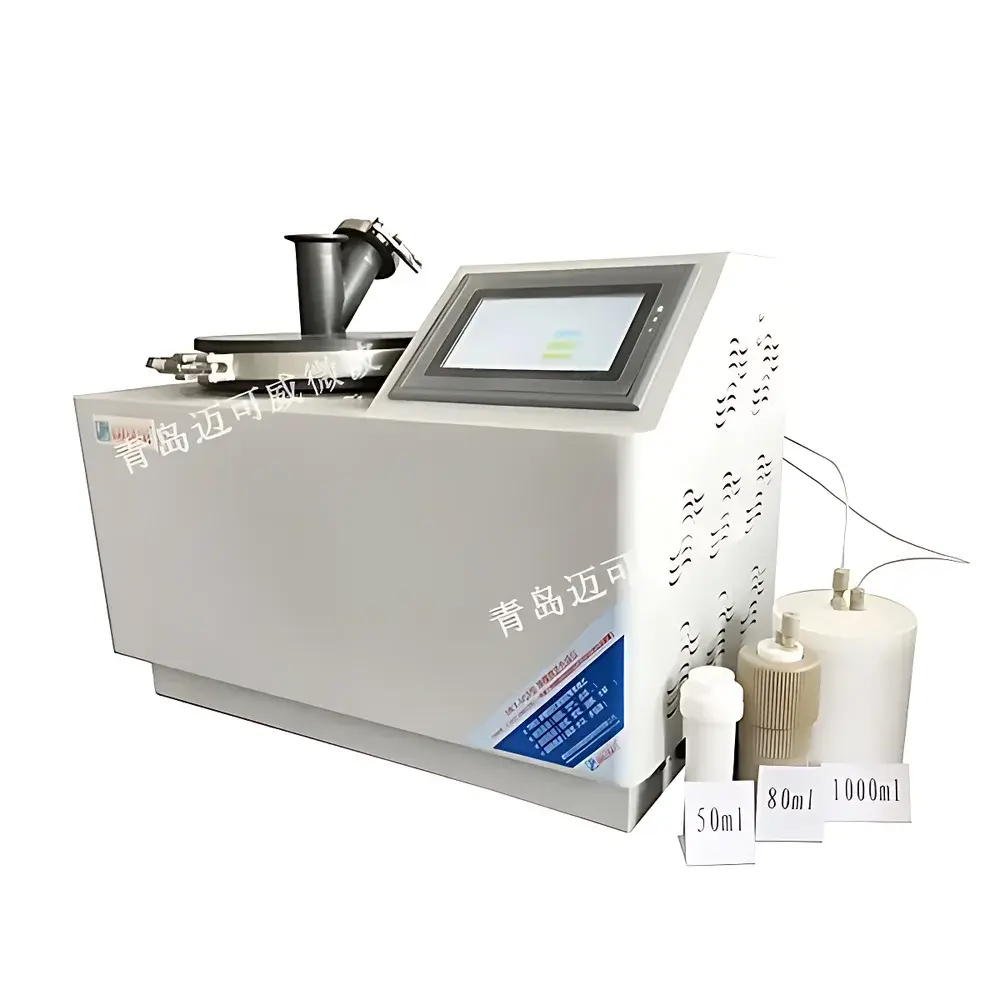
MakeWave MKM-H1B Single-Mode Focused Microwave Chemical Synthesizer
| Brand | MakeWave |
|---|---|
| Origin | Shandong, China |
| Manufacturer Type | Direct Manufacturer |
| Product Category | Domestic |
| Model | MKM-H1B |
| Price Range | USD 7,000–14,000 (FOB) |
| Temperature Range | 0–230 °C |
| Temperature Control Accuracy | ±0.1 °C |
| Reaction Units | 1 |
| Reaction Vessel Capacity | 80–1000 mL |
| Maximum Pressure Rating | 3 MPa |
| Microwave Frequency | 2450 MHz |
| Rated Microwave Power | 500 W (continuous, non-pulsed output) |
| Cavity Material | 304 Stainless Steel with Multi-Layer PTFE Coating |
| Microwave Leakage | <5 mW/cm² |
| Safety Compliance | Meets GB 10436 & IEC 61000-4-3 |
| Quality Certification | ISO 9001 Certified |
Overview
The MakeWave MKM-H1B Single-Mode Focused Microwave Chemical Synthesizer is an engineered platform for precision-controlled, high-efficiency microwave-assisted synthesis under sealed, pressurized conditions. Unlike multimode cavity systems—where field distribution is inherently heterogeneous—the MKM-H1B employs a rigorously designed cylindrical single-mode resonant cavity operating in the TM01 mode at 2450 MHz. This configuration delivers spatially confined, high-energy-density microwave fields, enabling reproducible and uniform volumetric heating of reaction mixtures. The system supports closed-vessel chemistry up to 230 °C and 3 MPa, making it suitable for demanding synthetic protocols requiring precise thermal management, rapid kinetics, and strict stoichiometric control. Its architecture aligns with modern laboratory requirements for traceable, auditable, and GLP-compliant reaction development—particularly in pharmaceutical process optimization, catalyst screening, and functional material synthesis.
Key Features
- Single-mode TM01 resonant cavity fabricated from seamless 304 stainless steel with multi-layer PTFE interior coating—resistant to strong acids, bases, and oxidants at elevated temperatures
- Continuous, non-pulsed 500 W microwave power delivery with real-time closed-loop regulation of incident and reflected power
- Optimized cavity volume (~1 L) accommodating reaction vessels from 80 mL to 1000 mL, including standard PTFE-lined stainless-steel autoclaves
- Fiber-optic temperature sensing (non-metallic, immune to EMI) with ±0.1 °C accuracy across full 0–230 °C range
- Integrated magnetic stirring with PTFE-coated stir bar and variable-speed drive—ensuring homogeneous mixing without introducing metallic contamination
- PLC-based control system with 7-inch resistive touchscreen interface; supports programmable ramp-hold profiles, data logging, and CSV export of time-stamped temperature, pressure, and power traces
- Redundant safety architecture: interlocked lid mechanism (power cutoff upon opening), λ/4 choke flange design minimizing microwave leakage (<5 mW/cm²), and real-time pressure monitoring with automatic shutdown at preset thresholds
Sample Compatibility & Compliance
The MKM-H1B accommodates a broad spectrum of chemically aggressive media—including concentrated HNO3, HF/HCl mixtures, alkaline hydroxides, and organometallic precursors—thanks to its corrosion-resistant cavity and PTFE-wetted vessel components. Reaction vessels are rated for sustained operation at ≤3 MPa and ≤230 °C, satisfying ASTM E2877-22 guidelines for microwave-assisted digestion and synthesis. The system’s closed-loop control architecture and audit-ready data logging meet foundational requirements for FDA 21 CFR Part 11 compliance when deployed with validated SOPs and electronic signature protocols. All mechanical and electrical designs conform to IEC 61010-1 (Safety Requirements for Electrical Equipment for Measurement, Control, and Laboratory Use) and electromagnetic compatibility standards per IEC 61000-4-3.
Software & Data Management
The embedded PLC controller records all critical process parameters—including wall temperature (via fiber optic probe), internal pressure (via piezoresistive transducer), forward/reflected microwave power, and stirring speed—at user-defined intervals (1–60 s). Data are stored locally on industrial-grade flash memory and exportable via USB to CSV format for post-processing in MATLAB, Origin, or LIMS platforms. Up to 20 independent method programs can be saved, each with customizable temperature ramps, hold durations, power limits, and safety overrides. Optional video monitoring (with integrated LED illumination and HD CMOS camera) enables visual verification of reflux behavior, phase separation, or precipitate formation—enhancing experimental interpretability without compromising containment integrity.
Applications
- Accelerated discovery and optimization of heterocyclic scaffolds in medicinal chemistry (e.g., Suzuki, Heck, and Buchwald–Hartwig couplings)
- Rapid solvothermal synthesis of metal–organic frameworks (MOFs), perovskites, and quantum dot nanomaterials
- Controlled hydrolysis and digestion of biological tissues or environmental samples prior to ICP-MS analysis
- Catalyst testing under realistic process conditions—evaluating thermal stability, leaching resistance, and turnover frequency (TOF)
- Method development for USP and EP 2.2.55-compliant microwave-assisted extraction of phytochemicals and natural products
- Academic research in green chemistry, where energy efficiency, solvent reduction, and reaction scalability are primary evaluation metrics
FAQ
What distinguishes single-mode from multimode microwave synthesis?
Single-mode systems generate a highly localized, standing-wave electromagnetic field with defined boundary conditions (TM01), enabling predictable energy coupling and superior reproducibility across small-to-medium sample volumes. Multimode cavities rely on mode stirring and statistical field averaging—introducing inherent hot/cold spots and batch-to-batch variability.
Can the MKM-H1B be integrated into automated lab workflows?
Yes—the unit provides RS-485 Modbus RTU communication interface for integration with central lab automation systems (e.g., Hamilton STAR, Tecan Fluent) and SCADA platforms, supporting remote start/stop, parameter override, and alarm forwarding.
Is validation support available for GMP environments?
MakeWave supplies IQ/OQ documentation templates aligned with ASTM E2500 and EU Annex 15 principles. Installation qualification (IQ) covers mechanical and electrical verification; operational qualification (OQ) includes temperature uniformity mapping, pressure sensor calibration, and power output linearity testing.
What maintenance is required for long-term reliability?
Annual inspection of waveguide gaskets, cavity coating integrity, and stir motor torque calibration is recommended. No routine magnetron replacement is needed—rated lifetime exceeds 5000 hours under continuous duty.
Does the system comply with international shipping and import regulations?
Yes—units are shipped with CE marking (per EMC and LVD directives), RoHS-compliant components, and full technical documentation including EC Declaration of Conformity, circuit diagrams, and hazardous substance declarations (REACH SVHC).



