
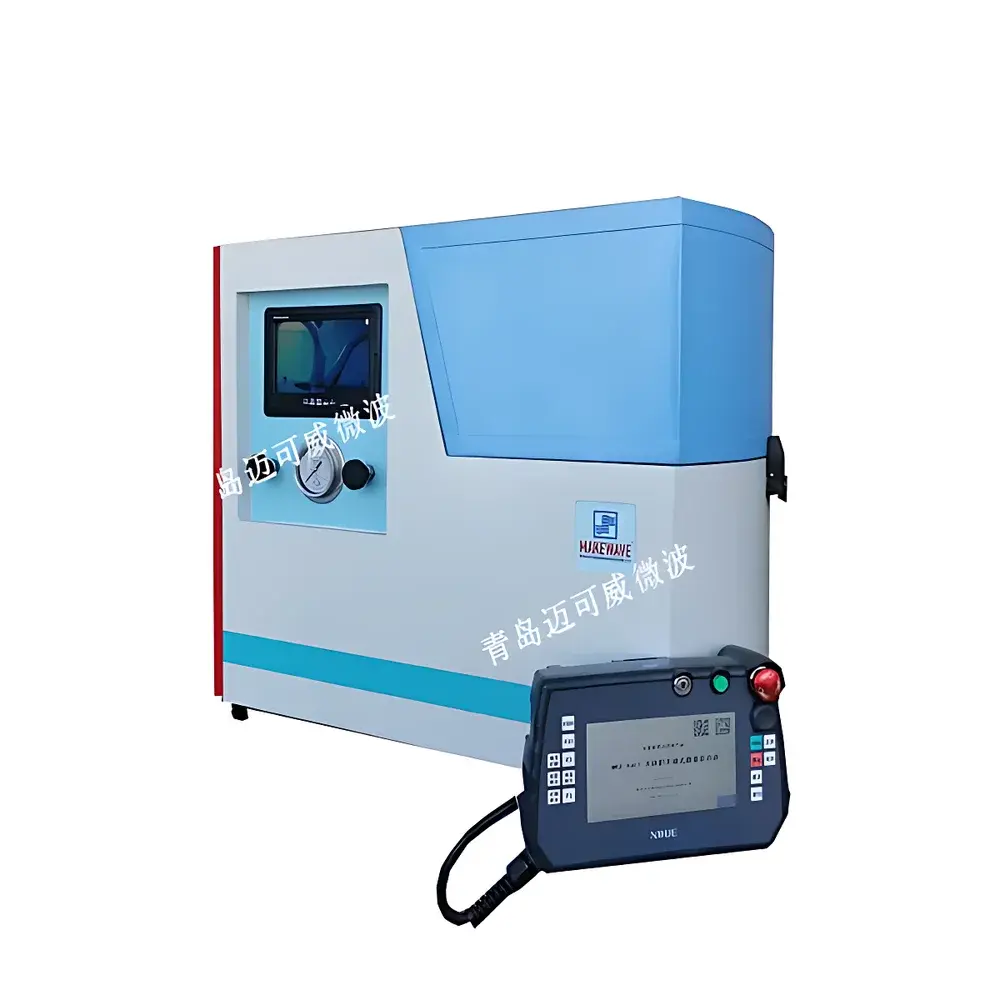
MakeWave MKM-SH1B Super Microwave High-Pressure Reaction System
| Brand | MakeWave |
|---|---|
| Origin | Shandong, China |
| Manufacturer Type | Direct Manufacturer |
| Country of Origin | China |
| Model | MKM-SH1B |
| Price Range | USD 7,000–14,000 (FOB) |
| Usable Volume | Large-scale |
| Construction Material | Stainless Steel (316L grade) |
| Operating Pressure | Up to 10 MPa (1,450 psi) |
| Reaction Vessel Capacity | 500–1,000 mL |
| Vacuum Rating | 10 MPa (rated for pressurized operation, not vacuum service) |
Overview
The MakeWave MKM-SH1B Super Microwave High-Pressure Reaction System is an engineered platform for conducting controlled, closed-vessel chemical synthesis and sample digestion under extreme thermobaric conditions—specifically, temperatures exceeding 300 °C and pressures up to 10 MPa. Unlike conventional microwave reactors (e.g., domestic microwave digesters or hydrothermal synthesizers), which rely on individual sealed vessels operating under self-generated pressure, the MKM-SH1B employs a monolithic, pre-pressurized reaction cavity. This design enables uniform thermal and mechanical loading across multiple parallel reaction vessels without requiring each vessel to withstand full system pressure independently. As a result, standard borosilicate glass or PTFE-lined reaction tubes—rather than specialized high-strength quartz or alloy containers—can be safely used. The system operates at 2450 MHz with continuous, non-pulsed microwave power delivery (500 W nominal), ensuring stable energy coupling and reproducible reaction kinetics in both synthetic organic chemistry and inorganic material preparation.
Key Features
- Monolithic sealed cavity architecture supporting simultaneous multi-vessel reactions under pre-applied and auto-regulated pressure (0–10 MPa)
- Temperature range: ambient to 300 °C, monitored via fiber-optic or K-type thermocouple sensors with ±1 °C accuracy
- Integrated electromagnetic stirring with PTFE-coated stir bars; speed adjustable from 0–1,200 rpm
- Active cooling system with water-cooled heat exchanger and forced-air exhaust for rapid thermal management and volatile byproduct removal
- PLC-based control system with 7-inch touchscreen HMI, real-time plotting of temperature, pressure, power, and stirring speed
- Programmable multi-step protocols with data logging (CSV export), up to 20 user-defined methods with timestamped audit trails
- Compliance-ready architecture: supports 21 CFR Part 11–compliant electronic records when integrated with validated software extensions
Sample Compatibility & Compliance
The MKM-SH1B accommodates heterogeneous, viscous, or particulate-laden samples—including metal oxides, polymers, biomass, and geological matrices—without clogging or uneven heating. Its large-volume cavity (≈1 L internal volume) accepts custom 500–1,000 mL stainless-steel or lined pressure vessels, while its parallel configuration supports up to 18 × 10 mL glass vials for high-throughput screening. All wetted surfaces feature multi-layer PTFE coating, ensuring resistance to concentrated acids (HF, HNO₃, HCl), alkalis, and oxidizing agents per ASTM D543 and ISO 15193. The system conforms to IEC 61000-6-3 (EMC) and IEC 61000-6-4, with verified microwave leakage <5 mW/cm² (measured per IEC 62233), well below the ICNIRP occupational exposure limit of 10 mW/cm². It is certified to ISO 9001:2015 for design and manufacturing quality assurance.
Software & Data Management
The embedded control firmware provides deterministic real-time regulation of all process variables through closed-loop PID algorithms. Temperature and pressure are actively maintained within user-specified tolerances via coordinated microwave power modulation and pneumatic pressure actuation. Data acquisition occurs at 1 Hz resolution and is stored locally on industrial-grade SD card memory with optional Ethernet/Wi-Fi connectivity for remote monitoring. Exported CSV files include absolute timestamps, sensor IDs, raw analog inputs, and calculated derived values (e.g., dT/dt, dP/dt). When deployed in regulated environments (e.g., pharmaceutical development labs), the system supports ALCOA+ principles—data integrity is ensured through immutable file naming, operator login authentication, and configurable electronic signature workflows compatible with LIMS integration.
Applications
This platform serves advanced applications where conventional solvothermal or reflux methods fall short: rapid crystallization of MOFs and perovskites under supercritical solvent conditions; accelerated oxidative digestion of refractory environmental solids (e.g., fly ash, sediments); catalytic C–H activation in inert atmospheres; and hydrothermal carbonization of lignocellulosic feedstocks. It is widely adopted in university research centers, national laboratories, and R&D departments engaged in materials science, green chemistry, and analytical method development—particularly where trace-metal contamination control, reaction scalability, or kinetic parameter extraction is critical.
FAQ
What distinguishes “super microwave” from standard microwave reactors?
Super microwave systems operate under externally applied pressure (up to 10 MPa) in a shared cavity, eliminating per-vessel pressure containment requirements and enabling use of low-cost, chemically inert glassware.
Can the MKM-SH1B be used for hydrogenation or other gas-phase reactions?
Yes—optional gas inlet/outlet manifolds support inert purging, reactive gas dosing (e.g., H₂, NH₃, CO), and real-time off-gas analysis when coupled with mass spectrometry or GC-TCD.
Is validation documentation available for GxP environments?
IQ/OQ protocols and factory calibration certificates (traceable to NIST standards) are provided; PQ support and 21 CFR Part 11 add-ons are available upon request.
What maintenance intervals are recommended for long-term reliability?
Annual verification of pressure transducer linearity, microwave leakage testing, and PTFE cavity coating integrity is advised per manufacturer guidelines.
Does the system support external sensor integration (e.g., pH, conductivity)?
Yes—the PLC I/O module includes four configurable analog inputs (0–10 V / 4–20 mA) for third-party process sensors with Modbus RTU support.



