
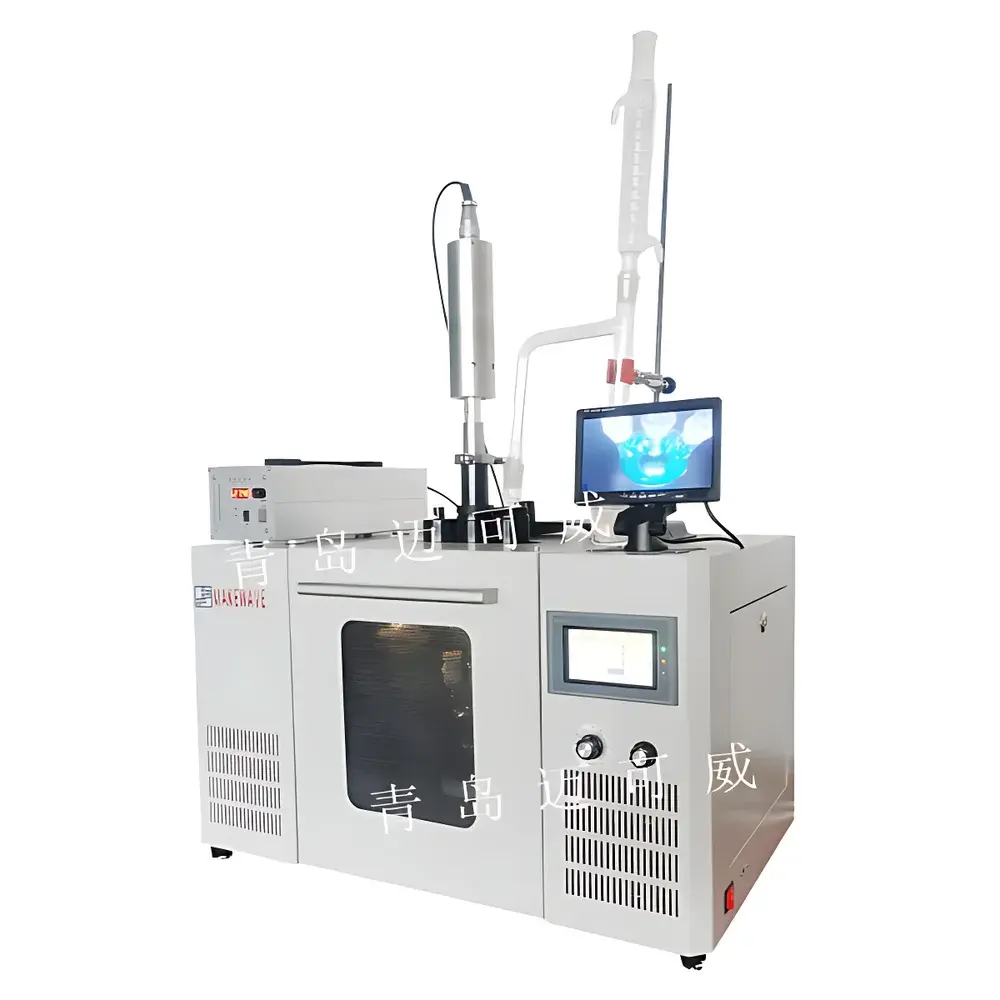
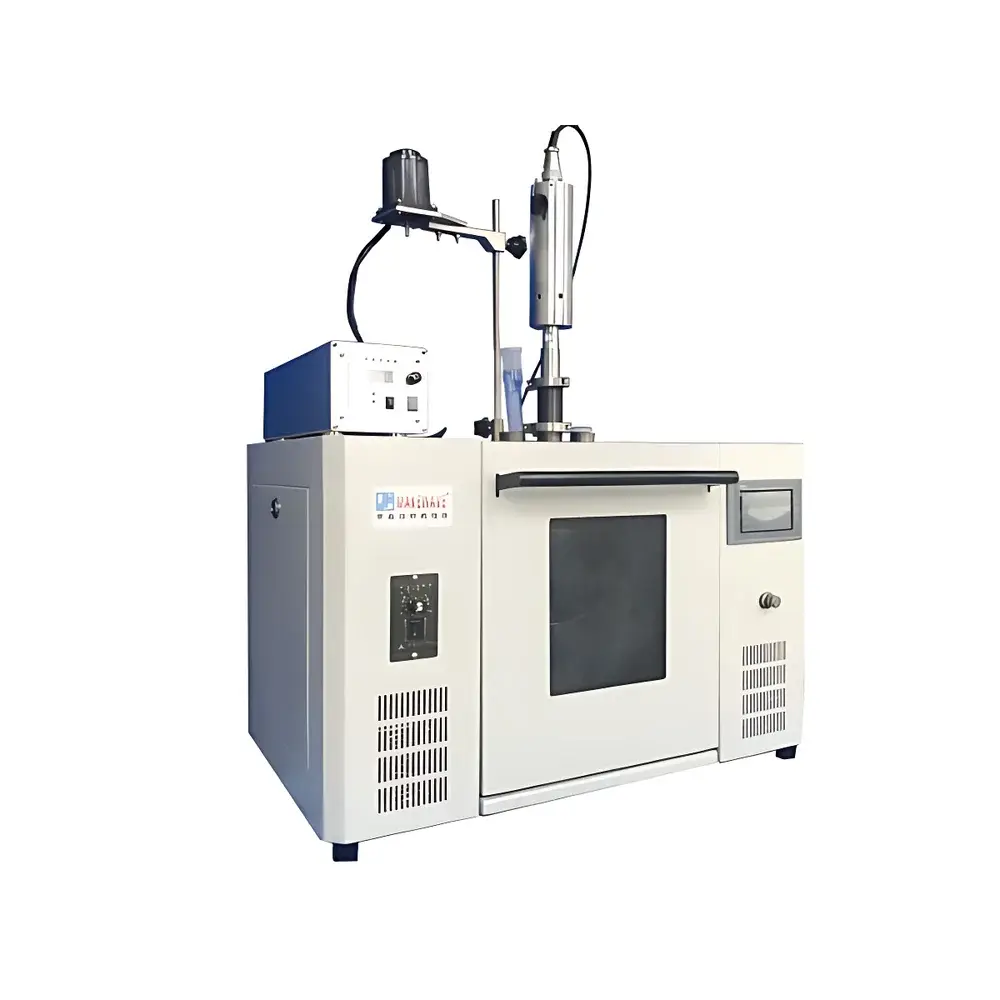
MakeWave MKX-H1C1M Microwave-Ultrasound Hybrid Synthesis and Extraction System
| Brand | MakeWave |
|---|---|
| Origin | Shandong, China |
| Manufacturer Type | Direct Manufacturer |
| Region Classification | Domestic (China) |
| Model | MKX-H1C1M |
| Temperature Range | 0–300 °C |
| Pressure Rating | Atmospheric (Ambient Pressure) |
| Microwave Output Power | 0–900 W (Linear, Continuous, Non-Pulsed) |
| Magnetron Frequency | 2450 MHz |
| Stirring Method | Mechanical + Magnetic Stirring |
| Reaction Volume Capacity | 20 L |
| Ultrasonic Frequency | 28 kHz (Adjustable Range: 15–40 kHz) |
| Ultrasonic Power Output | 1000 W |
| Microwave Cavity Dimensions | 250 × 285 × 275 mm (W × H × D) |
| Overall Dimensions (Excl. Stand) | ~670 × 460 × 450 mm (W × H × D) |
| Microwave Leakage Level | <5 mW/cm² (Compliant with GB 10436–2008) |
| Control Interface | Touchscreen PLC-based System with USB Data Export |
| Temperature Sensing | Infrared Sensor (0–300 °C, ±1 °C Accuracy) |
| Input Power | 1200 W (220 V ±10%, 50 Hz ±1%) |
| Cavity Material | 304 Stainless Steel with PTFE Coating |
| External Housing | Powder-Coated Carbon Steel |
| Safety Features | Interlocked Door Switch, Microwave Shielding Structure, Over-Temperature & Over-Current Protection |
Overview
The MakeWave MKX-H1C1M Microwave-Ultrasound Hybrid Synthesis and Extraction System is an integrated laboratory platform engineered for simultaneous or sequential microwave irradiation and high-intensity ultrasonic energy delivery in open or reflux-compatible reaction environments. It operates on the physical principles of dielectric heating (via 2450 MHz microwaves) and acoustic cavitation (via 28 kHz ultrasonic transduction), enabling accelerated reaction kinetics, enhanced mass transfer, and improved extraction efficiency across heterogeneous systems. Designed for reproducible process development under atmospheric pressure conditions, the system supports scalable synthetic workflows—from milligram-scale optimization to multi-liter batch processing—without requiring pressurized vessels or specialized containment. Its modular architecture accommodates standard glassware (e.g., round-bottom flasks, condensers, dropping funnels), making it compatible with conventional organic synthesis protocols while adding non-thermal activation pathways.
Key Features
- Continuous, linear microwave power control (0–900 W) with real-time digital feedback—no pulse modulation ensures stable thermal profiles and eliminates thermal overshoot during exothermic reactions.
- Dual-mode stirring: independent mechanical agitation (PTFE-coated impeller, variable speed) and optional magnetic stirring for uniform suspension of solids or immiscible phases.
- Infrared non-contact temperature monitoring (0–300 °C, ±1 °C accuracy) enables closed-loop thermal regulation without probe contamination or breakage risks.
- PLC-based touchscreen controller with programmable multi-step sequences; stores up to 50 user-defined protocols with time/power/temperature setpoints and automatic data logging via USB export.
- 20 L maximum working volume supported through external reactor configuration—ideal for solvent extraction, concentration, and drying applications involving natural products, polymers, or mineral matrices.
- Robust safety architecture: interlocked door circuitry, EMI-shielded cavity with PTFE-lined 304 stainless steel walls, and verified microwave leakage <5 mW/cm² (per GB 10436–2008), ensuring operator compliance with occupational exposure limits.
- Ultrasonic subsystem delivers 1000 W output at 28 kHz (adjustable 15–40 kHz), with amplitude modulation for controlled cavitation intensity—critical for cell lysis, nanoparticle dispersion, and crystallization nucleation.
Sample Compatibility & Compliance
The MKX-H1C1M accepts standard borosilicate glass reactors (including 5–20 L round-bottom flasks), reflux condensers, addition funnels, and gas inlet/outlet adapters—facilitating air- or inert-atmosphere reactions per ASTM E2877 and ISO 17025-aligned lab practices. Its atmospheric-pressure design avoids regulatory constraints associated with Class III pressure equipment (per PED 2014/68/EU), simplifying installation and operational validation. The system meets electromagnetic compatibility requirements per IEC 61000-6-3 and electrical safety standards per IEC 61010-1. While not certified for GMP manufacturing environments, its audit-trail-capable USB data export, parameter locking, and protocol versioning support GLP-compliant documentation for academic, industrial R&D, and QC laboratories.
Software & Data Management
The embedded HMI runs a deterministic real-time PLC kernel, recording timestamped values for temperature, microwave power, ultrasonic amplitude, and elapsed time at 1-second intervals. All logged datasets are saved in CSV format via USB port for post-processing in MATLAB, Python (Pandas), or LIMS-integrated analytics platforms. No proprietary software installation is required—data files are natively readable and compatible with 21 CFR Part 11–aligned electronic record review workflows when paired with institutional metadata management policies. Password-protected administrator mode allows calibration offset adjustment and firmware updates without compromising user protocol integrity.
Applications
- Organic & Medicinal Chemistry: Rapid Suzuki, Heck, and Ullmann couplings; heterocycle synthesis; catalyst screening under thermally accelerated yet controllable conditions.
- Natural Product Extraction: Solvent-assisted ultrasound-microwave extraction (SAUME) of polyphenols, alkaloids, and terpenoids from plant biomass with >30% yield improvement versus conventional Soxhlet methods (validated per AOAC 992.17).
- Materials Science: Sol-gel synthesis of metal oxides; graphene oxide reduction; MOF crystallization; and polymer grafting where synergistic energy input reduces side-product formation.
- Food & Agricultural Analysis: Accelerated fat determination (AOAC 991.36), pesticide residue cleanup, and enzymatic inactivation studies requiring precise thermal-ultrasonic dosing.
- Environmental Sample Processing: Heavy metal leaching from soils/sediments using chelating agents under combined acoustic-microwave fields to enhance diffusion-limited kinetics.
FAQ
Is the MKX-H1C1M suitable for closed-vessel high-pressure synthesis?
No. This system is designed exclusively for atmospheric-pressure operation. For sealed-vessel microwave synthesis, refer to dedicated high-pressure platforms compliant with ISO 21783 and ASTM D7213.
Can ultrasonic and microwave energy be applied simultaneously?
Yes—both modalities operate independently and can be triggered concurrently, sequentially, or in alternating cycles via programmable step logic in the controller.
What is the maximum allowable solvent volume for safe ultrasonic cavitation?
For optimal energy transfer and transducer longevity, maintain liquid levels between 30% and 80% of total reactor volume. Volumes exceeding 15 L require external cooling to manage cumulative heat load from dual-energy input.
Does the system support remote monitoring or Ethernet connectivity?
Not natively. Data acquisition is local-only via USB export. Integration with SCADA or LabVIEW requires third-party hardware gateways and custom driver development.
Are calibration certificates provided for the infrared temperature sensor?
A factory calibration report (traceable to NIM, China) is included. Field recalibration using blackbody reference sources is recommended annually or after mechanical impact to the sensor housing.



