
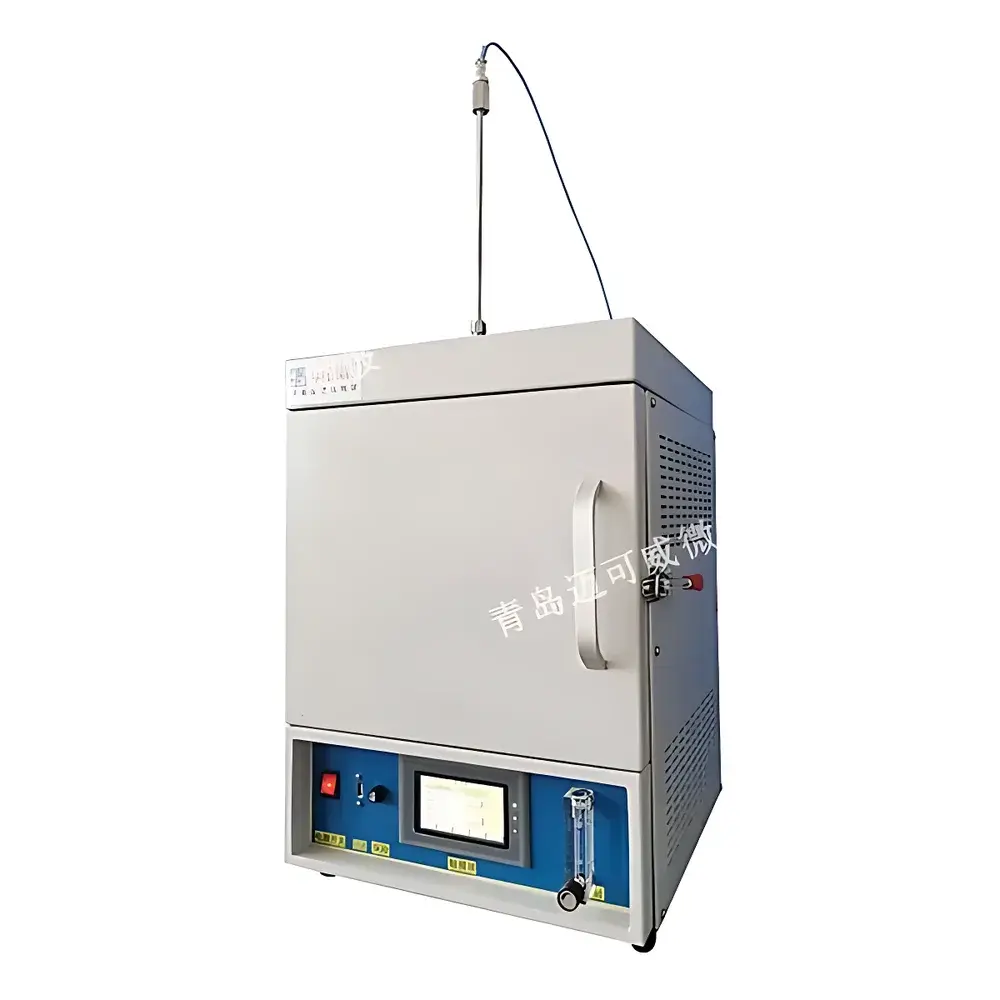
MakeWave MKX-M1B Microwave Muffle Furnace
| Brand | MakeWave |
|---|---|
| Origin | Shandong, China |
| Manufacturer Type | Direct Manufacturer |
| Product Category | Domestic |
| Model | MKX-M1B |
| Instrument Type | Crucible-Type Muffle Furnace |
| Maximum Temperature | 1200 °C |
| Temperature Control Accuracy | ±3 °C |
| Rated Microwave Power | 800 W (2450 MHz, continuous non-pulsed output) |
| Heating Rate to Max Temp | ≤30 min |
| Internal Cavity Dimensions | 401 mm (W) × 590 mm (H) × 436 mm (D) |
| Effective Heating Volume | ~1.2 L |
| Power Supply | 220 VAC / 50 Hz |
| Total Power Consumption | 1300 W |
| Net Weight | 50 kg |
| Safety Compliance | Microwave Leakage < 5 mW/cm² (per GB 10436–2008, exceeding national limits) |
| Quality Certification | ISO 9001 certified |
Overview
The MakeWave MKX-M1B Microwave Muffle Furnace is an advanced high-temperature thermal processing instrument that replaces conventional resistive heating with controlled microwave energy at 2450 MHz. Unlike traditional muffle furnaces relying on radiant conduction from heating elements, this system employs volumetric dielectric heating—where electromagnetic energy couples directly with polarizable or conductive components in the sample and crucible, enabling rapid, uniform, and selective thermal activation. Engineered for precision thermal decomposition, ashing, carbonization, sulfonation, sintering, and high-temperature calcination, the MKX-M1B operates reliably up to 1200 °C within a 1.2 L stainless-steel cavity. Its design addresses well-documented limitations of resistive furnaces—including extended ramp times, thermal gradient-induced sample heterogeneity, corrosion from volatile decomposition byproducts, cross-contamination of ash residues, and uncontrolled off-gas dispersion—by integrating a semi-closed micro-positive pressure atmosphere system with passive top-mounted exhaust.
Key Features
- Open-platform microwave high-temperature architecture optimized for laboratory-scale crucible-based processing
- Stainless-steel (AISI 304) monolithic cavity with embedded multi-layer insulation: low-εr ceramic fiber modules (thermal conductivity ≈ 0.226 W/m·K) minimize radial heat loss and enhance energy efficiency
- Real-time closed-loop control of both temperature (via inserted K-type thermocouple) and microwave power (0–800 W, continuously adjustable)
- PLC-based intelligent controller with 7-inch capacitive touchscreen interface; supports multi-step programmable protocols with automatic data logging
- Side-sliding door with λ/4 choke structure, mechanical interlock safety switch, and dual-function thermal/microwave shielding
- Natural-exhaust configuration compatible with standard fume hoods; enables safe venting of reactive or acidic off-gases during organic ashing or sulfonation
Sample Compatibility & Compliance
The MKX-M1B accommodates standard crucible formats up to 100 mm × 100 mm, including quartz, alumina, silicon carbide, and graphite variants—selected based on dielectric loss tangent (tan δ), thermal stability, and chemical inertness under target process conditions. It supports three primary operational modes: (i) inert-atmosphere sintering of ceramics and battery cathode materials (e.g., LiCoO2, YSZ); (ii) oxygen-rich or air-assisted thermal decomposition of biological tissues, polymers, and food matrices per AOAC 990.11 and EPA Method 3050B; and (iii) synchronized high-temperature combustion for thermogravimetric coupling (TGA-microwave hybrid workflows). The system conforms to ISO 9001 quality management standards and meets domestic Chinese safety requirements for industrial microwave equipment (GB 10436–2008), with verified leakage < 5 mW/cm² at 5 cm distance—significantly below the ICNIRP occupational exposure limit of 10 mW/cm².
Software & Data Management
Embedded firmware records time-stamped temperature, power, and duration parameters across all active runs. Real-time curves for T(°C) vs. t(min) and P(W) vs. t(min) are rendered on-screen and exportable via USB as CSV files for post-acquisition analysis in MATLAB, Origin, or Excel. Up to 20 user-defined programs may be stored, edited, duplicated, or deleted locally; no cloud dependency or proprietary software installation is required. Audit trails—including operator ID (optional field entry), start/stop timestamps, and deviation alerts—are retained in non-volatile memory for GLP-compliant documentation. While not FDA 21 CFR Part 11–validated out-of-the-box, the system’s deterministic control logic and immutable local log storage support traceability in regulated QC environments when integrated into site-specific validation protocols.
Applications
- Rapid ashing of plant tissue, animal feed, and pharmaceutical excipients (USP <281>, Ph. Eur. 2.2.33)
- Controlled carbonization of biomass for activated carbon precursor synthesis
- Low-thermal-budget sintering of ZnO varistors, ferrites, and piezoelectric ceramics
- Sulfonation of aromatic compounds under N2/SO3 co-flow conditions
- Residue-on-ignition (ROI) testing per ASTM E1282 and ISO 21072
- Preparation of homogeneous oxide catalysts via microwave-assisted sol-gel calcination
- High-temperature drying and dehydration of hygroscopic reference standards
FAQ
Can the MKX-M1B operate under vacuum or controlled gas flow?
No—the system is configured for semi-closed micro-positive pressure operation with passive natural exhaust. Active gas purging or vacuum integration requires external manifold retrofitting and is not supported natively.
Is the 1200 °C rating sustainable for extended dwell periods?
Yes, but continuous operation above 1100 °C is recommended only for ≤60 min intervals to preserve thermocouple longevity and insulation integrity. Extended high-temperature use necessitates periodic calibration verification.
What crucible materials are validated for 1200 °C microwave heating?
Alumina (99.7% Al2O3) and silicon carbide crucibles demonstrate optimal coupling efficiency and dimensional stability; quartz is limited to ≤1000 °C due to microwave-induced devitrification risk.
Does the unit comply with electromagnetic compatibility (EMC) directives for EU laboratories?
While CE marking is not applied, the unit meets IEC 61000-6-3 (emission) and IEC 61000-6-2 (immunity) thresholds when installed per manufacturer grounding and shielding guidelines—verification via third-party EMC testing is advised for EU deployment.
How is temperature uniformity characterized across the 1.2 L cavity?
Spatial profiling using multi-point thermocouple mapping confirms ±8 °C deviation across the central 75% volume at 1100 °C steady state—a marked improvement over resistive furnaces exhibiting >±25 °C gradients under identical load conditions.
Related Products



