
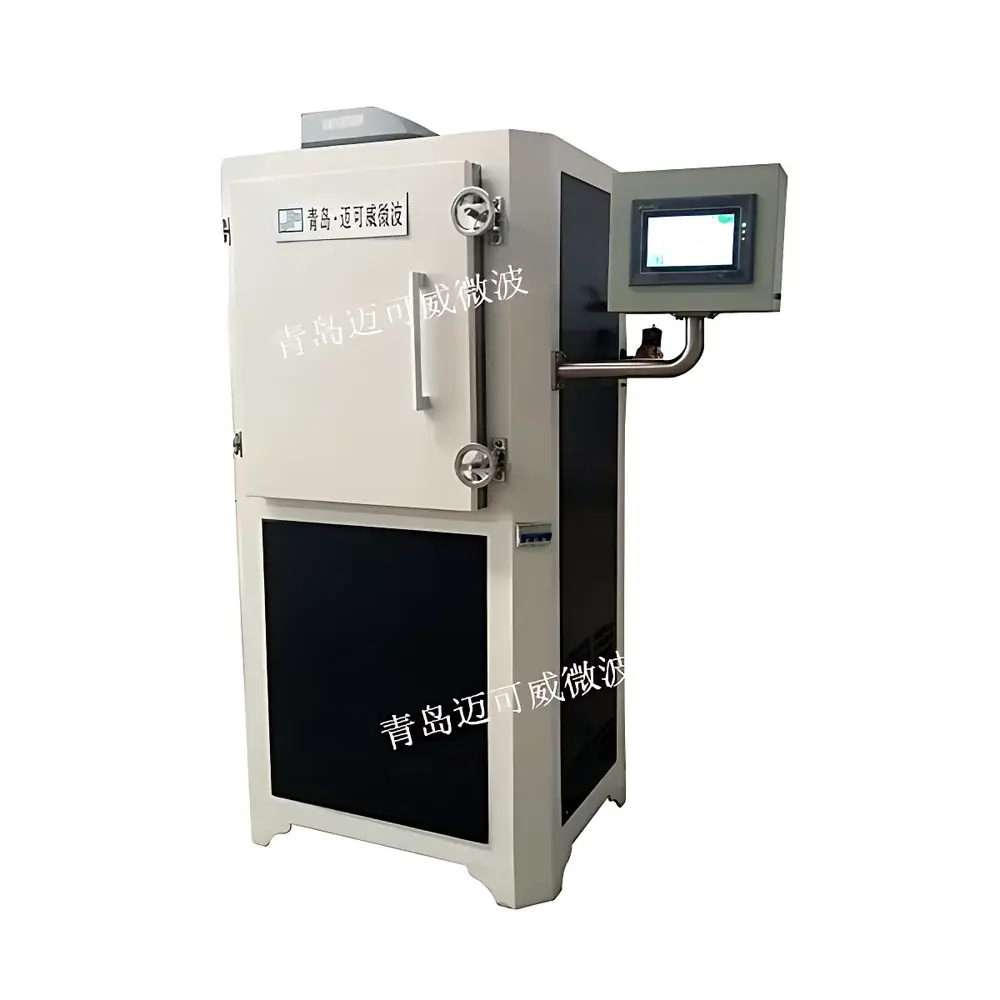
MakeWave MKX-T4A Microwave Muffle Furnace
| Brand | MakeWave |
|---|---|
| Origin | Shandong, China |
| Manufacturer Type | Direct Manufacturer |
| Product Category | Domestic |
| Model | MKX-T4A |
| Instrument Type | Box-Type Furnace |
| Maximum Temperature | 1400 °C |
| Temperature Control Accuracy | ±1 °C |
| Rated Microwave Power | 3200 W at 2450 MHz |
| Heating Rate to Max Temp | ≤40 min |
| Heating Method | Microwave Energy |
| Internal Cavity Dimensions | 1360 mm (W) × 1600 mm (H) × 800 mm (D) |
| Cavity Volume | ~8 L |
| Power Supply | 220 V AC / 50 Hz |
| Total Power Consumption | 5200 W |
| Net Weight | 80 kg |
Overview
The MakeWave MKX-T4A Microwave Muffle Furnace is an advanced high-temperature thermal processing platform engineered for precision-controlled microwave-assisted heating in laboratory and pilot-scale applications. Unlike conventional resistance-heated muffle furnaces, the MKX-T4A utilizes continuous, non-pulsed 2450 MHz microwave energy to directly couple with dielectric and conductive materials—enabling rapid, volumetric, and selective heating. This fundamental shift in thermal delivery mechanism eliminates surface-limited conduction, reduces thermal lag, and mitigates contamination risks associated with furnace element degradation or crucible interaction. Designed for operation up to 1400 °C in a fully sealed, atmospherically controlled cavity, the system supports reproducible thermal treatments including pyrolysis, carbonization, ashing, sulfonation, sintering, fusion, drying, and high-temperature residue combustion. Its architecture meets core requirements for GLP-compliant thermal analysis workflows, particularly where trace contamination control, reaction kinetics fidelity, and atmosphere integrity are critical—such as in ceramic sintering R&D, pharmaceutical residual ash testing (USP ), and environmental sample preparation per EPA Method 3050B.
Key Features
- Sealed, positive-pressure microwave cavity constructed from welded 304 stainless steel with certified gas-tight integrity for inert, reducing, oxidizing, or reactive atmospheres.
- Integrated multi-layer insulation system using low-dielectric-loss ceramic fiber modules (εr < 6.5, tan δ < 0.002), achieving thermal conductivity of ≈0.226 W/m·K and minimizing radial heat loss during sustained high-temperature operation.
- Non-contact infrared temperature monitoring with real-time feedback to PLC-based closed-loop power modulation—ensuring ±1 °C stability across the 500–1400 °C operational range.
- Modular gas management interface supporting up to three independently regulated inlet streams, mass flow controllers (MFCs), and programmable exhaust routing via top-mounted vent duct compatible with fume hood integration.
- Industrial-grade PLC controller with 7-inch capacitive touchscreen HMI, enabling multi-step ramp-soak programs, live curve visualization (time vs. temp vs. power), and CSV-exportable audit trails compliant with FDA 21 CFR Part 11 data integrity principles.
- Four-level safety architecture: (1) interlocked side-sliding door with λ/4 choke suppression; (2) microwave leakage <5 mW/cm² (measured per IEC 61000-4-3); (3) automatic power cutoff on door actuation; (4) passive thermal shielding and forced-air cooling zones adjacent to waveguide and magnetron assemblies.
Sample Compatibility & Compliance
The MKX-T4A accommodates standard high-temperature crucibles (up to 150 mm × 150 mm footprint) fabricated from alumina, silicon carbide, quartz, or graphite—selected based on material dielectric loss tangent and chemical compatibility with target samples. It supports ISO/IEC 17025-accredited laboratories performing ASTM C1171 (ceramic sintering), ISO 1171 (ash content determination), and USP (residue on ignition). The sealed cavity design prevents cross-contamination between sequential runs—a key requirement for forensic toxicology labs and regulatory QC environments. All firmware logs include timestamped metadata (user ID, program name, setpoints, actual readings), satisfying GLP documentation standards for instrument qualification (IQ/OQ/PQ) and GMP traceability audits.
Software & Data Management
The embedded control system records all operational parameters—including microwave power output, cavity wall temperature, IR-measured sample temperature, gas flow rates, and door status—at 1-second intervals. Data files are stored locally on industrial-grade SD card with optional Ethernet/Wi-Fi export to LIMS or ELN platforms. User-defined alarm thresholds trigger visual/audio alerts and automatic program suspension. Calibration certificates for IR sensor and MFCs are traceable to NIST standards. Firmware updates are delivered via encrypted USB key with SHA-256 signature verification to maintain software integrity throughout the device lifecycle.
Applications
- Ceramic engineering: Solid-state sintering of oxide and non-oxide ceramics (e.g., Al2O3, ZrO2, SiC) with reduced grain growth and improved density uniformity.
- Environmental testing: Rapid ashing of soil, sludge, and biomass per EPA SW-846 Method 3050B and ISO 1171 without sulfur retention artifacts.
- Pharmaceutical QA: Residue-on-ignition assays for active pharmaceutical ingredients (APIs) and excipients under nitrogen or air atmospheres.
- Materials science: Controlled pyrolysis of polymer composites and carbon precursor fibers for tailored porosity and graphitization degree.
- Agricultural research: Mineralization of plant tissues for elemental analysis (ICP-OES/MS) with minimized volatile loss of K, Na, and heavy metals.
FAQ
Is the MKX-T4A suitable for vacuum operation?
No—the standard MKX-T4A is configured for positive-pressure gas atmospheres only. A vacuum-compatible variant, the MKZ-T4B, is available as a custom-engineered option with reinforced flanged cavity and integrated turbomolecular pumping interface.
Can the system be integrated into an automated lab workflow?
Yes—RS-485 Modbus RTU and optional Ethernet/IP protocols enable bidirectional communication with SCADA systems, robotic sample handlers, and centralized lab automation platforms.
What maintenance is required for long-term reliability?
Annual inspection of waveguide gaskets, IR sensor window cleanliness, and magnetron cooling airflow is recommended. No routine replacement of consumables is required beyond standard crucible wear.
Does the unit comply with electromagnetic compatibility (EMC) directives for EU deployment?
Yes—the system meets EN 61000-6-3 (emission) and EN 61000-6-2 (immunity) standards, with CE marking valid for laboratory use within the European Economic Area.



